
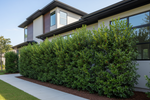
Native Privacy Plants for Florida: Best Screens & Hedges
, by Andrew Norouzian, 10 min reading time
, by Andrew Norouzian, 10 min reading time
Native Privacy Plants for Florida
A good privacy screen does more than block the view. The best ones also handle Florida's heat, storms, and sandy soils without constant watering, feeding, or spraying. Native plants are built for exactly that, and they feed birds and pollinators too.
Here are the best native options for privacy, how they differ, and how to pick the right one for your site.
Why Choose Native Plants for Privacy?
Quick Comparison
|
Plant |
Mature size |
Growth rate |
Best for |
Watch out for |
|
Wax myrtle |
10-20 ft tall |
Fast |
Fast, informal screens; poor soils |
Can sucker; can be short-lived |
|
Dahoon holly |
20-30 ft tall |
Moderate |
Tall screens, moist sites |
Needs male and female for berries |
|
Yaupon holly |
10-25 ft tall |
Moderate |
Clipped hedges, tough sites |
Choose cultivar by mature size |
|
Walter's viburnum |
10-30 ft tall |
Moderate to fast |
Clipped or natural hedges |
Can look open in shade |
|
Carolina cherry laurel |
20-30+ ft tall |
Fast |
Fast, tall, informal screens |
Shorter-lived; toxic if eaten |
|
Southern red cedar |
30-40 ft tall, narrow |
Moderate to fast |
Tall, narrow screens; windbreaks |
Needs space and sun |
|
Florida anise |
6-10 ft tall |
Moderate |
Shady, moist spots |
Needs moisture; fruit toxic |
|
Southern magnolia (compact cultivars) |
15-25 ft tall |
Moderate |
Formal, glossy evergreen screens |
Leaf drop; needs space |
Sizes and growth rates are typical and vary by cultivar, site, and care. Availability also varies, so ask us what we currently have.
The Best Native Privacy Plants for Florida
1. Wax Myrtle (Morella cerifera)
A fast-growing native with aromatic, narrow evergreen leaves and waxy blue-gray berries on females that birds eat. It tolerates poor, sandy, and even wet soils, which makes it one of the toughest screening plants you can plant.
Why choose it: Quick privacy, wide adaptability, and strong wildlife value. Keep in mind: It has a looser look than a holly, can send up suckers, and can be shorter-lived than slower plants.
2. Dahoon Holly (Ilex cassine)
A native evergreen tree with narrow, mostly smooth leaves and red berries on female plants. It grows in a graceful upright form and tolerates moist soils better than many hollies.
Why choose it: A taller, longer-lived screen with year-round green and berries for birds. It's easier on hands than spiny hollies. Keep in mind: Plant males and females if you want berries. It fills in more slowly than wax myrtle. See our holly comparison guide.
3. Yaupon Holly (Ilex vomitoria)
A tough native with small, scalloped, spineless leaves. It takes shearing well and handles drought, heat, and salt exposure, so it works as either a tidy clipped hedge or a small tree.
Why choose it: The most versatile native for formal hedges and challenging sites, with many cultivars in different sizes. Keep in mind: Match the cultivar's mature size to your space. Dwarf types won't provide tall privacy.
4. Walter's Viburnum (Viburnum obovatum)
A Florida native with small, glossy leaves, white spring flowers, and a dense, fine-textured habit. It handles pruning very well and adapts to a range of soils.
Why choose it: A native alternative to sweet viburnum and other hedge plants, with good pollinator and bird value. See how it compares in cherry laurel vs. viburnum. Keep in mind: It can get leggy in heavy shade or without pruning.
5. Carolina Cherry Laurel (Prunus caroliniana)
A fast-growing native evergreen with dark, glossy leaves and fragrant spring flowers. It's one of the quickest ways to get a tall screen with native plants.
Why choose it: Speed and height. See how fast cherry laurel grows. Keep in mind: It's shorter-lived, can get leaf spot and pests, and produces seedlings. The leaves, seeds, and pits are toxic if eaten, especially for livestock, so keep it away from horse pastures. Full details are in our cherry laurel privacy screens guide.
6. Southern Red Cedar (Juniperus virginiana var. silicicola)
A native evergreen with a narrow, upright form and scale-like foliage. It's often used as a tall, dense screen or windbreak and tolerates salt and poor soils.
Why choose it: A tall, narrow footprint that fits tighter spaces than broad-canopy trees, and good bird cover. Keep in mind: It needs full sun and good drainage, and it gets tall. Watch for spider mites in dry spells.
7. Florida Anise (Illicium floridanum)
A native shrub for shade. It has glossy, aromatic leaves and dark red spring flowers, and it thrives in moist, shady spots where sun-loving screening plants struggle.
Why choose it: One of the best native options for shady, moist privacy areas. Keep in mind: It prefers consistent moisture and acidic soil, and it stays shorter than tree-form screens. The fruit is toxic, so don't eat it.
8. Southern Magnolia, Compact Cultivars (Magnolia grandiflora)
Full-size southern magnolias get very large, but compact selections such as 'Little Gem' stay in the 15 to 25 foot range and make a bold, glossy evergreen screen with fragrant white flowers.
Why choose it: A formal, high-end look with year-round leaf cover. Keep in mind: Expect leaf drop, and confirm you're buying a compact cultivar, since a standard magnolia will outgrow a small lot.
A Note on Eagleston Holly
Eagleston holly is a hybrid, not a pure native, but both parents (dahoon and American holly) are Southeastern natives. It's a strong choice when you want a tall, uniform, low-maintenance evergreen screen, and it mixes well with true natives in a layered planting.
How to Choose the Right Native Screen
Mix Species for a Stronger Screen
Instead of planting one species in a straight line, try a layered or mixed screen:
Mixed screens look more natural, feed more wildlife, and keep working even if one species struggles. For community ideas, see native trees for HOA landscapes.
Spacing Guidelines
|
Plant |
Typical spacing (on center) |
|
Wax myrtle |
5 to 8 ft |
|
Dahoon holly |
6 to 10 ft |
|
Yaupon holly (tall forms) |
4 to 8 ft |
|
Walter's viburnum |
4 to 8 ft |
|
Carolina cherry laurel |
6 to 10 ft |
|
Southern red cedar |
6 to 10 ft |
|
Florida anise |
4 to 6 ft |
These are starting points. Closer spacing fills faster but creates more competition over time. Stay at least 4 to 5 feet from fences and walls, and see how far apart to plant Eagleston holly for the reasoning behind spacing.
Planting and Care Tips
Frequently Asked Questions
What is the best native privacy plant for Florida? It depends on your site and goals. Wax myrtle is a top pick for fast, adaptable screening, while dahoon holly and yaupon are excellent for longer-lived, lower-maintenance options.
What is the fastest-growing native privacy plant? Wax myrtle and Carolina cherry laurel are among the fastest.
Which native plant makes the best formal hedge? Yaupon holly and Walter's viburnum both take shearing well.
What native privacy plant grows in shade? Florida anise is a strong choice for moist shade, and some hollies tolerate partial shade.
What is the best native option for a tall, narrow screen? Southern red cedar and compact southern magnolia both fit narrower spaces.
Do native plants need less water? Generally yes, once established, but all new plants need regular watering during the first year or two.
Can I mix native privacy plants? Yes, and it's often the best approach. A mixed screen looks more natural, supports more wildlife, and is more resilient to pests and disease.
Build a Native Privacy Screen That Lasts
The right mix of native plants gives you privacy, wildlife, and a landscape that fits Florida. Contact Flowing Well Tree Farm to ask about available native screening trees and get recommendations for your property

$130.00

$125.00

$130.00

$30.00

$40.00

$135.00

$30.00

$130.00

$30.00

$30.00

$10.00

$10.00

$30.00

$30.00

$25.00

$155.00

$190.00

$160.00

$10.00

$130.00

$190.00

$135.00

$25.00

$12.00

$130.00

$10.00

$10.00

$125.00

$130.00

$190.00


