
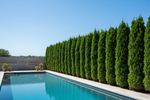
How Far Apart Should You Plant Privacy Trees in Florida?
, by Andrew Norouzian, 9 min reading time
, by Andrew Norouzian, 9 min reading time
How Far Apart Should You Plant Privacy Trees in Florida?
Most Florida privacy trees and hedges should be planted **3 to 6 feet apart on center**, but the right distance depends on the plant’s mature width, how quickly you need coverage, and whether you want a tightly clipped hedge or a more natural screen. A useful starting rule is to divide the plant’s mature width by two for a screen that fills in without excessive crowding.[3][9]
For a dense hedge, plants can be spaced a little closer. For a natural, lower-maintenance screen, use wider spacing and allow each plant to develop its own shape.
## Measure On Center
Privacy plants should be spaced **on center**, meaning from the center of one trunk or root ball to the center of the next—not from edge to edge of the nursery containers.
For example, if you are planting a 60-foot fence line with shrubs spaced 4 feet on center:
60 \div 4 = 15
You will need approximately **15 plants**. Buy one extra only if you need to account for a corner, curve, gate opening, or a replacement plant.
## Quick Spacing Guide
| Privacy Plant Type | Typical Spacing | Best Result |
|---|---:|---|
| Small formal hedge | 2 to 3 feet on center | Dense, tightly maintained screen |
| Medium hedge shrub | 3 to 5 feet on center | Fast coverage with manageable maintenance |
| Large shrub or small tree | 5 to 8 feet on center | Natural evergreen screen |
| Large vigorous screen plant | 8 to 10 feet on center | Wide, informal privacy buffer |
| Double-row planting | 3 to 5 feet within rows; 3 to 5 feet between rows | Faster, deeper screen where space allows |
Medium Florida hedge plants commonly go in at 3 to 5 feet apart, while larger shrubs and small trees generally need 5 to 8 feet to create a healthy long-term screen.[5][6]
## Recommended Spacing by Plant
### Eagleston Holly: 3.5 to 5 Feet Apart
Eagleston holly is one of the best choices for a tall, polished Florida privacy screen. Plant it about **3.5 to 4 feet on center** for a dense hedge that closes relatively quickly; use **5 to 6 feet** if you want individual trees to retain more of their natural form.
Tighter spacing creates privacy sooner, but it also means you will need more plants and may need more regular pruning as the hedge matures. A spacing range of 3 to 4 feet is commonly used for dense evergreen screens.[2][9]
### Wax Myrtle: 4 to 6 Feet Apart
Wax myrtle is a fast-growing native option for a softer, more natural privacy buffer. Plant wax myrtle **4 feet apart** for a denser hedge that will be maintained, or **5 to 6 feet apart** for a looser, informal screen.
Wider spacing gives the plants better airflow and lets their naturally rounded form develop. Wax myrtle is especially useful along large property lines, rural landscapes, and native planting designs.[10][3]
### Yaupon Holly: 4 to 6 Feet Apart
For an upright yaupon holly screen, space plants about **4 to 6 feet on center**. Use the closer end of that range for a hedge, and the wider end where you want a natural native screen with less shearing.
Yaupon holly is a strong choice for dry, sandy, coastal, or difficult sites. Choose an upright cultivar if height and privacy are the main goals.
### Dahoon Holly: 6 to 10 Feet Apart
Dahoon holly grows into a larger tree and needs more room than narrow hedge plants. Space dahoon hollies about **6 to 8 feet apart** for an eventual screen; use **8 to 10 feet** if you want individual specimens with fuller natural canopies.
Dahoon holly is especially useful in moist soil, low areas, and naturalized landscapes. Do not crowd it into a narrow planting strip where its mature width will become a problem.
### Podocarpus: 2.5 to 4 Feet Apart
Podocarpus is often used for formal, narrow privacy hedges. Plant it **2.5 to 3 feet on center** for a dense screen, particularly when the goal is a tall hedge; use **3 to 4 feet** for a slightly more relaxed planting.[1][10]
It responds well to shaping but requires regular trimming if you want a formal hedge. Avoid placing it too close to a fence or structure, since you still need room to prune both sides.
### Clusia: 3 to 4 Feet Apart
For small-leaf clusia, **3 feet on center** is a common spacing for a solid hedge. A slightly tighter spacing can speed up closure, while **4 feet apart** creates a wider, more relaxed screen that takes longer to fill in.[1][10]
Clusia is more common in warm Central and South Florida landscapes. Make sure the species and variety you choose are suited to your local winter temperatures and available planting width.
### Viburnum: 4 to 6 Feet Apart
Sweet viburnum is vigorous and broad, so **4 to 5 feet on center** is usually enough for a dense hedge. Use **6 feet** where airflow and a more natural mature profile are priorities.[2][1]
Because viburnum can become large, do not assume closer spacing is always better. Overcrowding eventually creates interior shading, reduced airflow, and more pruning work.
### Areca and Clumping Palms: 4 to 6 Feet Apart
Clumping palms should usually be spaced **4 to 5 feet on center** for privacy. These palms gradually widen through new cane growth, so they may look open at installation but often fill in significantly over the next few growing seasons.[10]
For immediate screening where there is plenty of width, a staggered double row can work well. Keep palms far enough from fences and structures to accommodate future clump expansion and pruning access.
## Dense Hedge vs. Natural Screen
Your desired appearance should guide spacing as much as the plant species.
| Goal | Spacing Strategy | What to Expect |
|---|---|---|
| Fastest privacy | Plant near the lower end of the recommended range | More plants, quicker closure, more pruning later |
| Formal hedge | Use closer spacing and prune consistently | Dense, tidy wall of foliage |
| Informal screen | Use wider spacing and selective pruning | Softer, more natural appearance |
| Individual specimen trees | Space close to mature canopy width | Distinct tree forms and more open views |
| Maximum sound and visual buffering | Use two staggered rows | A thicker screen, higher cost, and greater planting width |
Tighter spacing can deliver coverage faster, but crowding plants too closely may reduce airflow and create long-term competition for light, water, and nutrients.[9][2]
## Keep Plants Away From Fences
Do not plant privacy trees directly against a fence. Leave enough room to mulch, water, inspect, and prune the back side of the screen.
As a general guide, place small hedges at least **2 to 3 feet from a fence** and larger shrubs or trees at least **4 to 6 feet away**, depending on their expected mature spread. Also check for underground utilities, drainage swales, septic systems, pool equipment, rooflines, and overhead power lines before planting.[8][2]
## Plan for Mature Width
A privacy screen should be designed for the plant’s mature size—not the size it is in the nursery pot. Before purchasing, confirm:
- Mature height and width
- Sun and soil requirements
- Tolerance for dry, sandy, moist, or coastal conditions
- Expected annual growth rate
- Whether it needs regular pruning
- Clearance from fences, sidewalks, homes, pools, and utilities
- Whether the planting strip is wide enough for the mature plant
The mature-width rule is simple:
For a plant that matures 10 feet wide, begin with roughly 5 feet on-center spacing for an eventual continuous screen. Adjust slightly closer for faster coverage or slightly wider for improved airflow and a looser, natural appearance.[3][9]
## Single Row or Double Row?
A single row is usually enough for typical residential privacy needs. It uses less space, costs less, and is easier to maintain.
A staggered double row makes sense when you need a deeper screen for a busy road, neighboring two-story home, commercial property, or large open boundary. In most cases, space plants **3 to 5 feet apart within each row** and keep rows **3 to 5 feet apart**, adjusting for the mature width of the chosen species.
Avoid double rows in narrow side yards. Overcrowding a limited strip usually creates maintenance problems rather than better privacy.
## Planting Tips
1. Measure the full privacy line before purchasing plants.
2. Mark spacing with flags, stakes, or a tape measure before digging.
3. Position plants so their mature canopy will not cross into buildings, pools, utilities, or neighboring property.
4. Dig each hole wider than the root ball but no deeper than the root ball.
5. Keep the root flare at or slightly above surrounding soil level.
6. Water deeply after planting and regularly during establishment.
7. Mulch with 2 to 3 inches of mulch, keeping mulch away from stems and trunks.
8. Begin light shaping early if you want a formal hedge; early pruning encourages branching closer to the base.
## Choose Spacing for the Long Term
For most Florida privacy screens, plant medium hedge shrubs **3 to 5 feet apart**, larger native shrubs and small trees **5 to 8 feet apart**, and wide-growing screen plants **8 to 10 feet apart**.[5][3]
For help choosing the right spacing and plants for your yard, explore privacy trees, native hedges, and Florida-grown landscape plants at [Flowing Well Tree Farm](https://www.flowingwelltreefarm.com/). The right plant, correct spacing, and proper first-year care will create privacy that improves—not overwhelms—your landscape over time.
Sources
[1] Best Privacy Plants and Hedges for Florida | Tropical Yards ... https://www.tropicalyardstaugustine.com/privacy-plants-florida/
[2] Best Trees for a Privacy Fence: Florida Privacy Screen Picks https://www.palmstateclearcut.com/post/best-trees-for-a-privacy-fence-florida-privacy-screen-picks
[3] Best Trees and Shrubs for Privacy Screens in North Florida https://reedtreeservice.com/blog/privacy-screen-trees-north-florida-best-species
[4] Florida Privacy Plants (With Pictures) – Identification Guide https://leafyplace.com/florida-privacy-plants/
[5] Types of Fast-Growing Privacy Hedges for Florida https://cultivatingflora.com/types-of-fast-growing-privacy-hedges-for-florida/
[6] Privacy Plants for St. Augustine & Northeast FL | Southern Horticulture https://southernhorticultureflorida.com/privacy-plants-st-augustine-fl
[7] Florida Palm and Plant Co. | Premium Tropical Plants https://palmandplantco.com/guides/florida-privacy-hedges
[8] Privacy Planting Tips https://www.groundsource.pro/blog/planting-trees-shrubs-privacy-pro-landscaping-tips-orlando-fl
[9] How to Plant Privacy Trees: Spacing, Care, and Choosing ... https://www.trees.com/blogs/plant-care-guides/best-privacy-trees
[10] Privacy Hedge Plants for Sale Near Me in Northeast Florida (Fast ... https://www.tropicalyardstaugustine.com/blog/privacy-hedge-plants-for-sale-near-me-ne-florida/


