
Native Alternatives to Bradford Pear
, by Andrew Norouzian, 7 min reading time
, by Andrew Norouzian, 7 min reading time
# Native Alternatives to Bradford Pear
Bradford pear trees may look beautiful in early spring, but they come with serious drawbacks: weak branch structure, unpleasant-smelling flowers, and a tendency to spread beyond the landscape. For Florida homeowners who want spring blooms, shade, and wildlife value without planting an invasive ornamental pear, native trees offer far better long-term choices.[5]
Bradford pear, also called Callery pear (*Pyrus calleryana*), can cross-pollinate with other ornamental pears and produce viable seed that birds disperse into natural areas. It competes with native vegetation for sunlight, water, and nutrients—and its branches are especially prone to splitting in storms.[5]
## Why Replace Bradford Pear?
A native replacement can provide the ornamental qualities people like about Bradford pear—flowers, seasonal interest, manageable size, or a graceful form—while also supporting local birds, pollinators, and other wildlife.
For Central Florida landscapes, the best selection depends on your site: sun exposure, soil moisture, available planting space, and whether you want flowers, evergreen foliage, berries, or shade. Avoid replacing one short-lived ornamental problem with another poorly matched tree.
## Best Florida Native Alternatives
### Red Maple
**Red maple** (*Acer rubrum*) is a versatile native shade tree valued for its red flowers, winged seeds, and often colorful fall foliage. It grows best in moist, acidic soils but adapts to a range of Central Florida conditions when established.
- Mature size: Often 40–60 feet tall and wide
- Best for: Larger yards, seasonal color, and shade
- Light: Full sun to partial shade
- Wildlife value: Seeds and habitat benefit birds and other wildlife
Red maple is a better choice than Bradford pear when you need a true shade tree rather than a small ornamental specimen.
### Sweetbay Magnolia
**Sweetbay magnolia** (*Magnolia virginiana*) brings fragrant, creamy-white flowers and glossy foliage to the landscape. In warmer parts of Florida, it is often evergreen or semi-evergreen, offering a softer, more refined look than Bradford pear.
- Mature size: Approximately 20–40 feet tall
- Best for: Moist soils, rain gardens, and fragrant flowering landscapes
- Light: Full sun to partial shade
- Wildlife value: Flowers support pollinators; seeds are attractive to birds
Sweetbay magnolia is especially useful in sites that stay consistently moist. Its lemon-scented blooms arrive later than Bradford pear’s early flower display, extending seasonal interest.[7]
### Eastern Redbud
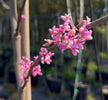
**Eastern redbud** (*Cercis canadensis*) is a small native tree with vivid pink-to-purple spring flowers that appear before the heart-shaped leaves emerge. It provides the early-season flower impact many people seek from a Bradford pear, but with a more natural form and stronger ecological value.
- Mature size: Usually 20–30 feet tall and wide
- Best for: Small yards, woodland edges, and spring color
- Light: Full sun to partial shade
- Wildlife value: Early flowers offer nectar for pollinators
Redbud performs best in well-drained soil and benefits from protection from harsh afternoon sun in hot, exposed Florida sites. It is a standout choice where a homeowner wants a compact flowering tree rather than large canopy shade. Native redbud species are widely recommended as replacements for invasive Callery pear.[5]
### American Fringe Tree
**American fringe tree** (*Chionanthus virginicus*) is one of the most distinctive native alternatives to Bradford pear. In spring, it produces clouds of delicate, fringe-like white flowers with a light fragrance and an airy, elegant appearance.
- Mature size: Roughly 12–20 feet tall and wide
- Best for: Small landscapes, specimen plantings, and white spring flowers
- Light: Full sun to partial shade
- Wildlife value: Fruit on female plants can support birds
Choose fringe tree when you love Bradford pear’s white-flowering effect but want a smaller, native tree with a more graceful character. It flowers most heavily in sunnier locations.[2]
### Flowering Dogwood
**Flowering dogwood** (*Cornus florida*) is a beloved native understory tree with showy white spring bracts, red fruit, and attractive fall color. Its layered branching gives it a strong presence even after flowering ends.
- Mature size: About 15–30 feet tall
- Best for: Filtered light, woodland gardens, and four-season interest
- Light: Partial shade to morning sun
- Wildlife value: Flowers, fruit, and branching structure benefit pollinators and birds
Dogwood is not ideal for every full-sun Florida lawn. Give it well-drained soil, mulch over the root zone, and protection from intense afternoon heat for the best performance. Native flowering dogwood is among the commonly recommended alternatives to ornamental pears.[7]
### Black Tupelo
**Black tupelo** (*Nyssa sylvatica*), also called blackgum, is an outstanding native tree for homeowners who want a durable shade tree with exceptional fall color. It does not mimic Bradford pear’s white flower display, but it offers a much stronger long-term canopy and seasonal appeal.
- Mature size: Commonly 30–50 feet tall or more
- Best for: Larger properties, shade, and fall color
- Light: Full sun to partial shade
- Wildlife value: Fruit is valuable to birds
Black tupelo tolerates moist soils well and can become a handsome, long-lived specimen tree. It is a strong option for replacing a mature Bradford pear where there is room for a larger native canopy.[7]
### Dahoon Holly
**Dahoon holly** (*Ilex cassine*) is a Florida-friendly native evergreen tree that provides year-round foliage and bright red berries on female plants. It makes an excellent choice for wet or periodically wet sites.
- Mature size: Typically 20–40 feet tall
- Best for: Privacy, screening, wet soils, and evergreen structure
- Light: Full sun to partial shade
- Wildlife value: Berry-producing female trees are valuable for birds
Unlike Bradford pear, dahoon holly provides a durable evergreen presence through every season. Plant a male nearby if fruit production is important.
## Choose by Landscape Goal
| If you want… | Consider planting… |
|---|---|
| White spring flowers | American fringe tree or flowering dogwood |
| Pink spring flowers | Eastern redbud |
| Fragrant flowers | Sweetbay magnolia |
| A larger shade tree | Red maple or black tupelo |
| Evergreen privacy | Dahoon holly |
| A tree for moist soil | Sweetbay magnolia, dahoon holly, or red maple |
| A compact specimen tree | Fringe tree or redbud |
## Planting Tips
- **Match the tree to the site.** Check mature height and canopy spread before planting, especially near power lines, driveways, roofs, and septic systems.
- **Plant at the right depth.** Keep the root flare at or slightly above finished soil grade; burying it too deeply can cause long-term decline.
- **Mulch correctly.** Apply a 2–3 inch layer of mulch over the root zone, but keep mulch several inches away from the trunk.
- **Water deeply while establishing.** New trees need consistent irrigation, especially during Central Florida’s dry periods, until their roots expand into surrounding soil.
- **Plan for storms.** Favor species with good structure, allow adequate spacing, and prune young trees thoughtfully rather than repeatedly cutting mature branches.
## A Better Tree for Florida
Replacing a Bradford pear is an opportunity to choose a tree that belongs in the landscape—not just one that looks good for a few weeks in spring. Native trees can provide flowers, shade, berries, fragrance, and habitat while fitting Florida’s climate more naturally.
At Flowing Well Tree Farm, we can help you select a native or Florida-friendly tree that matches your yard’s sunlight, soil, moisture, and long-term goals. A well-chosen tree will reward your landscape for decades rather than create problems down the road.
Sources
[1] Invasive Plants in Texas - And Their Best Native Alternatives https://www.gardenia.net/guide/invasive-plants-in-texas-best-native-alternatives-to-grow-instead
[2] Native Alternatives for Bradford Pear https://www.missouribotanicalgarden.org/gardens-gardening/your-garden/help-for-the-home-gardener/advice-tips-resources/visual-guides/native-alternatives-for-bradford-pear
[3] Native Alternatives To Grow Instead Of Bradford Pear Tree https://www.housedigest.com/1808532/bradford-pear-tree-native-alternatives/
[4] Bradford Pear Tree Replacements: Native Alternatives for a Sustainable Landscape - Gardening Tips and Tools https://www.gardeningtipsandtools.com/gardening/bradford-pear-tree-replacements/
[5] Native flowering tree options to replace invasive Bradford pears https://site.extension.uga.edu/forsyth/native-flowering-tree-options-to-replace-invasive-bradford-pears/
[6] AlterNATIVE: Native Choices Instead of Ornamental Pears http://usinggeorgianativeplants.blogspot.com/2020/03/alternative-native-choices-instead-of.html
[7] Natives That Are Great Bradford Pear Tree Alternatives https://www.gardeningknowhow.com/ornamental/trees/ornamental-pear/bradford-pear-alternatives.htm
[8] Native Tree Alternatives to Invasive Callery Pear - Fine Gardening https://www.finegardening.com/article/alternatives-to-invasive-callery-pear
[9] Native Alternative to Bradford Pear: 7 Better Trees for Your Yard https://nativenurseryfinder.com/articles/native-alternative-to-bradford-pear.html
[10] How to Replace Bradford Pear with Louisiana Natives – Cultivating Flora https://cultivatingflora.com/how-to-replace-bradford-pear-with-louisiana-natives/

$130.00

$125.00

$130.00

$30.00

$40.00

$135.00

$30.00

$130.00

$30.00

$30.00

$10.00

$10.00

$30.00

$30.00

$25.00

$155.00

$190.00

$160.00

$10.00

$130.00

$190.00

$135.00

$25.00

$12.00

$130.00

$10.00

$10.00

$125.00

$130.00

$190.00


