Weeping Yaupon Holly (Ilex vomitoria ‘Pendula’) — Locally Grown in Pierson, Florida at Flowing Well Tree Farm
Native Evergreen Accent Tree • Weeping Ornamental Form • Wildlife Berry Producer • Florida-Grown Landscape Stock
Weeping Yaupon Holly (Ilex vomitoria ‘Pendula’) is a striking native evergreen selection known for its graceful cascading branches, fine-textured foliage, and strong adaptability to Florida’s challenging landscape conditions. As a weeping form of native Yaupon Holly, it is widely used as an accent specimen, focal point planting, and wildlife-supporting ornamental tree in native landscapes and designed gardens throughout the Southeast.
When you buy Weeping Yaupon Holly here, you're not getting weak, overgrown nursery material—you’re getting locally grown, Florida-adapted plants produced in Pierson and conditioned for real-world conditions including heat, humidity, sandy soils, drought stress, and seasonal rainfall variability.
That matters for long-term success. Locally grown plants establish faster, develop stronger root systems, and adapt more reliably once planted into Florida landscapes compared to non-local ornamental stock.
This is direct-from-grower native ornamental material. Visit the farm, see how our native accent trees are grown, and receive practical guidance on spacing, specimen placement, and long-term landscape design.
Weeping Yaupon Holly is especially valued because it combines elegant architectural form with exceptional toughness and year-round ecological value.
Why Locally Grown Matters for Yaupon Holly
Starting with Florida-grown stock provides key advantages:
Faster root establishment in sandy soils
Better adaptation to heat and humidity
Improved drought tolerance once established
Reduced transplant shock
Stronger structural branching development
Better long-term survival in native landscapes
It creates a stronger foundation for durable ornamental plantings.
Ornamental & Landscape Value
Weeping Yaupon Holly is prized for its distinctive form:
Elegant cascading, weeping branch structure
Fine-textured evergreen foliage year-round
Strong architectural focal point in landscapes
Excellent specimen or accent tree use
Works well in modern and naturalistic designs
It is one of the most graceful native evergreen accent trees available.
Wildlife & Ecological Importance
This native holly supports important ecosystem functions:
Produces bright red berries consumed by birds
Provides year-round shelter and nesting cover
Supports native pollinators during bloom
Enhances biodiversity in landscape systems
Important winter food source for wildlife
It is both ornamental and ecologically functional.
Climate & Site Adaptability
Weeping Yaupon Holly is highly adaptable to Florida conditions:
Native to coastal plains and upland forests
Excellent heat and humidity tolerance
Performs well in sandy, well-drained soils
Highly drought tolerant once established
Tolerates coastal exposure and wind
Performs well in full sun to partial shade
It is one of Florida’s most reliable native evergreen ornamentals.
USDA Growing Zones
Best suited for Zones 7–10, performing strongly throughout Florida and the southeastern United States.
Mature Size & Growth Habit
A small to medium weeping ornamental tree:
10–15 ft mature height (can vary with training)
6–12 ft spread depending on structure
Cascading, pendulous branching habit
Slow to moderate growth rate
Long-lived evergreen form
Ideal for focal points and accent planting.
Light Requirements
For best form and density:
Full sun to partial shade
Strongest branching structure in full sun
Highly adaptable to varied light conditions
Soil & Site Requirements
Adapted to Florida landscapes:
Prefers well-drained sandy soils
Tolerates poor fertility conditions
Performs well in coastal environments
Highly drought tolerant once established
Avoid consistently waterlogged sites
Planting Guidance (Grower Recommended)
For best establishment:
Plant as a focal or specimen tree
Dig hole 2–3× wider than root ball
Plant at original soil depth
Water thoroughly after planting
Apply mulch while keeping away from trunk base
Stake if needed for early structure control
Maintain regular watering during establishment
We can assist with specimen placement, landscape design, and native accent planning.
Watering & Establishment
Water regularly during the first growing season. Once established, Weeping Yaupon Holly becomes highly drought tolerant and thrives with minimal supplemental irrigation.
Fertilizer
Low to moderate requirements:
Light balanced fertilizer during establishment if needed
Organic compost supports foliage density
Avoid excessive fertilization
Performs best in natural soil conditions
Pruning & Maintenance
Low maintenance ornamental:
Minimal pruning required to maintain form
Can be shaped lightly for structure emphasis
Naturally maintains cascading habit
Very durable long-term landscape plant
Why This Is a Smarter Long-Term Investment
✔ Locally grown in Florida for superior adaptation
✔ Native evergreen ornamental accent tree
✔ Elegant weeping architectural form
✔ Excellent wildlife berry production
✔ High drought and heat tolerance
✔ Low-maintenance long-term performance
✔ Strong native alternative to exotic ornamentals
✔ Grower-direct guidance for landscape placement
The Real Value
This isn’t just an ornamental tree—it’s living landscape art.
You’re not simply planting Weeping Yaupon Holly. You’re adding structure, elegance, wildlife value, and native resilience to the landscape, creating a long-term focal point that performs in Florida conditions while improving ecological function year after year.
Yaupon Holly (Florida Yaupon) (Ilex vomitoria) — Locally Grown in Pierson, Florida at Flowing Well Tree Farm
Native Evergreen Shrub • Wildlife Berry Producer • Dense Screening Hedge Plant • Florida-Grown Restoration Stock
Yaupon Holly (Ilex vomitoria), often called Florida Yaupon, is one of the most important and adaptable native evergreen shrubs in the southeastern United States. Known for its dense branching, small glossy leaves, and bright red berries, it is widely used in native hedges, wildlife plantings, coastal landscapes, restoration projects, and low-maintenance screening systems throughout Florida.
When you buy Yaupon Holly here, you're not getting weak, over-irrigated ornamental hedge stock—you’re getting locally grown, Florida-adapted plants produced in Pierson and conditioned for real Florida growing conditions including heat, humidity, sandy soils, coastal wind exposure, and seasonal drought stress.
That matters for long-term success. Locally grown Yaupon establishes faster, develops stronger root systems, and performs more reliably in Florida’s tough landscape conditions compared to non-local nursery stock.
This is direct-from-grower native hedge material. Visit the farm, see how our evergreen screening plants are grown, and receive practical guidance on spacing, hedge design, and long-term native landscape structure.
Yaupon Holly is especially valuable because it combines dense evergreen screening with exceptional wildlife support and extreme durability.
Why Locally Grown Matters for Yaupon Holly
Starting with Florida-grown stock provides key advantages:
Faster root establishment in sandy soils
Better adaptation to heat and humidity
Improved drought and wind tolerance after establishment
Reduced transplant shock
Stronger branching and hedge density development
Better long-term survival in coastal and inland sites
It creates a stronger foundation for durable evergreen screening systems.
Hedge & Screening Value
Yaupon Holly is one of the best native hedge plants in Florida:
Extremely dense evergreen foliage
Fine-textured branching ideal for privacy screens
Can be maintained as formal hedge or natural thicket
Excellent windbreak and property border plant
Responds very well to pruning and shaping
It is widely used as a native alternative to non-native hedge species.
Wildlife & Ecological Importance
Yaupon Holly is a critical native wildlife plant:
Produces bright red berries eaten by birds
Provides year-round shelter and nesting habitat
Supports pollinators during spring bloom
Enhances biodiversity in native landscapes
Important winter food source for wildlife
It is one of the most valuable evergreen wildlife shrubs in the Southeast.
Climate & Site Adaptability
Yaupon Holly is exceptionally tough and adaptable:
Native to coastal plains, hammocks, and upland forests
Highly heat and humidity tolerant
Excellent drought tolerance once established
Tolerates coastal wind and salt exposure
Performs well in sandy, well-drained soils
Adapts to full sun or partial shade conditions
It is one of the most resilient native shrubs available.
USDA Growing Zones
Best suited for Zones 7–10, performing strongly throughout Florida and the southeastern United States.
Mature Size & Growth Habit
A versatile evergreen shrub or small tree:
10–20 ft mature height (can be maintained smaller with pruning)
8–15 ft spread depending on management
Dense, multi-stem branching structure
Long-lived evergreen form
Easily trained into hedge or tree form
It is highly flexible in landscape design.
Light Requirements
For best density and berry production:
Full sun to partial shade
Strongest growth in full sun
Highly adaptable to varying light conditions
Soil & Site Requirements
Adapted to Florida landscapes:
Prefers well-drained sandy soils
Tolerates poor fertility conditions
Performs well in coastal environments
Highly drought tolerant once established
Avoid long-term waterlogged soils
Planting Guidance (Grower Recommended)
For best hedge establishment:
Plant in full sun or partial shade rows
Space 3–6 ft apart depending on hedge density goals
Dig hole 2–3× wider than root ball
Plant at original soil depth
Water thoroughly after planting
Apply mulch while keeping away from trunk base
Maintain regular watering during establishment period
We can assist with hedge layout design, spacing strategy, and wildlife planting systems.
Watering & Establishment
Water regularly during the first growing season. Once established, Yaupon Holly becomes highly drought tolerant and thrives on minimal supplemental irrigation.
Fertilizer
Low fertilizer requirements:
Light balanced fertilizer during establishment if needed
Organic compost improves hedge density
Avoid excessive fertilization
Performs best in natural soil conditions
Pruning & Maintenance
Very low maintenance:
Responds extremely well to pruning and shaping
Can be maintained as formal hedge or natural screen
Prune 1–2 times per year for density control
Naturally regrows vigorously after trimming
Why This Is a Smarter Long-Term Investment
✔ Locally grown in Florida for superior adaptation
✔ One of the toughest native evergreen hedge plants
✔ Excellent wildlife berry production
✔ Dense, fast-forming privacy screening
✔ High wind, heat, and drought tolerance
✔ Low-maintenance long-term landscape solution
✔ Native alternative to exotic hedge plants
✔ Grower-direct guidance for hedge systems
The Real Value
This isn’t just a hedge shrub—it’s living landscape infrastructure built for Florida.
You’re not simply planting Yaupon Holly. You’re creating privacy, strengthening property edges, supporting wildlife habitat, and establishing a resilient evergreen system that performs for decades in Florida’s toughest conditions.
Live Oak (Quercus virginiana) — Locally Grown in Pierson, Florida at Flowing Well Tree FarmIconic Evergreen Canopy Tree • Long-Lived Structural Hardwood • Wildlife Habitat Keystone Species • Florida-Grown Shade, Restoration & Legacy Landscape Tree
Live Oak (Quercus virginiana) is one of the most iconic and ecologically important native trees in the southeastern United States. Known for its massive spreading canopy, strong horizontal limbs, and extraordinary lifespan, the Live Oak defines Florida’s natural landscapes—from coastal hammocks and historic sites to upland forests and open pasture edges.
At Flowing Well Tree Farm in Pierson, Florida, we grow Live Oak as premium native canopy stock selected for strong central leaders in early growth, resilient branching structure, and long-term performance in Florida’s heat, humidity, sandy soils, wind exposure, and storm cycles. Each tree is field-grown under real Florida conditions to ensure superior establishment and long-term structural integrity.
When you buy Live Oak here, you are not receiving soft ornamental nursery stock—you are getting Florida-adapted legacy trees conditioned for decades of growth, wind resistance, and ecological performance.
That local adaptation matters. Quercus virginiana develops deeper anchoring root systems, stronger structural wood, and superior wind resilience when grown from the beginning in Florida conditions.
Why Locally Grown Matters for Live Oak
Starting with Florida-grown stock provides key advantages:
Stronger establishment in sandy and coastal soils
Improved heat and humidity tolerance
Deeper, more stable root systems
Greater wind and hurricane resilience over time
Higher survival rates in restoration and landscape projects
Better long-term canopy architecture and structural strength
Increased adaptability to drought and seasonal flooding cycles
This creates a permanent landscape anchor tree capable of living for centuries.
Canopy Structure & Landscape Value
Live Oak is one of the most powerful structural shade trees in North America:
40–80+ ft mature height depending on site conditions
Massive canopy spread often exceeding 80–120 ft at maturity
Broad, sculptural horizontal branching architecture
Dense evergreen-to-semi-evergreen foliage in Florida climates
Creates deep, cooling shade beneath its canopy
Iconic silhouette defining Southern landscapes
It is a true architectural landscape centerpiece tree.
Ecological & Wildlife Importance
Live Oak is a foundational keystone species in Florida ecosystems:
Supports hundreds of native insect species
Provides critical habitat for birds, mammals, and pollinators
Acorns serve as a major food source for deer, turkey, squirrels, and wildlife
Dense canopy offers nesting and shelter opportunities
Stabilizes coastal and inland soils with extensive root systems
Essential component of hammocks, coastal forests, and upland ecosystems
It is one of the most ecologically important trees in the Southeast.
Growth Habit & Structural Function
Live Oak is a long-lived structural hardwood:
40–80+ ft mature height depending on site conditions
Massive lateral canopy spread with age
Extremely strong, flexible wood structure
Slow to moderate growth with exceptional longevity
Can live several hundred years in natural conditions
Excellent wind resistance when mature
It functions as a permanent, generational landscape anchor.
Climate & Site Adaptability
Live Oak thrives across a wide range of Florida environments:
Native throughout Florida and the coastal Southeast
Excellent tolerance to heat, humidity, and salt exposure
Performs well in sandy, loamy, and coastal soils
Highly wind and storm resilient when established
Moderate drought tolerance once mature
Adaptable to urban, rural, and natural landscapes
It is one of the most reliable long-term shade trees for Florida.
USDA Growing Zones
Best suited for Zones 7–10, with exceptional performance throughout Florida and coastal regions of the southeastern United States.
Light Requirements
For best canopy development:
Full sun preferred for strongest structure
Tolerates partial shade in early growth stages
Sun exposure promotes dense canopy formation
Ideal for large open landscapes, pastures, and restoration sites
Soil & Site Requirements
Highly adaptable native hardwood:
Thrives in sandy Florida soils
Tolerates coastal and inland conditions
Prefers well-drained sites but adapts widely
Excellent in low-fertility native soils
Benefits from mulch during establishment
Avoid prolonged standing water in poorly drained areas
Planting Guidance (Grower Recommended)
For best long-term performance:
Plant in full sun
Dig hole 2–3× wider than root ball
Set at original soil depth
Water deeply after planting
Apply mulch to stabilize moisture and soil temperature
Space 40–80 ft apart for full canopy development
Allow ample room for long-term growth and limb spread
We can assist with legacy landscape planning, shade canopy design, restoration forestry, and large-scale native tree installations.
Watering & Establishment
Water regularly during the first 2–3 growing seasons. Once established, Live Oak becomes extremely drought tolerant and highly resilient to Florida’s seasonal rainfall cycles and storm conditions.
Fertilizer
Low input requirements:
Minimal fertilization needed once established
Organic compost supports early root development
Avoid excessive nitrogen applications
Performs best in natural soil systems
Pruning & Maintenance
Very low maintenance:
Prune early to establish strong branch structure
Remove weak or crossing limbs during youth
Minimal pruning required once canopy develops
Naturally forms strong, balanced architecture
Long-lived with extremely stable structure over time
Why This Is a Smarter Long-Term Investment
✔ Locally grown in Florida for maximum adaptation
✔ One of the most iconic native shade trees in America
✔ Exceptional wind and storm resilience when mature
✔ Massive long-term canopy and shade production
✔ Keystone wildlife habitat species
✔ Extremely long-lived, multi-century potential
✔ Strong ecological and restoration value
✔ Grower-direct quality for Florida conditions
The Real Value
This isn’t just a shade tree—it’s a generational landscape foundation that defines place, history, and ecosystem structure.
When you plant Live Oak, you’re investing in a living legacy tree that will outlast structures, support wildlife for centuries, and provide unmatched shade, strength, and ecological value across Florida’s landscapes for generations to come.
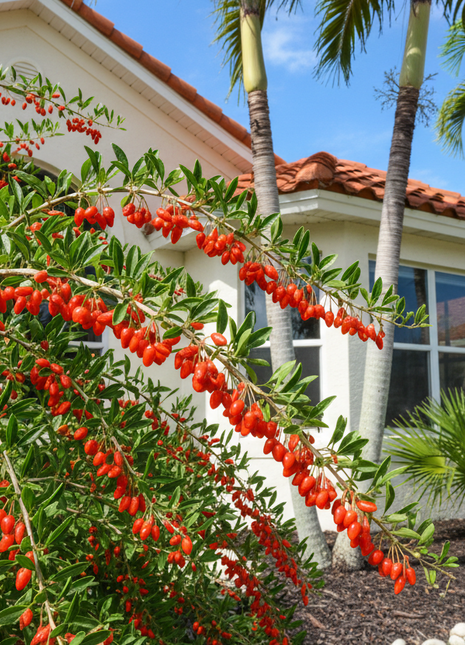
Red Berry Fruiting Shrub — Locally Grown at Flowing Well Tree Farm
Hardy Fruit Shrub • High-Yield Edible Landscape Plant • Drought-Tolerant Once Established • Florida-Grown Stock
When you buy this fruiting shrub here, you’re not getting generic, out-of-region nursery material—you’re getting locally grown plants produced in Pierson, already acclimated to Florida heat, humidity, sandy soils, and seasonal rainfall patterns.
That matters with fast-growing edible shrubs. Locally grown stock establishes faster, handles transplant stress better, and transitions more smoothly into real-world landscape conditions—especially in edible gardens and orchard systems where performance matters.
This is direct-from-grower material. You can visit the farm, see how edible shrubs are grown and selected, and get real guidance from people who work with these fruiting plants in Florida conditions year-round—not generic care sheets.
This type of productive berry shrub is especially valued for its adaptability, early fruiting potential, and long-term reliability in both home gardens and small orchards.
Why Locally Grown Matters
Starting with Florida-grown stock improves long-term performance:
Faster establishment in heat and sandy soils
Reduced transplant shock in home landscapes and containers
Better adaptation to humidity and rainfall variability
More consistent flowering and fruiting cycles
Stronger long-term root development
It’s a more reliable foundation for a productive edible shrub system.
Bright Red, Nutrient-Rich Fruit
This shrub is valued for its edible production:
Bright red, nutrient-rich berries
Suitable for fresh eating and culinary use
Attractive seasonal fruit display
Strong edible landscape appeal
It performs well in both ornamental and food-focused plantings.
USDA Growing Zones
Best suited for Zones 5–9, with strong adaptability across both warm and temperate climates once established.
Mature Growth & Habit
A fast-growing, productive shrub:
Medium shrub form depending on pruning
Dense, fruiting cane structure
Excellent for hedges, borders, and edible gardens
Can be managed for size and yield with regular pruning.
Light Requirements
Performs best in full sun (6–8+ hours daily) for:
Maximum fruit production
Strong cane development
Improved overall plant vigor
Soil & Site Requirements
Highly adaptable but prefers:
Well-draining sandy or loamy soils
Slightly acidic to neutral pH (6.5–7.0)
Organic matter added at planting for best establishment
Avoidance of heavy clay or waterlogged conditions
Planting Guidance (Grower Recommended)
We focus on real-world success in edible landscapes:
Dig a hole twice as wide as the root ball
Plant at the same depth as the container
Backfill with native soil and compost if needed
Water deeply after planting
Apply light mulch, keeping it away from the base
Maintain consistent moisture during establishment
If you visit the farm, we can help match this shrub to orchard rows, edible hedges, or container systems.
Watering & Establishment
Water regularly during the first growing season to build a strong root system. Once mature, the plant becomes moderately drought tolerant and performs well in low-water conditions.
Fertilizer
Apply balanced slow-release fertilizer in early spring
Avoid high nitrogen, which promotes foliage over fruit
Light feeding supports better fruiting performance
Fruiting Timeline
This is a fast producer:
Fruit may begin in years 1–2
Full production typically by year 3
Extended fruiting season from late spring into fall
Pruning & Maintenance
Low to moderate maintenance:
Prune in late winter
Remove weak, old, or unproductive canes
Encourage new shoots for higher future yields
Maintain airflow for better fruiting performance
Why This Is a Smarter Long-Term Investment
✔ Locally grown in Florida for stronger establishment✔ Direct grower expertise for edible shrub success✔ Fast fruiting timeline compared to many shrubs✔ Highly adaptable across multiple climate zones✔ Dual-purpose edible + landscape plant✔ Better performance than out-of-region nursery stock✔ Opportunity to visit, learn, and select in person
The Real Value
This isn’t just a berry shrub—it’s a fast-producing edible system designed for resilience and yield.
You’re not just planting a plant. You’re building a reliable, long-term source of homegrown fruit with a shrub engineered for adaptability and productivity.
Cherry Laurel (Prunus laurocerasus) — Locally Grown in Pierson, Florida at Flowing Well Tree Farm
Evergreen Privacy Shrub • Dense Screening Hedge • Fast-Growing Landscape Barrier • Florida-Adapted Nursery Stock
Cherry Laurel (Prunus laurocerasus) is a vigorous evergreen shrub widely used for privacy hedges, windbreaks, and dense screening in residential and commercial landscapes. Known for its fast growth, large glossy foliage, and ability to form thick living walls, it is one of the most effective structural hedge plants used in designed landscapes.
When you buy Cherry Laurel here, you're not getting weak, over-irrigated ornamental hedge material—you’re getting locally grown, Florida-conditioned plants produced in Pierson and acclimated to heat, humidity, sandy soils, and seasonal stress conditions typical of Florida landscapes.
That matters for long-term performance. Locally grown stock establishes faster, develops stronger root systems, and transitions more reliably into dense hedge structure under real Florida growing conditions.
This is direct-from-grower screening plant material. Visit the farm, see how our privacy hedges are grown, and receive practical guidance on spacing, hedge shaping, and long-term landscape screening systems.
Cherry Laurel is especially valued because it builds fast, dense evergreen coverage where privacy and structure are the priority.
Why Locally Grown Matters for Cherry Laurel
Starting with Florida-conditioned stock provides key advantages:
Faster root establishment after planting
Better adaptation to Florida heat and humidity
Improved drought tolerance once established
Reduced transplant shock
Stronger early canopy and branching development
Better long-term hedge survival in real landscapes
It creates a stronger foundation for dense evergreen screening systems.
Hedge & Privacy Value
Cherry Laurel is widely used as a structural hedge plant:
Fast-growing evergreen foliage
Dense leaf coverage for privacy screening
Excellent for property borders and windbreaks
Can be shaped into formal hedges or natural screens
Provides year-round visual barrier
It is often selected where rapid privacy is the primary goal.
Ornamental Value
In addition to its screening function, it offers strong ornamental qualities:
Large, glossy dark green leaves
Dense, lush evergreen appearance
Strong architectural presence in the landscape
Excellent background plant for garden design
Works well in modern and traditional landscapes
It adds both structure and visual weight to plantings.
Wildlife & Ecological Notes
Cherry Laurel can provide limited habitat value:
Dense foliage offers shelter for birds
Occasional flowering supports pollinators
Provides protective cover in hedgerows
Enhances structural diversity in managed landscapes
It is primarily valued as a functional landscape hedge plant.
Climate & Site Adaptability
Cherry Laurel performs best in moderate climates:
Prefers temperate to subtropical conditions
Performs well in Florida with proper site selection
Tolerates heat and humidity with irrigation support
Requires well-drained soils
Benefits from partial shade in extreme heat zones
Performs best in protected landscape settings
It is widely used in managed ornamental and privacy plantings.
USDA Growing Zones
Best suited for Zones 6–9, performing in Florida in protected or irrigated landscape environments.
Mature Size & Growth Habit
A dense evergreen hedge shrub:
10–20 ft mature height (can be maintained smaller with pruning)
6–12 ft spread depending on pruning
Upright, dense branching structure
Fast vegetative growth under good conditions
Long-lived hedge form with maintenance
Ideal for tall privacy screens and boundary plantings.
Light Requirements
For best performance:
Full sun to partial shade
Strongest density in full sun with irrigation
Shade tolerance in warmer climates
Soil & Site Requirements
Adaptable landscape shrub:
Prefers well-drained soils
Performs well in amended sandy soils
Benefits from organic matter and mulch
Avoid poorly drained or constantly saturated soils
Performs best with consistent moisture during establishment
Planting Guidance (Grower Recommended)
For best hedge establishment:
Plant in full sun or partial shade rows
Space 3–6 ft apart depending on hedge density goals
Dig hole 2–3× wider than root ball
Plant at original soil depth
Water thoroughly after planting
Apply mulch while keeping away from stems
Maintain consistent watering during establishment
We can assist with hedge layout design, spacing strategy, and privacy screening plans.
Watering & Establishment
Water regularly during the first 1–2 growing seasons. Once established, Cherry Laurel becomes moderately drought tolerant but performs best with occasional irrigation in dry periods.
Fertilizer
Moderate feeding recommended:
Balanced fertilizer during active growth
Organic compost improves foliage density
Avoid excessive nitrogen to prevent overly soft growth
Consistent nutrition supports hedge thickness
Pruning & Maintenance
Moderate maintenance hedge:
Responds very well to pruning and shaping
Can be maintained as formal hedge or natural screen
Prune 1–2 times per year for density control
Benefits from regular shaping for tight structure
Why This Is a Smarter Long-Term Investment
✔ Locally grown in Florida for improved field adaptation
✔ Fast-growing evergreen privacy hedge plant
✔ Dense screening and windbreak performance
✔ Strong ornamental foliage value
✔ Ideal for structured landscape design
✔ Long-term hedge durability with maintenance
✔ Grower-direct guidance for hedge establishment
✔ Reliable living privacy system for properties
The Real Value
This isn’t just a shrub—it’s living infrastructure for privacy and structure.
You’re not simply planting Cherry Laurel. You’re building a fast, dense evergreen barrier, improving property function, creating long-term screening, and investing in a managed landscape system that delivers privacy and structure year after year.
Spruce Pine (Pinus glabra) — Locally Grown in Pierson, Florida at Flowing Well Tree Farm
Shade-Tolerant Native Pine • Evergreen Structure • Restoration Tree • Florida-Grown for Field Performance
When you buy Spruce Pine here, you’re not getting field-dug, stressed forestry stock—you’re getting locally grown native trees produced in Pierson, already adapted to Florida’s heat, humidity, rainfall cycles, and sandy soils from the start.
That matters with a slower-growing native conifer like Pinus glabra. Locally grown stock develops stronger root systems in-region, transitions more smoothly after planting, and performs more predictably in natural landscapes and restoration settings.
This is direct-from-grower material. You can visit the farm, see how native pines are produced and selected, and get real guidance from people who work with these species in Florida ecosystems—not generic forestry assumptions.
Spruce Pine is especially valuable because it brings something most pines don’t: real shade tolerance and graceful structure in mixed forests and naturalized landscapes.
Why Locally Grown Matters for Native Pines
Even hardy native conifers benefit from regional production:
Stronger adaptation to Florida soils and climate stress
Improved root establishment in sandy and mixed soils
Reduced transplant shock in restoration settings
More consistent long-term survival in natural landscapes
Better early structural development in the field
It’s a stronger foundation for a long-lived evergreen tree.
A Unique Shade-Tolerant Native Pine
Unlike most southern pines, Spruce Pine can tolerate:
Partial shade conditions
Mixed hardwood forests
Understory and edge plantings
Filtered light environments
This makes it one of the most versatile native pines for naturalized and restoration plantings.
Graceful Evergreen Structure
Spruce Pine is known for its refined appearance:
Straight, upright trunk
Soft, dark green needles
Clean, open canopy over time
Elegant forest form rather than dense or rugged structure
It adds quiet structure to natural landscapes without overpowering them.
Wildlife & Ecological Value
This native pine supports long-term ecosystem health:
Provides shelter for birds and small wildlife
Contributes to native forest structure
Supports biodiversity in mixed ecosystems
Valuable for reforestation and conservation plantings
It plays a steady, foundational role in natural habitats.
USDA Growing Zones
Best suited for Zones 7–10, thriving across the Southeast in both coastal and inland environments.
Mature Size & Growth Habit
A long-lived native evergreen:
40–70 ft tall
20–35 ft wide
Develops a tall, open canopy suited for forested and semi-open landscapes.
Light Requirements
Adaptable:
Full sun for strongest growth
Partial shade tolerated better than most pines
Excellent for understory or edge conditions
Soil & Site Adaptability
Naturally flexible native species:
Prefers moist, well-drained soils
Performs in sandy, loamy, or light clay soils
Tolerates occasional moisture fluctuations
Avoids standing water or poorly drained sites
Performs best in slightly acidic soils
Planting Guidance (Grower Recommended)
We focus on long-term establishment success:
Choose a site with room for mature canopy development
Dig a hole twice as wide as the root ball
Plant at original soil level (do not bury trunk flare)
Backfill with native soil and water deeply
Apply light mulch, keeping it away from the trunk
Maintain consistent watering during establishment
If you visit the farm, we can help determine where Spruce Pine performs best in mixed native plantings or restoration layouts.
Watering & Establishment
Water regularly during the first growing season to establish a strong root system. Once established, Spruce Pine becomes moderately drought tolerant and thrives with only occasional deep watering.
Fertilizer
Minimal feeding required:
Apply balanced slow-release fertilizer in early spring if needed
Avoid heavy fertilization, as this species is adapted to low-nutrient soils
Pruning & Maintenance
Very low-maintenance:
Remove dead or damaged branches as needed
Light pruning only in late winter or early spring if necessary
Maintain natural form for best long-term structure
Why This Is a Smarter Long-Term Investment
✔ Locally grown in Florida conditions from the start✔ Stronger establishment in restoration and landscape settings✔ Direct grower expertise for site selection and success✔ Shade-tolerant native pine (rare and highly useful)✔ Excellent for natural forests and conservation plantings✔ Long-lived evergreen structure for ecological stability✔ Opportunity to visit, learn, and select in person
The Real Value
This isn’t just a pine tree—it’s a structural foundation species for natural landscapes.
You’re not just planting a tree. You’re building long-term forest diversity, habitat, and resilience with a native evergreen designed to last for generations.
Sweetbay Magnolia (Magnolia virginiana) — Locally Grown in Pierson, Florida at Flowing Well Tree Farm
Fragrant Native Tree • Pollinator Favorite • Moisture-Tolerant Magnolia • Florida-Grown Landscape Stock
When you buy Sweetbay Magnolia here, you’re not getting generic retail nursery material—you’re getting locally grown trees produced in Pierson, already acclimated to Florida heat, humidity, rainfall patterns, and sandy-to-organic soil transitions from the start.
That matters with magnolias. Locally grown stock develops stronger root systems in-region, establishes faster after planting, and adapts more reliably to wet sites, rain gardens, and Florida landscapes where moisture and heat fluctuate seasonally.
This is direct-from-grower material. You can visit the farm, see how native magnolias are grown and selected, and get real planting guidance from people who work with these trees in Florida conditions every season—not generic landscape advice.
Sweetbay Magnolia stands out because it combines fragrance, adaptability to wet soils, and refined native beauty in one highly useful landscape tree.
Why Locally Grown Matters
Starting with Florida-grown stock improves long-term success:
Faster establishment in Florida soils and climate
Reduced transplant shock in heat and humidity
Stronger adaptation to wet/dry seasonal cycles
More reliable flowering and growth performance
Better long-term resilience in landscape settings
It’s a stronger foundation for a long-lived native flowering tree.
Fragrant Blooms & Seasonal Beauty
Sweetbay Magnolia is prized for its elegant floral display:
Creamy white, lemon-scented flowers
Blooming from late spring through summer
Strong pollinator attraction (bees, butterflies)
Light, refreshing fragrance in the landscape
It adds sensory value—especially near patios, walkways, and garden edges.
Elegant Native Foliage
This tree offers year-round visual appeal:
Glossy green leaves
Silvery-white undersides that shimmer in wind
Semi-evergreen to evergreen habit in warmer climates
Refined structure suited for both natural and formal landscapes
It is one of the more graceful native magnolias.
Perfect for Moist Landscapes
Sweetbay Magnolia excels where many ornamentals struggle:
Rain gardens and stormwater areas
Pond edges and low-lying sites
Consistently moist soils
Naturalized and restoration plantings
It is especially valuable in Florida’s wetter landscape zones.
Pollinator & Wildlife Value
A strong ecological contributor:
Supports bees and butterflies
Provides seasonal nectar resources
Adds habitat structure in native plantings
Enhances biodiversity in managed landscapes
USDA Growing Zones
Best suited for Zones 5–10, performing strongly across the Southeast and adapting well into a wide range of climates.
Mature Size & Growth Habit
A versatile native tree:
10–35 ft tall
10–20 ft wide
Can be used as a small specimen tree or multi-trunk naturalized form.
Light Requirements
Performs best in:
Full sun for best flowering and density
Partial shade in hotter climates or young plantings
Soil & Site Requirements
Highly adaptable when moisture is consistent:
Prefers moist, acidic soils
Performs in sandy, loamy, or clay soils
Thrives in organic-rich wet areas
Tolerates seasonal saturation better than most ornamentals
Avoid prolonged dry, compacted conditions.
Planting Guidance (Grower Recommended)
We focus on real-world establishment success:
Select a site with consistent moisture or irrigation access
Dig a hole twice as wide as the root ball
Plant at original soil level (do not bury trunk flare)
Backfill with native soil and water deeply
Apply mulch, keeping it away from the trunk
Maintain steady moisture during establishment
If you visit the farm, we can help match Sweetbay Magnolia to rain gardens, pond edges, or landscape focal points.
Watering & Establishment
Water regularly during the first growing season to establish strong roots. Once established, it becomes more adaptable but performs best with consistent moisture, especially during dry periods.
Fertilizer
Apply light slow-release fertilizer for acid-loving plants in early spring
Avoid over-fertilizing, which can reduce flowering and natural vigor
Pruning & Maintenance
Low-maintenance native tree:
Minimal pruning required
Light shaping after flowering if needed
Remove dead or damaged branches in late winter or early spring
Avoid heavy structural pruning
Why This Is a Smarter Long-Term Investment
✔ Locally grown in Florida conditions for better establishment✔ Direct grower expertise for wet-site and landscape success✔ Strong pollinator and wildlife value✔ Fragrant, ornamental native flowering tree✔ Excellent for rain gardens and moisture-rich landscapes✔ Adaptable across a wide range of climates✔ Opportunity to visit, learn, and select in person
The Real Value
This isn’t just a flowering tree—it’s a landscape anchor for wet, biodiverse, and pollinator-rich environments.
You’re not just planting a tree. You’re adding fragrance, ecological function, and long-term native beauty to your landscape with a species built for Florida conditions.
Pond Spice (Litsea aestivalis) — Rare Native Aromatic Shrub | Locally Grown in Pierson, Florida at Flowing Well Tree Farm
Fragrant Native Foliage • Wetland Adapted • Wildlife Support Shrub • Florida-Grown Specialty Plant
When you buy Pond Spice here, you’re not getting a generic native plug or wild-dug material—you’re getting nursery-grown, Florida-acclimated plants produced in Pierson, already adapted to local humidity, rainfall patterns, and sandy-to-organic wetland soils.
That matters with a rare native like Litsea aestivalis. Locally grown stock develops stronger roots, transitions more reliably into home landscapes, and performs better in the exact moisture and heat conditions it will face after planting.
This is direct-from-grower material. You can visit the farm, see how rare natives are propagated and grown, and get real guidance from people who work with Florida ecosystems every season—not generalized native plant advice.
Pond Spice stands out because it is both ecologically important and sensory-rich, bringing fragrance, wildlife value, and refined native structure into moisture-focused landscapes.
Why Locally Grown Matters for Rare Native Shrubs
Rare natives benefit even more from regional production:
Stronger establishment in Florida soils and climate
Reduced transplant shock in heat and humidity
Better long-term survival in wetland-adjacent sites
More predictable growth form in managed landscapes
Improved performance in restoration and native gardens
It’s a more reliable foundation for a hard-to-find native species.
Fragrant Native Foliage
Pond Spice is valued for its unique sensory character:
Glossy green leaves with subtle sheen
Aromatic foliage and bark with a light spicy fragrance
Year-round evergreen to semi-evergreen presence
Distinctive native character rarely found in landscape plants
It adds a subtle but memorable fragrance layer to the garden.
Ecological & Wildlife Value
This native shrub plays an important ecological role:
Supports native insect and wildlife systems
Valuable in restoration plantings and habitat corridors
Enhances biodiversity in wet and semi-wet landscapes
Functions as a structural understory plant in native ecosystems
It’s a true conservation-oriented landscape species.
Ideal for Moist Landscapes
Pond Spice naturally thrives in:
Pond edges and wetland margins
Rain gardens and stormwater zones
Moist woodland understories
Organic-rich, consistently damp soils
It is especially useful in Florida landscapes where water management is part of the design.
USDA Growing Zones
Best suited for Zones 8–11, performing well across Florida and other warm, humid regions.
Mature Size & Growth Habit
A versatile native structure plant:
Shrub to small tree form
Typically 8–20 ft tall depending on conditions
Graceful, open natural shape
Can be trained as a multi-stem shrub or small specimen tree.
Light Requirements
Adaptable:
Partial shade preferred for best growth
Full sun tolerated with adequate moisture
Performs well in filtered light and woodland edges
Soil & Site Requirements
Naturally adapted to moist soils:
Prefers sandy or loamy, well-drained but moist soils
Tolerates organically rich wet soils
Performs best in slightly acidic to neutral pH
Avoid prolonged standing water without movement or drainage
Planting Guidance (Grower Recommended)
We focus on real-world success in Florida landscapes:
Choose a site with consistent moisture and airflow
Dig a hole twice as wide as the root ball
Plant at original container depth
Backfill with native soil and water deeply
Apply mulch lightly, keeping it away from the trunk
Maintain consistent moisture during establishment
If you visit the farm, we can help place Pond Spice in rain gardens, pond margins, or shaded native plantings for best performance.
Watering & Establishment
Water regularly during the first growing season to develop a strong root system. Once established, it becomes moderately drought tolerant but performs best with consistent moisture.
Fertilizer
Apply light balanced slow-release fertilizer in early spring if needed
Avoid heavy feeding, which is unnecessary for native shrubs
Pruning & Maintenance
Low-maintenance native plant:
Minimal pruning required
Light shaping in late winter if needed
Remove lower suckers if a tree form is desired
Maintain natural habit for best ecological value
Why This Is a Smarter Long-Term Investment
✔ Rare native plant grown locally for Florida success✔ Direct grower expertise for wet-site planting✔ Strong ecological and wildlife value✔ Aromatic foliage adds unique sensory appeal✔ Excellent for rain gardens and restoration plantings✔ Better establishment than wild-dug or out-of-region stock✔ Opportunity to visit, learn, and select in person
The Real Value
This isn’t just a shrub—it’s a rare native ecosystem plant with fragrance, function, and ecological importance.
You’re not just planting a tree. You’re adding biodiversity, sensory character, and long-term native resilience to moisture-rich Florida landscapes.
Dwarf Pomegranate (Punica granatum var. nana) — Locally Grown in Pierson, Florida at Flowing Well Tree Farm
Compact Fruiting Shrub • Ornamental Blooming Plant • Heat-Loving Landscape Accent • Florida-Grown Nursery Stock
When you buy Dwarf Pomegranate here, you’re not getting mass-produced retail shrubs grown in different climates—you’re getting locally grown, Florida-acclimated plants produced in Pierson, already adapted to heat, humidity, sandy soils, and intense sun conditions from the start.
That matters with compact fruiting ornamentals. Locally grown stock establishes faster, handles transplant stress better, and transitions more smoothly into Florida landscapes, containers, and small-space gardens.
This is direct-from-grower material. You can visit the farm, see how flowering fruit shrubs are grown and selected, and get real guidance from people who work with these plants in Florida conditions year-round—not generic care instructions.
Dwarf Pomegranate is especially valuable because it delivers high visual impact in a small footprint—combining ornamental flowers, edible-style fruiting, and extreme heat tolerance.
Why Locally Grown Matters
Starting with Florida-grown shrubs improves long-term success:
Faster establishment in heat and sandy soils
Reduced transplant shock in containers and landscapes
Better flowering response in warm climates
Stronger long-term structure and branching habit
More reliable fruiting and bloom cycles
It’s a more dependable foundation for a long-lived ornamental edible shrub.
Brilliant Flowers & Seasonal Color
Dwarf Pomegranate is grown primarily for its ornamental impact:
Bright orange-red blooms from late spring through summer
Long flowering season with continuous color
Strong attraction for pollinators like bees and hummingbirds
High visual impact even at a young age
It functions as a flowering accent plant in nearly any warm-climate landscape.
Ornamental Fruit Display
In addition to blooms, it produces:
Small decorative pomegranates in late summer to fall
Bright seasonal fruit color for landscape interest
Long-lasting ornamental value even after flowering ends
Unique texture and visual appeal in edible landscapes
While fruit is smaller than standard varieties, the ornamental value is exceptional.
USDA Growing Zones
Best suited for Zones 7–11, performing especially well in Florida and other hot, sunny climates.
Mature Size & Growth Habit
A compact, highly manageable shrub:
2–4 ft tall (dwarf form)
2–3 ft wide
Ideal for containers, borders, patios, and small-space edible landscapes.
Light Requirements
Requires full sun (6–8+ hours daily) for:
Maximum flowering
Best fruit color development
Dense, compact growth habit
Soil & Site Requirements
Adaptable but prefers:
Well-draining sandy or loamy soils
Slightly acidic to neutral pH (5.5–7.0)
Added organic matter for best performance
Avoidance of heavy, compacted, or waterlogged soils
Planting Guidance (Grower Recommended)
We emphasize long-term performance in Florida landscapes:
Choose a full sun location with good airflow
Plant at the same depth as the container
Backfill with native soil and water deeply
Apply light mulch, keeping it away from the stem
Space properly for airflow and shape development
Maintain consistent watering during establishment
If you visit the farm, we can help match placement for containers, hedges, or ornamental edible borders.
Watering & Establishment
Water regularly during the first growing season to build a strong root system. Once established, Dwarf Pomegranate is highly drought tolerant and thrives in hot, dry conditions.
Fertilizer
Apply balanced slow-release fertilizer in early spring
Avoid excess nitrogen, which reduces flowering and fruiting
Light feeding is preferred for compact growth and bloom production
Pruning & Maintenance
Low-maintenance ornamental shrub:
Light pruning in late winter to shape
Remove suckers regularly to maintain structure
Thin dense growth to improve airflow and flowering
Minimal intervention needed once established
Why This Is a Smarter Long-Term Investment
✔ Locally grown in Florida conditions for stronger establishment✔ Direct grower expertise for heat-loving ornamentals✔ Long flowering season with high visual impact✔ Compact size ideal for modern landscapes and containers✔ Pollinator-friendly flowering shrub✔ Better adaptation than out-of-region nursery stock✔ Opportunity to visit, learn, and select in person
The Real Value
This isn’t just a small shrub—it’s a high-impact ornamental fruiting plant built for Florida heat and small-space landscapes.
You’re not just planting a plant. You’re adding long-lasting color, structure, and low-maintenance performance to your landscape with a proven warm-climate performer.
Wax Myrtle (Morella cerifera) — Locally Grown in Pierson, Florida at Flowing Well Tree Farm
Fast-Growing Native Hedge • Privacy Screen • Wildlife Shrub • Florida-Grown Landscape Plant
When you buy Wax Myrtle here, you’re not getting weak, greenhouse-soft hedge stock—you’re getting locally grown, field-hardened plants produced in Pierson, already adapted to Florida heat, humidity, sandy soils, salt exposure, and real-world landscape conditions.
That matters for privacy hedges. Locally grown Wax Myrtle establishes faster, roots deeper, and forms denser coverage because it’s already conditioned for the same climate it’s going into. You’re not “adapting” it—you’re planting something already built for it.
This is direct-from-grower material. You can visit the farm, see how native hedging plants are grown and shaped, and get real guidance from people who use Wax Myrtle every season for privacy, restoration, and wildlife plantings.
Wax Myrtle is especially valuable because it delivers fast privacy, ecological function, and low-maintenance performance in one of the most versatile native shrubs available.
Why Locally Grown Matters for Privacy Hedges
Starting with Florida-grown stock makes a noticeable difference:
Faster canopy fill for privacy screens
Stronger root establishment in sandy soils
Better tolerance of heat, wind, and salt exposure
More uniform hedge density over time
Improved long-term survival with minimal inputs
It’s a stronger foundation for living screens and windbreaks.
Fast-Growing Privacy & Screening
Wax Myrtle is one of the best native options for instant structure:
Rapid growth rate for quick privacy
Dense evergreen foliage
Excellent for hedges, fences, and property borders
Can be shaped or left natural
It creates a living wall that improves year after year.
Aromatic Native Foliage
One of its standout features:
Spicy, bayberry-scented leaves
Pleasant fragrance when brushed or trimmed
Evergreen foliage for year-round coverage
Adds sensory value to outdoor spaces
It brings both function and atmosphere to the landscape.
Wildlife & Ecological Value
Wax Myrtle is a powerhouse native species:
Produces berries that attract birds
Supports pollinators and beneficial insects
Provides nesting and shelter habitat
Strong contributor to native biodiversity
It turns a privacy hedge into a living ecosystem.
Coastal & Tough Site Adaptability
This is one of the most resilient native shrubs for Florida conditions:
Tolerates salt spray and coastal exposure
Handles sandy, nutrient-poor soils
Performs well in wind-prone areas
Adaptable to dry or moderately moist sites once established
It is widely used in both coastal and inland landscapes.
USDA Growing Zones
Best suited for Zones 7–10, performing strongly throughout Florida and the Southeastern coastal region.
Mature Size & Growth Habit
Highly flexible growth form:
10–20 ft as a shrub
Can be trained into small tree form
Spreads densely when used as a hedge
Responds well to pruning and shaping.
Light Requirements
Performs well in:
Full sun for densest growth
Partial shade with slightly looser form
Flexible across many landscape settings
Soil & Site Requirements
Highly adaptable native shrub:
Prefers well-drained sandy or loamy soils
Tolerates poor, low-fertility soils
Handles coastal and dry conditions
Avoids long-term standing water
Planting Guidance (Grower Recommended)
We focus on fast establishment for hedging success:
Plant in full sun or partial shade
Space appropriately for hedge density goals
Dig a hole 2–3 times wider than the root ball
Plant at original container depth
Water deeply after planting
Apply mulch while keeping it off the trunk
Maintain regular watering during establishment
If you visit the farm, we can help design hedge spacing for privacy speed vs. long-term density.
Watering & Establishment
Water regularly during the first growing season to build strong roots. Once established, Wax Myrtle becomes drought tolerant and only needs occasional watering during extended dry periods.
Fertilizer
Light balanced fertilizer in early spring if needed
Avoid over-fertilizing, which reduces natural toughness
Thrives in low-input conditions
Pruning & Maintenance
Very easy to manage:
Prune in late winter or early spring
Shape for hedge density or tree form
Responds well to regular trimming
Minimal maintenance once established
Why This Is a Smarter Long-Term Investment
✔ Locally grown in Florida conditions for faster establishment✔ Direct grower expertise for hedge design and spacing✔ Fast privacy screen compared to many ornamentals✔ Native plant with strong ecological value✔ Salt, drought, and wind tolerant✔ Excellent for wildlife and habitat creation✔ Opportunity to visit, learn, and select in person
The Real Value
This isn’t just a hedge plant—it’s a living privacy system built for Florida landscapes.
You’re not just planting a shrub. You’re building a fast, resilient, evergreen boundary that improves with time while supporting wildlife and reducing maintenance.
Butterfly Milkweed (Asclepias tuberosa) — Locally Grown in Pierson, Florida at Flowing Well Tree Farm
Native Pollinator Plant • Monarch Host Plant • Drought-Tolerant Wildflower • Florida-Grown Restoration Stock
Butterfly Milkweed (Asclepias tuberosa) is one of the most valuable native wildflowers for pollinator habitat, restoration projects, and wildlife-friendly landscapes throughout Florida and the Southeast. Known for its brilliant orange blooms, exceptional drought tolerance, and critical role in supporting Monarch butterflies, this long-lived native perennial brings both ecological function and natural beauty to any planting.
When you buy Butterfly Milkweed here, you're not getting greenhouse-grown plants shipped from another region—you’re getting locally grown, Florida-adapted plants produced in Pierson and conditioned to thrive in Florida's heat, humidity, sandy soils, and seasonal rainfall patterns.
That matters for establishment and long-term performance. Locally grown milkweed develops stronger root systems, adapts more quickly after planting, and often performs better under real Florida growing conditions than plants produced outside the region.
This is direct-from-grower native plant material. Visit the farm, see how our native plants are grown, and receive practical guidance on pollinator habitat creation, restoration projects, and native landscape design.
Butterfly Milkweed is especially important because it serves as a host plant for Monarch butterfly caterpillars while providing abundant nectar for a wide range of pollinators.
Why Locally Grown Matters for Native Milkweed
Starting with Florida-grown stock offers important advantages:
Better adaptation to Florida heat and humidity
Stronger root system development
Improved drought tolerance after establishment
Faster acclimation to landscape conditions
Increased long-term survival and vigor
Better performance in restoration and pollinator projects
It creates a stronger foundation for successful native plant establishment.
Pollinator & Wildlife Value
Butterfly Milkweed is one of the most beneficial native plants you can add to a landscape:
Essential host plant for Monarch butterflies
Supports Queen and Soldier butterflies
Provides nectar for bees, butterflies, and beneficial insects
Increases pollinator diversity
Helps restore declining butterfly habitat
Contributes to healthy native ecosystems
A single planting can become a valuable food source for pollinators throughout the growing season.
Bright Seasonal Color
Butterfly Milkweed is prized for its vibrant blooms:
Clusters of brilliant orange flowers
Long flowering season from spring through summer
Excellent addition to native gardens and pollinator beds
Provides continuous visual interest
Combines well with native grasses and wildflowers
Its vivid flowers create a striking display while serving an important ecological purpose.
Climate & Site Adaptability
Butterfly Milkweed thrives in challenging Florida conditions:
Native to dry prairies, pinelands, and open habitats
Highly drought tolerant once established
Performs well in sandy and well-drained soils
Handles Florida heat exceptionally well
Tolerates low fertility conditions
Unsuitable for poorly drained or constantly wet sites
This species excels in naturalized landscapes, restoration sites, and low-maintenance gardens.
USDA Growing Zones
Best suited for Zones 4–9, performing exceptionally well throughout Florida and much of the southeastern United States.
Mature Size & Growth Habit
A compact native perennial:
1–3 ft mature height
1–2 ft spread
Upright, clump-forming habit
Returns annually from deep roots
Long-lived once established
Light Requirements
For best flowering performance:
Full sun preferred
Minimum 6 hours of direct sunlight daily
Reduced flowering in heavy shade
Soil & Site Requirements
Adapted to Florida's native soils:
Prefers well-drained sandy soils
Tolerates poor, low-fertility sites
Performs well in native landscapes
Avoid heavy clay and poorly drained locations
Does not tolerate standing water
Planting Guidance (Grower Recommended)
For best establishment:
Plant in full sun
Choose well-drained soil
Dig planting hole 2–3× wider than root ball
Plant at original soil depth
Water thoroughly after planting
Apply mulch while keeping away from the crown
Avoid disturbing established roots
We can help with pollinator garden layouts, restoration plantings, and Monarch habitat planning.
Watering & Establishment
Water regularly during the first growing season while roots become established. Once established, Butterfly Milkweed becomes highly drought tolerant and requires minimal supplemental irrigation.
Fertilizer
Minimal fertilization needed:
Performs well in native soils
Light balanced fertilizer only if necessary
Avoid excessive nitrogen applications
Overfertilization may reduce flowering
Pruning & Maintenance
Extremely low maintenance:
Remove spent flower stalks if desired
Leave seed pods for wildlife and natural reseeding
Cut back dormant growth in late winter
No routine pruning required
Why This Is a Smarter Long-Term Investment
✔ Locally grown in Florida for superior adaptation
✔ Essential host plant for Monarch butterflies
✔ Supports bees, butterflies, and native pollinators
✔ Brilliant orange flowers throughout the season
✔ Highly drought tolerant once established
✔ Excellent for restoration and pollinator habitats
✔ Low-maintenance native perennial
✔ Grower-direct expertise and planting guidance
The Real Value
This isn't just a flowering perennial—it's a critical piece of native habitat.
You're not simply planting color in the landscape. You're creating food sources for pollinators, supporting Monarch butterfly populations, and helping restore the ecological connections that make Florida's native environments thrive.
Prime-Ark® Freedom Thornless Blackberry (Rubus ×) — Locally Grown in Pierson, Florida at Flowing Well Tree Farm
Premium Edible Berry Plant • Thornless Everbearing Blackberry • High-Yield Fruit Cane • Florida-Grown Orchard Stock
Prime-Ark® Freedom Thornless Blackberry (Rubus ×) is a modern, high-performance blackberry variety valued for its thornless canes, extended fruiting season, and exceptional productivity in warm climates. As one of the most reliable primocane-fruiting blackberries available, it produces sweet, firm berries on first-year growth, making it ideal for home orchards, edible landscapes, and small-scale commercial berry production throughout Florida and the Southeast.
When you buy Prime-Ark® Freedom here, you're not getting stressed, long-shipped nursery cane material—you’re getting locally grown, Florida-adapted plants produced in Pierson and conditioned for real Florida growing conditions including heat, humidity, sandy soils, and seasonal rainfall variation.
That matters for long-term productivity. Locally grown blackberry plants establish faster, develop stronger root systems, and transition more smoothly into consistent fruit production under Florida’s climate conditions.
This is direct-from-grower edible fruit stock. Visit the farm, see how our berry plants are grown, and receive practical guidance on row spacing, trellising systems, and long-term orchard management.
Prime-Ark® Freedom is especially valued because it combines thornless growth with extended harvest potential and excellent fruit quality.
Why Locally Grown Matters for Blackberry Plants
Starting with Florida-grown stock provides key advantages:
Faster root establishment in sandy soils
Better adaptation to Florida heat and humidity
Reduced transplant shock
Stronger cane development in early growth stages
Improved long-term productivity
Better performance in real orchard conditions
It creates a stronger foundation for reliable fruit production systems.
Fruit Quality & Production Value
Prime-Ark® Freedom is known for its excellent berry performance:
Large, sweet, firm blackberries
Excellent fresh-eating quality
Good balance of sugar and acidity
Extended harvest window in warm climates
Suitable for fresh markets, jams, and baking
Reliable production on first-year canes
It is one of the most productive thornless blackberry types for southern growers.
Thornless Growth & Easy Harvest
One of its biggest advantages is handling ease:
Completely thornless canes
Easier pruning and maintenance
Safer harvesting experience
Better suitability for family gardens
Ideal for u-pick and small farms
It makes berry production more accessible and efficient.
Growth Habit & Orchard Use
A vigorous, productive berry plant:
4–6 ft upright to semi-erect canes
Can be trained on trellis systems
Produces on primocanes (first-year growth)
Forms expanding berry rows over time
Excellent for small orchard systems
It integrates well into structured edible landscapes.
Climate & Site Adaptability
Prime-Ark® Freedom performs well in warm climates when properly managed:
Thrives in full sun conditions
Performs well in Florida heat and humidity
Prefers well-drained soils
Benefits from consistent moisture during fruiting
Adaptable to raised beds and orchard rows
Requires airflow for best disease management
It is well suited for southeastern growing systems.
USDA Growing Zones
Best suited for Zones 5–9, performing strongly throughout Florida and similar warm temperate regions.
Light Requirements
For best fruit production:
Full sun required
Minimum 6–8 hours of direct sunlight daily
Reduced yield in shaded areas
Soil & Site Requirements
Adapted to orchard conditions:
Prefers well-drained sandy or loamy soils
Benefits from organic matter enrichment
Avoid poorly drained or waterlogged soils
Performs best in raised rows or berms in heavy soil areas
Mulching improves moisture stability and soil health
Planting Guidance (Grower Recommended)
For best establishment and production:
Plant in full sun orchard rows or garden beds
Space plants for airflow and access (typically 3–5 ft spacing)
Dig hole 2–3× wider than root system
Plant at original soil depth
Water thoroughly after planting
Apply mulch to retain moisture and suppress weeds
Install trellis system early for training canes
We can assist with orchard layout design, trellis setup, and berry production planning.
Watering & Establishment
Water regularly during establishment and fruiting periods. Once established, plants benefit from consistent moisture but can tolerate short dry periods with mulching support.
Fertilizer
Moderate feeding recommended:
Balanced fertilizer during active growth
Avoid excessive nitrogen (can reduce fruit quality)
Organic compost improves long-term soil performance
Split applications during growing season improve yields
Pruning & Maintenance
Moderate maintenance required for productivity:
Prune spent canes after fruiting cycle
Train new canes on trellis system
Maintain airflow for disease prevention
Remove weak or overcrowded growth
Annual pruning improves long-term yield
Why This Is a Smarter Long-Term Investment
✔ Locally grown in Florida for better adaptation
✔ Thornless canes for easy harvest and maintenance
✔ High-yield primocane fruit production
✔ Excellent edible landscape and orchard plant
✔ Extended fruiting season in warm climates
✔ Strong performance in home and small farm systems
✔ Grower-direct orchard planning support
✔ Reliable, productive berry system for Florida gardens
The Real Value
This isn’t just a blackberry plant—it’s a productive food system.
You’re not simply planting berries. You’re building a harvestable orchard, producing fresh fruit at home or on your farm, and investing in a long-term edible landscape that delivers seasonal production, sustainability, and value year after year.
Native Viburnum (Viburnum obovatum) — Locally Grown in Pierson, Florida at Flowing Well Tree FarmNative Evergreen Shrub/Small Tree • Dense Screening Plant • Pollinator Flowering Species • Florida-Grown Restoration & Hedgerow Stock
Native Viburnum (Viburnum obovatum), commonly known as Walter’s Viburnum, is one of the most versatile and structurally important native shrubs in Florida ecosystems. Known for its dense evergreen foliage, fine branching habit, and seasonal clusters of small white flowers followed by dark fruit, this species is widely used in hedgerows, natural privacy screens, wildlife corridors, and habitat restoration plantings.
Naturally found in hammocks, floodplains, and forest edges across the southeastern United States, Viburnum obovatum thrives in Florida’s heat, humidity, and variable soil conditions. At Flowing Well Tree Farm in Pierson, Florida, we grow this species as premium native stock specifically selected for strong branching, fast establishment, and long-term landscape performance.
When you buy Native Viburnum here, you’re not receiving weak ornamental filler stock—you’re getting locally grown, Florida-adapted plants conditioned for real-world conditions including sandy soils, seasonal flooding, drought cycles, and intense summer heat.
That local adaptation is critical. Viburnum obovatum is one of the best native plants for fast hedging and ecological structure, but only performs at its highest level when grown and hardened in similar conditions from the start.
Why Locally Grown Matters for Native Viburnum
Starting with Florida-grown stock provides major advantages:
Faster establishment in sandy and variable soils
Stronger branching structure for hedges and screens
Improved heat and humidity tolerance
Better long-term drought and flood cycle resilience
Denser growth habit for privacy and habitat value
Higher survival rates in restoration plantings
This creates a more reliable and functional native hedge system from year one.
Flowering, Fruit & Seasonal Value
Native Viburnum provides year-round ecological and seasonal interest:
Clusters of small white flowers in spring
Nectar source for native bees and pollinators
Dark berry-like drupes in late summer to fall
Important seasonal food source for birds and wildlife
Subtle but consistent ornamental appeal
Naturalistic texture in native landscapes
It delivers function without losing its refined native aesthetic.
Wildlife & Habitat Importance
Viburnum obovatum is a foundational wildlife shrub:
Berries consumed by songbirds and small mammals
Dense evergreen structure provides year-round cover
Excellent nesting and shelter habitat in hedgerows
Supports pollinators during spring bloom period
Enhances corridor connectivity in fragmented landscapes
It is one of the most dependable native species for habitat structure.
Growth Habit & Landscape Value
This is one of Florida’s best native screening plants:
8–15 ft shrub or small tree form (can be kept lower with pruning)
Extremely dense, fine-textured branching habit
Naturally forms thick hedges and living fences
Responds exceptionally well to trimming and shaping
Ideal for formal or naturalized native hedgerows
Excellent substitute for non-native privacy shrubs
It is widely considered one of the best native alternatives for evergreen screening.
Climate & Site Adaptability
Native Viburnum is highly adaptable across Florida:
Native to southeastern U.S. wetlands and uplands
Performs well in full sun to partial shade
Tolerates seasonal flooding and drought once established
Thrives in sandy, loamy, and organic soils
Highly heat and humidity tolerant
Performs well in both managed and natural systems
It is one of the most flexible native shrubs available.
USDA Growing Zones
Best suited for Zones 7–10, performing strongly throughout Florida and the Gulf and coastal southeastern regions.
Light Requirements
For best density and flowering:
Full sun to partial shade
More sun increases density and flowering
Partial shade helps in hotter inland sites
Highly adaptable across light conditions
Soil & Site Requirements
Adapted to a wide range of Florida soils:
Prefers moist, well-drained soils
Tolerates sandy, clay, and organic soils
Handles periodic wet conditions
Benefits from mulch and organic matter
Avoid permanently saturated stagnant sites
Planting Guidance (Grower Recommended)
For best hedge or specimen performance:
Plant in full sun or partial shade
Dig hole 2–3× wider than root ball
Set at original soil depth
Water deeply after planting
Apply mulch to retain moisture and suppress weeds
Space 4–6 ft apart for hedges or screening rows
Prune lightly early to encourage branching density
We can assist with hedge design, property screening layouts, and native landscape structuring.
Watering & Establishment
Water regularly during the first 1–2 growing seasons. Once established, Native Viburnum becomes highly resilient and can tolerate both drought and wet cycles common in Florida climates.
Fertilizer
Low-input native shrub:
Minimal fertilizer required
Compost improves density and flowering performance
Avoid high nitrogen fertilizers (prevents overly loose growth)
Performs best in natural soil systems
Pruning & Maintenance
Highly manageable and responsive:
Responds extremely well to pruning and shaping
Can be maintained as formal hedge or natural screen
Benefits from periodic trimming for density
Rebounds quickly after cutting
Low maintenance in naturalized landscapes
Why This Is a Smarter Long-Term Investment
✔ Locally grown in Florida for superior adaptation✔ One of the best native evergreen screening shrubs✔ Excellent hedge, buffer, and privacy plant✔ High wildlife and pollinator value✔ Strong tolerance to Florida’s climate extremes✔ Fast-forming dense structure for landscapes✔ Ideal for restoration and native hedgerows✔ Grower-direct expertise for real Florida systems
The Real Value
This isn’t just a landscape shrub—it’s a living structural system that creates privacy, supports wildlife, and restores native habitat function.
When you plant Native Viburnum, you’re building a dense evergreen hedge that replaces non-native ornamentals with a resilient, ecologically valuable native alternative that improves every year it grows.
Florida Red Maple (Acer rubrum) — Locally Grown in Pierson, Florida at Flowing Well Tree Farm
Native Fast-Growing Shade Tree • Brilliant Red Fall Color • Wetland & Upland Adaptable • Florida-Grown Canopy & Wildlife Tree
Florida Red Maple (Acer rubrum) is a beautiful, fast-growing native deciduous tree valued for its attractive form, dependable shade, and brilliant red seasonal color. Native throughout much of the eastern United States, Red Maple is especially well suited to Florida landscapes where adaptable native canopy trees are needed for residential landscapes, parks, conservation projects, wildlife habitat, and restoration plantings.
At Flowing Well Tree Farm in Pierson, Florida, we grow Florida Red Maple as premium native canopy stock selected for strong trunk development, balanced branching, and reliable establishment in Florida conditions. Our trees are grown under real Florida heat, humidity, rainfall, and seasonal moisture cycles—not shipped in from a distant growing climate.
When you buy Florida Red Maple from Flowing Well Tree Farm, you're getting Florida-grown native stock conditioned for the soils and growing conditions found throughout the Southeast.
That local production provides an important advantage: trees have already developed under Florida's intense sunlight, heat, humidity, rainfall patterns, and variable soil moisture.
Why Locally Grown Matters for Florida Red Maple
Florida-grown Red Maple provides several advantages for landscape and restoration projects:
Faster establishment in Florida's sandy and moisture-variable soils
Root systems developed under local growing conditions
Improved tolerance of Florida heat and humidity
Better adaptation to seasonal wet and dry periods
Stronger transition from nursery production to landscape conditions
Reliable performance in residential, commercial, and restoration landscapes
Growing conditions matter. A tree raised in Florida is already accustomed to the environmental pressures it will encounter after planting.
Canopy Structure & Landscape Value
Florida Red Maple is an excellent native shade and canopy tree:
40–60 ft mature height, depending on site conditions
Broad, rounded to oval canopy with age
Fast to moderately fast growth rate
Attractive branching structure
Provides meaningful shade as the canopy develops
Brilliant red, orange, and scarlet foliage during cooler months
Excellent focal and canopy tree for large residential landscapes
Well suited to parks, streetscapes, campuses, and naturalized areas
Its combination of rapid establishment, attractive structure, and seasonal color makes Red Maple one of the most versatile native deciduous trees for the Southeast.
Brilliant Seasonal Color
One of the defining characteristics of Acer rubrum is its seasonal foliage.
As temperatures cool, the normally green leaves can transition into shades of:
Bright red
Scarlet
Orange-red
Orange
Deep crimson
Fall color can vary depending on genetics, weather, site conditions, and the length and temperature of the fall season. In Florida and other warm climates, seasonal color is generally more variable than in northern regions, but Florida Red Maple can still provide beautiful late-season color when conditions are favorable.
Ecological & Wildlife Importance
Florida Red Maple contributes significant ecological value to native landscapes.
It can:
Provide cover and nesting habitat for birds
Offer shelter for wildlife within developing canopy
Contribute organic matter through seasonal leaf drop
Support native forest ecosystems
Help diversify native hardwood plantings
Provide valuable canopy structure around wetland and upland transition areas
Red Maple is an important component of many eastern North American hardwood ecosystems and works especially well as part of diverse native planting designs.
Growth Habit & Structural Function
Florida Red Maple develops into a substantial native canopy tree with a broad crown.
Typical characteristics include:
40–60+ ft mature height under favorable conditions
Rounded to oval crown
Relatively rapid early growth
Strong central leader when properly trained
Attractive branching architecture
Excellent shade-producing potential
Useful as a transition tree between open landscapes and native woodland plantings
For larger properties, it can serve as a long-term canopy anchor while smaller native shrubs, grasses, and understory trees establish beneath it.
Climate & Site Adaptability
Florida Red Maple is highly adaptable and naturally occurs across a wide range of environments.
It can perform well in:
Moist woodlands
Wetland margins
Floodplain forests
Stream and pond edges
Flatwoods
Upland transition areas
Residential landscapes
Naturalized planting areas
It tolerates periodically wet soils and can also adapt to better-drained landscape sites when properly established.
Once established, trees can tolerate periods of reduced rainfall, although consistent moisture is preferred for the fastest growth and best overall performance.
USDA Growing Zones
USDA Hardiness Zones: 3–9
Florida Red Maple is particularly well suited to Zones 8–9 throughout much of Florida and the Southeast.
Light Requirements
For best growth and canopy development:
Full sun is preferred
Tolerates partial shade
Greater sunlight generally promotes stronger growth and better canopy development
Full sun provides the best opportunity for seasonal foliage color
For large landscape installations, provide adequate space for the mature canopy to develop naturally.
Soil & Site Requirements
Florida Red Maple is adaptable to a wide range of soil conditions.
It prefers:
Moist, well-drained soil
Consistent soil moisture during establishment
Sandy, loamy, or organically enriched soils
Moisture-retentive locations
Slightly acidic to neutral soil conditions
It can tolerate periodically saturated conditions and is especially useful near wet areas, drainage corridors, ponds, and rain gardens.
In extremely dry, compacted, or poorly prepared landscape soils, supplemental irrigation during establishment is recommended.
Planting Guidance — Grower Recommended
For the best long-term performance:
Plant in full sun to partial shade.
Dig the planting hole approximately 2–3 times wider than the root ball.
Set the tree at the same depth at which it was growing.
Backfill with the native soil removed from the planting hole.
Water deeply immediately after planting.
Apply 2–4 inches of mulch around the root zone.
Keep mulch several inches away from the trunk.
Provide adequate spacing for the mature canopy.
Maintain consistent moisture during the establishment period.
For large properties, Red Maple works especially well when incorporated into layered native landscape designs with understory trees, shrubs, grasses, and wildlife plants.
Watering & Establishment
Water consistently during the first 1–2 growing seasons.
Young trees benefit from deep, thorough watering rather than frequent shallow watering. As the root system expands, Florida Red Maple becomes increasingly capable of handling normal seasonal fluctuations in rainfall.
Trees planted in naturally moist locations may require less supplemental irrigation once established.
Fertilizer
Florida Red Maple generally has moderate nutrient requirements.
For best results:
Begin with healthy, properly amended planting soil
Use a balanced fertilizer when needed
Avoid excessive nitrogen
Maintain adequate organic matter
Consider soil testing before applying significant fertilizer
Healthy root development and appropriate watering are more important than heavy fertilization.
Pruning & Maintenance
Florida Red Maple is relatively straightforward to maintain when properly established.
Recommended practices include:
Establish a strong central leader while young
Remove competing leaders when necessary
Remove damaged, dead, or crossing branches
Maintain adequate clearance from structures and pathways
Perform structural pruning while the tree is young
Avoid excessive canopy removal
Early structural training can significantly improve the long-term form and strength of a mature canopy.
Ideal Landscape Uses
Florida Red Maple is an excellent choice for:
Residential shade trees
Large yards
Parks and recreation areas
Commercial landscapes
Streetscapes with adequate growing space
Pond and lake edges
Rain gardens and drainage areas
Wetland restoration
Native habitat plantings
Wildlife gardens
Naturalized landscapes
Reforestation and conservation projects
Native canopy restoration
Why This Is a Smarter Long-Term Investment
✔ Locally grown in Florida✔ Native fast-growing shade tree✔ Brilliant seasonal red foliage✔ Adaptable to wet and upland conditions✔ Excellent long-term canopy potential✔ Valuable wildlife and ecological function✔ Performs well in Florida's heat and humidity✔ Suitable for residential, commercial, and restoration projects✔ Grower-direct quality from Florida field production
The Real Value
Florida Red Maple is more than a beautiful shade tree. It is a native canopy species that combines fast establishment, seasonal color, wildlife value, and long-term landscape structure.
When you plant Florida Red Maple, you're adding a tree capable of becoming a major part of the landscape for years to come—providing shade, habitat, seasonal interest, and the natural character of a Florida-grown native hardwood.
Locally grown at Flowing Well Tree Farm in Pierson, Florida.
Eastern Redbud (Cercis canadensis) — Locally Grown in Pierson, Florida at Flowing Well Tree FarmNative Flowering Understory Tree • Early Spring Blooming Accent Species • Wildlife-Friendly Small Canopy Tree • Florida-Grown Ornamental & Ecological Landscape Tree
Eastern Redbud (Cercis canadensis) is one of the most beloved native flowering trees in eastern North America, known for its brilliant early spring magenta-pink blooms that emerge directly on bare branches before the leaves appear. This unique flowering habit makes it one of the most visually striking small native trees in the landscape, especially in naturalized gardens, woodland edges, and understory plantings.
At Flowing Well Tree Farm in Pierson, Florida, we grow Eastern Redbud as premium native understory and accent stock selected for strong branching structure, reliable flowering performance, and adaptation to Florida’s heat, humidity, and variable soil conditions. Each tree is field-conditioned to ensure resilience in sandy soils, seasonal moisture swings, and warm climate stress.
When you buy Eastern Redbud here, you are not receiving delicate northern-grown ornamental stock—you are getting Florida-adapted native flowering trees developed for real-world performance in southern landscapes.
That local adaptation matters. Cercis canadensis performs best when grown in-region, where it develops improved heat tolerance, stronger root systems, and more consistent flowering performance under Florida’s climate conditions.
Why Locally Grown Matters for Eastern Redbud
Starting with Florida-grown stock provides key advantages:
Stronger establishment in sandy and well-drained soilsImproved heat and humidity tolerance from early developmentBetter drought resilience once established in Florida conditionsHigher survival rates in residential and naturalized landscapesMore consistent flowering performance in southern climatesStronger branching structure for long-term ornamental form
This creates a reliable native flowering tree that thrives beyond typical nursery expectations in Florida environments.
Flowering & Seasonal Interest
Eastern Redbud is a premier native flowering accent species:
Early spring magenta to pink blooms appear before leaf-outFlowers emerge directly on branches and trunk (cauliflorous flowering)Provides one of the earliest nectar sources for pollinatorsHeart-shaped green leaves follow bloom cycle for summer canopyGolden-yellow fall color in late season conditionsHigh visual impact in naturalized and designed landscapes
It is one of the most recognizable and celebrated native flowering trees in the Southeast.
Canopy Structure & Landscape Value
Eastern Redbud is a small ornamental canopy tree:
20–30 ft mature height depending on site conditionsBroad, vase-shaped to rounded canopy structureMulti-trunk or single-trunk form depending on trainingLight to medium shade ideal for understory ecosystemsCompact size suitable for residential and small landscape useStrong seasonal visual interest across all four seasons
It functions as a signature accent tree in native and ornamental plantings.
Ecological & Habitat Importance
Eastern Redbud plays an important ecological role:
Early spring nectar source for bees, butterflies, and pollinatorsProvides cover and nesting habitat for small birdsSupports understory biodiversity in mixed hardwood forestsThrives along woodland edges and transition zonesContributes to native pollinator corridor systemsEnhances diversity in restoration and rewilding projects
It is a valuable species for pollinator-focused landscapes.
Growth Habit & Structural Function
Eastern Redbud is a small structural understory tree:
20–30+ ft mature height depending on site conditionsRounded, spreading canopy with graceful branching structureOften multi-stemmed with naturally artistic formModerate growth rate with strong early establishmentMedium lifespan with consistent ornamental performanceWell-suited for understory and edge planting systems
It provides structure without overwhelming surrounding plantings.
Climate & Site Adaptability
Eastern Redbud adapts well to Florida conditions when properly established:
Native to eastern and central United States woodlandsTolerates heat and humidity in partial shade or filtered sunPerforms best in well-drained soils with organic matterModerate drought tolerance once establishedPrefers protection from extreme, prolonged floodingExcellent in mixed woodland and residential landscapes
It is a flexible native flowering tree for diverse planting conditions.
USDA Growing Zones
Best suited for Zones 4–9, with strong performance throughout Florida when properly sited and established.
Light Requirements
For best flowering and structure:
Partial shade to full sun in northern Florida conditionsMorning sun with afternoon shade ideal in hotter sitesFull sun possible with adequate moisture and soil healthFiltered light improves longevity and canopy balance
Soil & Site Requirements
Adaptable native understory species:
Prefers well-drained sandy or loamy soilsBenefits from organic matter and mulchTolerates a range of soil pH conditionsDoes not prefer prolonged flooding or saturated soilsPerforms well in woodland edges and mixed plantings
Planting Guidance (Grower Recommended)
For best long-term performance:
Plant in partial shade or filtered sun for best longevityDig hole 2–3× wider than root ballSet at original soil depthWater deeply after planting to establish root contactApply mulch 2–4 inches deep, keeping away from trunkSpace 15–25 ft apart for natural form developmentProtect young trees from extreme afternoon heat exposure
We can assist with understory design, flowering native gardens, and pollinator habitat layouts.
Watering & Establishment
Water regularly during the first 1–2 growing seasons. Once established, Eastern Redbud becomes moderately drought tolerant and performs reliably in Florida’s seasonal rainfall patterns.
Fertilizer
Low to moderate input requirements:
Light fertilization supports early growth and floweringOrganic compost improves soil biology and root developmentAvoid excessive nitrogen to maintain strong bloom productionPerforms best in balanced, natural soil systems
Pruning & Maintenance
Low maintenance ornamental tree:
Prune lightly after flowering to shape structureRemove dead or crossing branches as neededNaturally develops attractive branching formMinimal long-term pruning requiredBest left in natural aesthetic form for flowering display
Why This Is a Smarter Long-Term Investment
✔ Locally grown in Florida for climate adaptation✔ One of the earliest and most beautiful native bloomers✔ High pollinator and wildlife value✔ Excellent small-scale shade and ornamental structure✔ Adaptable understory and edge planting species✔ Strong seasonal interest (spring flowers + fall color)✔ Ideal for residential and restoration landscapes✔ Grower-direct native flowering stock
The Real Value
This is not just a flowering tree—it is a seasonal signature species that brings color, life, and ecological function to Florida landscapes at the most visually impactful time of year.
When you plant Eastern Redbud, you are investing in a native flowering understory tree that supports pollinators, enhances biodiversity, and delivers one of the most striking seasonal displays in southeastern native ecosystems.
Oakleaf Hydrangea (Hydrangea quercifolia) — Locally Grown in Pierson, Florida at Flowing Well Tree FarmNative Flowering Understory Shrub • Seasonal Color & Bloom Accent Plant • Woodland Edge & Shade Garden Species • Florida-Grown Naturalistic Landscape Foundation Shrub
Oakleaf Hydrangea (Hydrangea quercifolia) is one of the most distinctive and structurally beautiful native flowering shrubs in the southeastern United States. Known for its large oak-shaped leaves, dramatic cone-shaped white blooms, and exceptional fall color, this species is a cornerstone plant for shaded gardens, woodland edges, and naturalized Florida landscapes.
At Flowing Well Tree Farm in Pierson, Florida, we grow Oakleaf Hydrangea as premium native understory stock selected for strong branching structure, reliable seasonal bloom production, and long-term adaptation to Florida’s heat, humidity, sandy soils, and shaded environments. Each plant is field-grown and conditioned under real Florida landscape conditions to ensure durability and consistent performance.
When you buy Oakleaf Hydrangea here, you are not receiving fragile greenhouse ornamentals—you are getting Florida-acclimated native flowering shrubs built for resilience, structure, and long-term seasonal beauty in real landscape conditions.
That local adaptation is essential. Hydrangea quercifolia performs best when grown in-region, where it develops stronger root systems, improved heat tolerance, and more reliable flowering cycles in southern climates.
Why Locally Grown Matters for Oakleaf Hydrangea
Starting with Florida-grown stock provides key advantages:
Stronger establishment in sandy, organic, and woodland soilsImproved heat and humidity tolerance from early developmentBetter drought resilience once established in shaded environmentsHigher survival rates in residential and naturalized plantingsMore consistent flowering and fall color performanceStronger branching structure for long-term landscape stability
This creates a dependable native flowering shrub for Florida shade landscapes.
Flowering & Seasonal Interest
Oakleaf Hydrangea is a multi-season ornamental standout:
Large cone-shaped white flower panicles bloom in late spring through summerFlowers gradually age to soft pink and tan tonesStrong visual presence in shaded garden environmentsLong-lasting blooms provide extended seasonal interestAttracts pollinators including bees and beneficial insectsExcellent cut flower and dried floral structure value
It is one of the most visually dynamic native shrubs in the Southeast.
Foliage Structure & Landscape Value
Oakleaf Hydrangea is prized for its bold foliage:
Large, lobed “oak-like” leaves with strong textureDense multi-stemmed shrub form for natural screeningDeep green summer foliage with strong seasonal transformationBrilliant fall color ranging from burgundy to deep red and bronzeMedium-density structure ideal for woodland layeringExcellent companion plant in shaded landscape designs
It provides structure even when not in bloom.
Ecological & Habitat Importance
Oakleaf Hydrangea contributes significantly to native ecosystems:
Provides nectar for pollinators during extended bloom periodSupports native insect diversity in shaded environmentsOffers shelter for birds and small wildlifeEnhances understory diversity in hardwood forestsThrives in natural woodland edge ecosystemsImproves ecological layering in restoration plantings
It is an important flowering shrub for shaded habitat systems.
Growth Habit & Structural Function
Oakleaf Hydrangea is a long-lived understory shrub:
4–8 ft mature height depending on site conditions and pruningBroad, rounded multi-stemmed growth habitModerate growth rate with strong long-term stabilityNaturally architectural form with seasonal variationResponds well to shaping or natural growth stylesExcellent for mass planting or specimen use
It functions as both a focal shrub and a structural understory layer.
Climate & Site Adaptability
Oakleaf Hydrangea is well adapted to Florida conditions:
Native to southeastern United States woodland ecosystemsThrives in partial shade to filtered light environmentsPerforms best in moist, well-drained organic soilsTolerates Florida heat and humidity when properly establishedModerate drought tolerance once root system is developedDoes not tolerate prolonged standing water
It is one of the most reliable flowering shrubs for shaded Florida landscapes.
USDA Growing Zones
Best suited for Zones 5–9, with excellent performance throughout Florida and the southeastern United States.
Light Requirements
For best flowering and foliage performance:
Partial shade to morning sun with afternoon shade is idealTolerates deeper shade but may reduce bloom intensityAvoid harsh full afternoon sun in hot inland Florida sitesFiltered woodland light produces best structure and color
Soil & Site Requirements
Highly adaptable woodland shrub species:
Prefers rich, organic, well-drained soilsAdapts to sandy soils with added organic matterBenefits from mulch to stabilize moisture and temperatureTolerates slightly acidic soil conditions wellAvoids prolonged flooding or saturated root zones
Planting Guidance (Grower Recommended)
For best long-term performance:
Plant in partial shade or filtered lightDig hole 2–3× wider than root ballSet at original soil depthWater deeply after planting to establish rootsApply mulch 2–4 inches deep, keeping away from stemsSpace 5–8 ft apart for natural massing or hedgesAllow room for seasonal expansion and bloom display
We assist with shade garden design, native flowering shrub layouts, and woodland restoration planning.
Watering & Establishment
Water regularly during the first 1–2 growing seasons. Once established, Oakleaf Hydrangea becomes moderately drought tolerant in shaded environments with stable soil moisture.
Fertilizer
Low to moderate input requirements:
Light fertilization supports bloom production and foliage densityOrganic compost improves soil structure and microbial activityAvoid excessive nitrogen to prevent weak, leggy growthPerforms best in balanced woodland soil systems
Pruning & Maintenance
Low maintenance flowering shrub:
Prune immediately after flowering to preserve next season’s bloomsCan be left natural for woodland appearance or lightly shapedRemove old or weak stems to encourage rejuvenation growthNaturally forms attractive multi-season structureExcellent long-term landscape reliability with minimal care
Why This Is a Smarter Long-Term Investment
✔ Locally grown in Florida for true climate adaptation✔ One of the most ornamental native flowering shrubs✔ Large seasonal blooms with long display period✔ Exceptional fall color in shaded landscapes✔ Strong wildlife and pollinator value✔ Excellent woodland and understory structure plant✔ Low-maintenance long-term landscape performance✔ Grower-direct field-conditioned native stock
The Real Value
This is not just a flowering shrub—it is a multi-season structural landscape plant that delivers bloom impact, fall color, and long-term ecological function in shaded Florida environments.
When you plant Oakleaf Hydrangea, you are investing in a native understory shrub that strengthens woodland landscapes, supports pollinators, and provides some of the most dramatic seasonal transitions available in southeastern native plant systems.
Native White Milkweed (Asclepias perennis) — Locally Grown in Pierson, Florida at Flowing Well Tree FarmNative Monarch Host Plant • Wetland Pollinator Perennial • Long-Blooming Wildlife Flower • Florida-Grown Restoration, Rain Garden & Butterfly Habitat Species
Native White Milkweed (Asclepias perennis), also known as Aquatic Milkweed, is one of the most important native plants for monarch butterflies and pollinator conservation throughout the southeastern United States. Unlike many milkweed species that prefer dry soils, this unique native perennial naturally thrives in moist environments, making it an outstanding choice for rain gardens, pond edges, wetlands, and pollinator-focused landscapes.
At Flowing Well Tree Farm in Pierson, Florida, we grow Native White Milkweed as premium Florida-grown pollinator stock selected for vigorous growth, abundant flowering, and reliable monarch support. Each plant is grown under real Florida conditions to ensure adaptation to heat, humidity, seasonal rainfall, and fluctuating moisture levels.
When you buy Native White Milkweed here, you are not receiving greenhouse-grown ornamentals—you are getting Florida-adapted native plants built to support pollinators, strengthen ecosystems, and thrive in challenging wetland environments.
That local adaptation matters. Asclepias perennis develops stronger root systems, improved resilience, and more consistent flowering when grown in Florida conditions from the start.
Why Locally Grown Matters for Native White Milkweed
Starting with Florida-grown stock provides key advantages:
Stronger establishment in Florida’s sandy and moisture-rich soilsImproved heat and humidity toleranceBetter adaptation to seasonal rainfall and flooding cyclesMore vigorous flowering and pollinator activityHigher survival rates in restoration and habitat projectsEnhanced monarch butterfly support throughout the growing season
This creates a dependable native perennial that performs exceptionally well in Florida landscapes.
Monarch Butterfly Importance
Native White Milkweed is a critical host plant for monarch butterflies:
Provides essential food source for monarch caterpillarsSupports the complete monarch life cycleOffers nectar for adult monarch butterfliesEncourages egg-laying and breeding activityHelps strengthen declining pollinator populationsImportant component of monarch migration corridors
Few native plants are more valuable for butterfly conservation.
Flowering & Seasonal Interest
Native White Milkweed provides months of bloom:
Clusters of delicate white flowers appear throughout the growing seasonLong bloom period supports pollinators over extended periodsAttracts butterflies, bees, wasps, and beneficial insectsFresh green foliage creates attractive garden textureDecorative seed pods develop following floweringSilky seeds provide seasonal visual interest and natural dispersal
Its elegant flowers stand out beautifully in native gardens and wetlands.
Pollinator & Wildlife Benefits
Native White Milkweed is a pollinator powerhouse:
Supports monarch butterflies and numerous native butterfly speciesProvides nectar for bees, moths, and beneficial insectsEnhances biodiversity in gardens and restoration sitesContributes to healthy native pollinator populationsCreates valuable food resources throughout the growing seasonStrengthens ecological function in wetland landscapes
It is one of the most beneficial native perennials available.
Growth Habit & Landscape Value
Native White Milkweed is a versatile native perennial:
2–4 ft mature height depending on site conditionsUpright growth habit with attractive green foliageForms natural colonies over time in suitable environmentsExcellent for rain gardens and pond-edge plantingsCombines well with native wildflowers and wetland speciesIdeal for habitat restoration and naturalized landscapes
It functions as both a beautiful ornamental and a critical ecological species.
Climate & Site Adaptability
Native White Milkweed thrives in Florida conditions:
Native to wetlands, streambanks, and moist meadows throughout the SoutheastExceptional tolerance to wet soils and seasonal floodingPerforms well in rain gardens and retention areasHandles Florida heat and humidity with easeAdaptable to both managed landscapes and natural restoration projectsExcellent long-term performance in moisture-rich environments
It is one of the few milkweed species specifically adapted to wetland habitats.
USDA Growing Zones
Best suited for Zones 6–10, with exceptional performance throughout Florida and the southeastern United States.
Light Requirements
For best flowering and monarch activity:
Full sun preferred for maximum bloomsTolerates light partial shade in wetter environmentsIncreased sunlight improves flower production and plant vigorIdeal for open pollinator gardens and wetland plantings
Soil & Site Requirements
Highly adaptable native wetland perennial:
Thrives in moist, wet, and seasonally flooded soilsPerforms exceptionally well near ponds, streams, and wetlandsTolerates sandy soils when moisture is availableBenefits from organic-rich soils but adapts readilyExcellent choice for rain gardens and bioswales
Planting Guidance (Grower Recommended)
For best long-term performance:
Plant in full sun whenever possibleDig hole slightly wider than root ballSet at original soil depthWater thoroughly after plantingApply light mulch around plants while avoiding stem contactSpace 18–24 inches apart for natural colony developmentCombine with other native pollinator species for maximum habitat value
We can assist with monarch gardens, pollinator habitats, wetland restoration projects, and native plant landscape design.
Watering & Establishment
Water regularly during establishment, especially during dry periods. Once rooted, Native White Milkweed thrives in naturally moist soils and can tolerate seasonal flooding and fluctuating water levels.
Fertilizer
Very low input requirements:
Minimal fertilization neededOrganic compost can support early establishmentAvoid excessive nitrogen applicationsPerforms best in natural soil ecosystems
Pruning & Maintenance
Extremely low maintenance:
Deadhead spent flowers if desired to encourage additional bloomsLeave seed pods for wildlife and natural reseedingCut back dormant stems at the end of the season if neededNaturally resistant to most landscape challengesThrives with minimal intervention once established
Why This Is a Smarter Long-Term Investment
✔ Locally grown in Florida for maximum adaptation✔ Essential host plant for monarch butterflies✔ Outstanding pollinator and wildlife value✔ Thrives in wet soils and rain gardens✔ Long flowering season with elegant white blooms✔ Excellent restoration and conservation species✔ Low-maintenance native perennial✔ Grower-direct quality for Florida conditions
The Real Value
This isn’t just a flowering perennial—it’s a critical piece of Florida’s pollinator ecosystem.
When you plant Native White Milkweed, you’re investing in monarch butterfly conservation, pollinator health, and long-term ecological resilience. Every plant helps create habitat, support biodiversity, and strengthen the natural systems that make Florida’s landscapes thrive for generations to come.
Sunmist Nectarine (Prunus persica var. nucipersica) — Locally Grafted in Pierson, Florida at Flowing Well Tree Farm
Low-Chill Fruit Tree • Early Season Nectarine • Edible Landscape Favorite • Florida-Grown Grafted Stock
When you buy Sunmist Nectarine here, you’re not getting generic orchard stock shipped from cooler production regions—you’re getting grafted trees grown and finished in Pierson, already conditioned for Florida heat, humidity, and low-chill fruiting performance.
That matters. Locally grafted fruit trees establish faster, handle transplant stress better, and begin their productive life already adapted to the climate they’re being planted into. You’re not forcing adaptation—you’re starting with it built in.
This is direct-from-grower material. You can visit the farm, see how nectarines are grafted and trained, and get real-world guidance from people who work with these varieties in Florida conditions every season—not generalized nursery advice.
Sunmist is valued for its reliable fruiting in warm climates and its combination of ornamental bloom and edible harvest potential.
Why Locally Grafted Trees Perform Better
Starting with Florida-grown grafted stock provides real advantages:
Faster transition into fruit production
Improved adaptation to heat and humidity
Reduced transplant shock in sandy soils
More consistent flowering and fruit set
Stronger long-term orchard performance
It’s a more reliable foundation for a productive home orchard.
Smooth, Sweet Early-Season Fruit
Sunmist Nectarine produces attractive fruit with:
Smooth, fuzz-free skin
Sweet, flavorful flesh
Early-season ripening window
Excellent fresh eating quality
It’s a dependable option for gardeners who want consistent nectarine production in warm climates.
Ornamental Spring Bloom Value
Before fruiting, Sunmist provides:
Attractive spring blossoms
Strong pollinator support
Seasonal ornamental interest in edible landscapes
A visually appealing early-season display
It functions as both a fruit tree and a flowering landscape feature.
USDA Growing Zones
Best suited for Zones 8–10, performing well in Florida and other warm Southern climates with mild winters.
Mature Size & Growth Habit
A manageable fruit tree:
10–15 ft tall
Similar spread when unpruned
Can be maintained smaller and more productive with regular pruning.
Light Requirements
Requires full sun (6–8+ hours daily) for best flowering, fruit development, and sugar content.
Soil & Site Requirements
Performs best in:
Well-drained sandy or loamy soils
Slightly acidic to neutral pH
Open, well-ventilated planting sites
Avoid poorly drained or waterlogged soils, which can lead to root stress and disease issues.
Planting Guidance (Grower Recommended)
We prioritize long-term orchard success:
Select a full sun location with good airflow
Dig a hole twice as wide as the root ball
Plant at original container soil level
Backfill with native soil and water deeply
Apply mulch, keeping it away from the trunk
Maintain consistent watering during establishment
If you visit the farm, we can help match varieties to your property conditions and goals.
Watering & Establishment
Water regularly during the first growing season to build a strong root system. Once established, provide deep watering during dry periods, especially during flowering and fruit development.
Fertilizer
Apply balanced slow-release fruit tree fertilizer in early spring
Optional light feeding after harvest if growth slows
Avoid excessive nitrogen, which reduces fruit quality and encourages weak growth
Pruning & Maintenance
Annual dormant pruning is essential:
Prune in late winter
Maintain an open-center structure for airflow and sunlight
Remove dead, weak, or crossing branches
Thin canopy to improve fruit size and quality
Proper pruning directly impacts yield and tree health.
Why This Is a Smarter Long-Term Investment
✔ Grafted and locally grown in Florida conditions✔ Faster establishment and earlier fruit production✔ Direct grower expertise for orchard success✔ Low-chill variety suited for warm climates✔ Strong edible + ornamental landscape value✔ Better adaptation than out-of-region nursery stock✔ Opportunity to visit, learn, and select in person
The Real Value
This isn’t just a nectarine tree—it’s a climate-adapted fruiting system designed for reliable production in Florida landscapes.
You’re not just planting a tree. You’re planting a long-term harvest that improves with every season.
Florida Crest Nectarine (Prunus persica ‘Florida Crest’) — Grafted & Locally Grown in Pierson, Florida at Flowing Well Tree Farm
Low-Chill Fruit Tree • Early Season Nectarine • Edible Landscape Favorite • Florida-Adapted Grafted Stock
When you buy Florida Crest Nectarine here, you’re not getting generic nursery fruit trees shipped from cooler climates—you’re getting grafted trees grown and finished at Pierson, selected specifically for Florida heat, humidity, and low-chill fruiting performance.
That matters. Grafted, locally grown trees establish faster, respond better to Florida soils, and begin their productive life with a head start in both structure and fruiting potential. You’re not correcting climate mismatch—you’re starting with a tree already built for it.
This is direct-from-grower material. You can visit the farm, see how fruit trees are grafted and trained, and get real guidance from people who work with these varieties in Florida conditions every season—not generic orchard instructions.
Florida Crest is one of the most reliable nectarines for warm climates because it was developed specifically for low-chill production and consistent fruit set in Southern regions.
Why Locally Grown, Grafted Trees Perform Better
Starting with grafted, Florida-grown stock provides clear advantages:
Faster time to fruit compared to seed-grown trees
Stronger adaptation to heat and humidity
Reduced transplant shock in Florida soils
More predictable flowering and fruiting cycles
Better long-term orchard performance in warm climates
It’s a smarter foundation for a productive home orchard.
Early Season, Smooth-Skinned Fruit
Florida Crest produces attractive nectarines with:
Red-blushed, smooth skin (no fuzz)
Firm, flavorful yellow flesh
Early-season ripening for extended harvest windows
Excellent fresh eating and culinary use
It’s one of the better choices for dependable fruit production in warm regions.
Spring Bloom & Landscape Value
Before fruiting, the tree produces:
Beautiful spring blossoms
Strong pollinator attraction
Ornamental value in edible landscapes
Seasonal color that enhances home orchards
It functions as both a productive fruit tree and a flowering landscape feature.
USDA Growing Zones
Best suited for Zones 8–10, with strong performance in Florida and similar warm-climate regions.
Mature Size & Growth Habit
A manageable home orchard tree:
10–15 ft tall
Similar spread
Can be kept smaller and more productive with consistent pruning.
Light Requirements
Requires full sun (6–8+ hours daily) for optimal fruiting, sugar development, and overall tree health.
Soil & Site Requirements
Performs best in:
Well-drained sandy or loamy soils
Slightly acidic to neutral pH
Elevated or well-aerated planting sites
Avoid low-lying areas or soils that retain water, as nectarines are sensitive to “wet feet.”
Planting Guidance (Grower Recommended)
We focus on long-term fruiting success:
Select a sunny site with good airflow
Dig a hole twice as wide as the root ball
Plant at original container depth
Backfill with native soil and water deeply
Apply mulch, keeping it away from the trunk
Maintain consistent watering during establishment
If you visit the farm, we can help match placement to your soil and microclimate for better fruit production.
Watering & Establishment
Water regularly during the first growing season to establish strong roots. Once established, provide deep watering during dry periods, especially during flowering and fruit development for best fruit quality.
Fertilizer
Apply balanced slow-release fruit tree fertilizer in early spring
Light feeding after harvest may support growth if needed
Avoid excessive nitrogen, which reduces fruit quality and increases weak growth
Pruning & Maintenance
Annual pruning is essential:
Prune in late winter during dormancy
Maintain an open-center structure for airflow
Remove dead, damaged, or crossing branches
Thin canopy for better sunlight penetration and fruit sizing
Proper pruning directly improves fruit quality and tree health.
Why This Is a Smarter Long-Term Investment
✔ Grafted and grown locally in Florida conditions✔ Faster, more reliable fruit production✔ Direct grower expertise for orchard success✔ Low-chill variety bred for warm climates✔ Better adaptation than out-of-region nursery stock✔ Strong edible + ornamental landscape value✔ Opportunity to visit, learn, and select in person
The Real Value
This isn’t just a nectarine tree—it’s a climate-matched fruiting system built for Florida success.
You’re not just planting a tree. You’re planting an early-season harvest engine that gets better with every year of care.
Southern Magnolia (Magnolia grandiflora) — Locally Grown in Pierson, Florida at Flowing Well Tree Farm
Iconic Evergreen • Fragrant Native Blooms • Legacy Shade Tree • Florida-Grown from Seed for Strong Landscape Performance
When you buy Southern Magnolia here, you’re not getting weak, greenhouse-forced liners or long-distance shipped trees—you’re getting seed-grown specimens raised directly in Pierson, grown under real Florida sun, humidity, wind, and sandy soil conditions from the start.
That matters with a long-lived species like Magnolia grandiflora. Locally grown trees develop stronger root systems, adapt more quickly after planting, and transition into the landscape with far less stress. Seed-grown material also brings natural genetic variation, producing unique, resilient trees with strong long-term structure.
This is direct-from-grower material. You can visit the farm, see how seed-grown native trees are produced, and get real guidance from people who work with these trees in Florida landscapes—not generic retail advice.
Southern Magnolia is a true legacy tree, designed to define landscapes for generations.
Why Locally Grown, Seed-Grown Magnolia Matters
Growing this species from seed in Florida conditions provides real advantages:
Stronger adaptation to local climate stress (heat, humidity, storms)
Deeper, more resilient root development
Improved long-term transplant success
Greater genetic diversity and natural form variation
Better performance in real Southern landscapes over decades
It’s a more natural, durable foundation for a permanent shade tree.
A True Southern Icon
Southern Magnolia is one of the most recognizable trees in America:
Glossy evergreen leaves year-round
Rich copper-brown leaf undersides
Large, creamy white, highly fragrant flowers
Strong architectural presence in the landscape
It delivers both structure and elegance in every season.
Fragrant Blooms with Seasonal Impact
The flowers are one of the defining features:
Large, showy white blossoms
Rich, sweet citrus-like fragrance
Blooming through warm months
Attracts pollinators and adds sensory impact
It is both visually and aromatically iconic.
USDA Growing Zones
Best suited for Zones 7–10, thriving throughout Florida and the Southeastern United States.
Mature Size & Growth Habit
A large, long-lived evergreen shade tree:
60–80 ft tall
30–40 ft wide
Develops a broad, pyramidal canopy that becomes more majestic with age.
Light Requirements
Performs best in full sun to partial shade. Full sun encourages stronger flowering, denser structure, and faster growth.
Soil & Site Adaptability
Adaptable once established, but prefers:
Well-drained, slightly acidic soils
Loamy or sandy soils with organic matter
Avoidance of compacted or poorly drained sites
Once established, it becomes highly resilient in Southern conditions.
Planting Guidance (Grower Recommended)
We emphasize long-term establishment success:
Choose a spacious, open site away from structures
Dig a hole twice as wide as the root ball
Plant at original soil level (do not bury trunk flare)
Backfill with native soil and water deeply
Apply mulch 2–3 inches deep, keeping it off the trunk
Maintain consistent watering during establishment
If you visit the farm, we can help you select the right placement for long-term canopy development.
Watering & Establishment
Water regularly during the first year to develop a strong root system. Once established, Southern Magnolia becomes moderately drought tolerant but benefits from deep watering during extended dry periods.
Fertilizer
Minimal fertilization required:
Apply a balanced slow-release fertilizer in early spring if needed
Mature trees typically thrive without supplemental feeding
Pruning & Maintenance
Low-maintenance once established:
Prune in late winter or early spring if needed
Remove dead, damaged, or crossing branches
Avoid heavy pruning to preserve natural form
Why This Is a Smarter Long-Term Investment
✔ Grown locally in Florida conditions from seed✔ Stronger root systems and better transplant success✔ Direct grower expertise for planting and placement✔ Genetic diversity for long-term landscape resilience✔ Evergreen structure with seasonal blooms and fragrance✔ True legacy shade tree for property value and permanence✔ Opportunity to visit, learn, and select in person
The Real Value
This isn’t just a magnolia purchase—it’s a generational landscape decision.
You’re not just planting a tree. You’re planting a permanent Southern landmark that defines the character of your property for decades.
Passion Fruit ‘Bounty’ (Passiflora edulis ‘Bounty’) — Locally Grown in Pierson, Florida at Flowing Well Tree Farm
Fast-Growing Tropical Vine • Large Sweet Fruit • Ornamental Blooms • Florida-Adapted from Day One
When you buy Passion Fruit ‘Bounty’ here, you’re not getting a delicate, long-distance shipped vine—you’re getting plants grown directly in Pierson, raised under real Florida sun, humidity, rainfall, and storm-season conditions from the start.
That matters. Locally grown vines are already conditioned to the environment they’re being planted into, which means faster establishment, stronger early growth, and more reliable flowering and fruiting once in the landscape.
This is direct-from-grower material. You can visit the farm, see how tropical fruit vines are produced and trained, and get real guidance from the people who grow them every day—not generic instructions pulled from a label.
‘Bounty’ is a high-performance passion fruit variety chosen for its combination of vigorous growth, large fruit size, and dependable productivity in warm climates.
Why Locally Grown Makes the Difference
Because these vines are grown outdoors in Florida conditions, they are already adapted to:
Heat, humidity, and heavy rainfall cycles
Rapid summer growth and flowering patterns
High disease and pest pressure environments
Strong seasonal fruiting response
That translates into:
Faster establishment in the home landscape
Reduced transplant shock
Stronger vine structure early on
More consistent flowering and fruit production
It’s a better starting point for long-term success.
Large, Sweet-Tart Tropical Fruit
‘Bounty’ produces big, aromatic passion fruit with a rich sweet-tart tropical flavor.
Perfect for:
Fresh eating
Juices and smoothies
Desserts and sorbets
Syrups and sauces
Culinary use and cocktails
It’s a productive edible vine designed for both flavor and yield.
Exotic Flowers with Real Ornamental Value
Before fruiting, this vine produces intricate, tropical flowers that:
Attract bees, butterflies, and hummingbirds
Add bold ornamental appeal to structures
Bloom throughout warm growing seasons
Elevate edible landscapes into visual focal points
It’s as much a landscape feature as it is a fruit crop.
USDA Growing Zones
Best suited for Zones 9–11. In cooler regions, it can be grown in containers and protected from frost.
Growth Habit & Landscape Use
A vigorous climbing vine that rapidly covers structures when supported:
Trellises
Fences
Pergolas
Arbors
Edible privacy screens and green walls
With proper training, it becomes a dense, productive canopy.
Sun Requirements
Full sun is essential for best flowering and maximum fruit production (6–8+ hours daily).
Soil & Site Adaptability
Performs best in:
Well-drained sandy or loamy soils
Fertile, organic-rich garden beds
Slightly acidic to neutral conditions
Avoid waterlogged or poorly drained sites, which reduce plant vigor.
Planting Guidance (Grower Recommended)
We focus on setting vines up for long-term productivity:
Choose a warm, sunny site with strong structural support
Dig a hole twice as wide as the root ball
Plant at original container depth
Water deeply after planting
Apply mulch while keeping it off the stem
Install trellis or arbor immediately for training
If you visit the farm, we can help plan spacing and structure based on your property conditions.
Watering & Establishment
Keep soil evenly moist during establishment. Once rooted in, vines benefit from deep watering during dry periods and fruiting cycles to support yield and fruit quality.
Fertilizer
Feed in early spring and mid-summer using a balanced or fruiting fertilizer. Avoid excess nitrogen, which promotes vine growth at the expense of flowers and fruit.
Support & Pruning (Key to Productivity)
This is a vigorous vine that requires structure and management:
Provide a strong trellis, fence, or arbor
Prune lightly to maintain airflow and control growth
Remove tangled or weak growth to encourage fruiting wood
Maintain open structure for sunlight penetration
Proper training directly improves harvest quality and consistency.
Why This Is a Smarter Long-Term Investment
✔ Grown locally in Florida tropical conditions from the start✔ Faster establishment with stronger root development✔ Direct grower expertise for planting and training success✔ Proven performance in heat, humidity, and rainfall cycles✔ High ornamental + edible value in one plant✔ Reliable production in home orchard systems✔ Opportunity to visit, learn, and select in person
The Real Advantage
This isn’t just a passion fruit vine—it’s a high-performance edible landscape system built from locally grown, climate-adapted stock.
You’re not just planting a vine. You’re planting a long-term tropical harvest system that gets better every season.
Panama Red Passion Fruit — Locally Grown in Pierson, Florida at Flowing Well Tree Farm
Premium Tropical Vine • High-Yield Fruit • Ornamental Blooming Climber • Florida-Adapted from the Start
When you buy Passion Fruit ‘Panama Red’ here, you’re not getting a fragile, long-haul shipped vine—you’re getting plants grown directly in Pierson, raised in real Florida heat, humidity, rainfall patterns, and storm-season conditions from day one.
That matters. Locally grown vines establish faster, root deeper, and adapt more predictably to backyard trellises, fences, and orchard systems because they’ve already been conditioned in the same climate they’re going into.
This is direct-from-grower material. You can visit the farm, see how tropical fruit vines are produced, and get real guidance from the people who grow them—not a reseller reading from a label. That means better planting decisions, better training advice, and better long-term fruit production.
‘Panama Red’ is one of the most rewarding passion fruit varieties because it delivers both ornamental beauty and consistent, high-quality fruit in warm climates.
Why Locally Grown Makes the Difference
Because these vines are grown outdoors in Florida conditions, they’re already adapted to:
Heat, humidity, and heavy rainfall cycles
Fast summer growth patterns
High disease and pest pressure environments
Strong seasonal flowering and fruiting cycles
That translates into:
Faster establishment
Reduced transplant shock
Stronger early vine development
More reliable flowering and fruit set
It’s a head start on productivity and landscape success.
Sweet, Aromatic Tropical Fruit
Panama Red produces vibrant red-purple passion fruit with rich aroma and bold tropical flavor.
Perfect for:
Fresh eating
Juices and smoothies
Desserts and sorbets
Sauces, syrups, and cocktails
Culinary garnishes
The fruit combines sweetness and acidity in a way that makes it one of the most desirable tropical flavors you can grow at home.
Exotic Flowers with Real Landscape Impact
Before fruiting, this vine produces large, intricate tropical flowers that:
Attract bees, butterflies, and hummingbirds
Add strong visual interest to structures
Bloom throughout the warm growing season
Elevate edible landscapes into ornamental displays
It’s a plant that performs in both beauty and production.
USDA Growing Zones
Best suited for Zones 9–11. In cooler climates, it can be grown in containers and protected from frost.
Growth Habit & Landscape Use
A fast-growing climbing vine reaching significant coverage quickly when supported:
Trellises
Fences
Arbors
Pergolas
Privacy screens and edible green walls
With proper structure, it becomes a dense, productive canopy.
Sun Requirements
Full sun is essential for maximum flowering and fruit production. At least 6–8 hours daily is ideal.
Soil & Site Adaptability
Performs best in:
Well-drained sandy or loamy soils
Fertile, organic-rich planting areas
Slightly acidic to neutral conditions
Avoid poorly drained or constantly wet soils, which reduce vine health and productivity.
Planting Guidance (Grower Recommended)
We focus on real-world success, not just installation:
Choose a warm, sunny site with strong support
Dig a hole twice as wide as the root ball
Plant at original container depth
Water deeply after planting
Apply mulch, keeping it away from the stem
Install trellis or support immediately for training
If you visit the farm, we can help design placement for airflow, sun exposure, and long-term vine structure.
Watering & Establishment
Keep soil evenly moist during establishment. Once rooted in, vines benefit from deep watering during dry periods and fruit development to maximize yield and fruit quality.
Fertilizer
Feed in early spring and mid-summer with a balanced or fruiting fertilizer. Avoid excess nitrogen, which encourages vine growth at the expense of flowers and fruit.
Support & Pruning (Key to Productivity)
This is a vigorous climbing vine that requires structure:
Provide strong trellis, fence, or arbor support
Prune lightly to control growth and improve airflow
Remove tangled or weak growth to encourage fruiting wood
Maintain open structure for sunlight penetration
Good training equals better harvests.
Why This Is a Smarter Long-Term Investment
✔ Grown locally in Florida tropical conditions from the start✔ Faster establishment and stronger root systems✔ Direct grower expertise for planting and training success✔ Reliable flowering and fruiting performance in warm climates✔ High ornamental + edible value in one vine✔ Better adaptation than out-of-region nursery stock✔ Opportunity to visit, learn, and select in person
The Real Advantage
This isn’t just a passion fruit purchase—it’s a long-term edible landscape system built on local experience and real Florida-grown stock.
You’re not just planting a vine. You’re planting a fast-growing tropical harvest system that improves every season.
Longleaf Pine (Pinus palustris) — Locally Grown in Pierson, Florida at Flowing Well Tree Farm
Iconic Southern Native • Restoration Keystone • Wildlife Habitat Tree • Florida-Grown for Field Success
When you buy Longleaf Pine here, you’re not getting bare-root forestry stock or stressed, out-of-region seedlings—you’re getting trees grown directly in Pierson, raised in real Florida sand, heat, humidity, and wind conditions from the beginning.
That matters because Longleaf Pine is a long-term investment species. Locally grown stock develops stronger root systems, establishes more reliably, and transitions more successfully into restoration sites, natural landscapes, and large properties.
This is direct-from-grower material. You can visit the farm, see how native pines are produced, and get guidance from people who understand how these trees perform over decades—not just the first season.
Longleaf Pine is not just a tree—it’s a foundation species for entire ecosystems.
Why Locally Grown Matters for Longleaf Pine
Even native pines benefit significantly from regional production:
Stronger adaptation to Florida’s sandy soils and climate
Improved root development for long-term stability
Reduced transplant shock in open-field conditions
Better survival in restoration and reforestation sites
More predictable early establishment in challenging landscapes
It’s a stronger start for a tree meant to last generations.
A True Legacy Southern Pine
Longleaf Pine is one of the most important native trees in the Southeast, known for:
Exceptionally long needles (up to 18 inches)
Tall, straight trunk development over time
Open canopy structure that defines Southern landscapes
Lifespan measured in generations, not decades
It creates the classic “high, open pine forest” ecosystem that once dominated the region.
Ecological Powerhouse & Wildlife Value
This is a keystone species in Southern ecology:
Supports native grasses and understory diversity
Provides habitat for birds and wildlife
Essential to longleaf pine ecosystem restoration
Encourages fire-adapted native plant communities
Supports pollinators and specialized species
It is one of the most ecologically valuable trees you can plant in the Southeast.
USDA Growing Zones
Best suited for Zones 7–10, thriving in warm, coastal, and inland Southeastern climates.
Mature Size & Growth Habit
A large, long-lived native conifer:
60–100+ ft tall (at maturity)
20–40 ft spread
Develops a tall, straight trunk with a high canopy over time.
Light Requirements
Requires full sun. Shade reduces vigor and long-term structural development.
Soil & Site Requirements
Naturally adapted to harsh, nutrient-poor soils:
Prefers well-drained sandy soils
Tolerates low fertility conditions
Does not perform well in heavy clay or standing water
Thrives in open, natural landscapes
It is one of the best trees for difficult, sandy sites.
Planting Guidance (Grower Recommended)
We focus on long-term establishment success:
Choose a full sun site with wide open space
Dig a hole twice as wide as the root ball
Plant at ground level (do not bury the trunk flare)
Backfill with native soil and water deeply
Apply light mulch, keeping it away from the trunk
Avoid compacted soils and competition early on
If you visit the farm, we can help identify ideal restoration or landscape placements.
Watering & Establishment
Water regularly during the first growing season to establish a strong root system. Once established, Longleaf Pine becomes highly drought tolerant and thrives with minimal supplemental irrigation.
Fertilizer
Minimal fertilization required. This species is adapted to natural, low-nutrient environments. Over-fertilization can reduce long-term resilience.
Pruning & Maintenance
Extremely low-maintenance:
Remove only dead or damaged branches if necessary
Avoid shaping or heavy pruning
Allow natural structure to develop
It is designed to grow with minimal human intervention.
Ideal Uses
Habitat restoration projects
Reforestation and conservation land
Large naturalized landscapes
Wildlife corridors
Long-term land stewardship plantings
Why This Is a Smarter Long-Term Investment
✔ Grown locally in Florida sandhill conditions from the start✔ Stronger survival in restoration and field planting✔ Direct grower expertise for site selection and success✔ Keystone species for ecosystem restoration✔ Exceptional drought tolerance once established✔ Supports long-term wildlife and biodiversity✔ Opportunity to visit, learn, and select in person
The Real Value
This isn’t just a pine tree purchase—it’s ecosystem restoration at scale, backed by local production and real field experience.
You’re not just planting a tree. You’re helping rebuild a landscape that can last for generations.
Swamp Milkweed (Asclepias incarnata) — Locally Grown in Pierson, Florida at Flowing Well Tree Farm
Native Pollinator Perennial • Monarch Essential • Wetland Adapted • Florida-Grown for Strong Establishment
When you buy Swamp Milkweed here, you’re not getting mass-produced plugs or stressed greenhouse stock—you’re getting native perennials grown directly in Pierson, raised in real Florida heat, humidity, and seasonal rainfall conditions from the start.
That matters for native restoration and pollinator success. Locally grown milkweed establishes faster, handles Florida climate stress better, and becomes a more reliable long-term nectar and host plant in real landscapes.
This is direct-from-grower material. You can visit the farm, see how native pollinator plants are produced, and get guidance from people who work with these species in real habitat and garden settings—not just catalog descriptions.
Swamp Milkweed is one of the most ecologically important native perennials you can plant, especially for supporting monarch butterflies and overall pollinator health.
Why Locally Grown Native Milkweed Matters
Even native plants perform better when they’re grown in-region:
Stronger adaptation to Florida’s humidity and rainfall cycles
Faster establishment in garden and restoration sites
Improved survival in wet or fluctuating soils
Better long-term flowering and nectar production
More reliable support for pollinator populations
It’s a native plant already conditioned for your environment.
Monarch Essential Pollinator Plant
Swamp Milkweed is a critical species in monarch butterfly life cycles:
Host plant for monarch caterpillars
Nectar source for adult butterflies
Supports continuous pollinator activity throughout bloom season
Encourages biodiversity in native and restored landscapes
If you’re building a pollinator garden, this is not optional—it’s foundational.
Fragrant Summer Blooms with Real Ecological Value
In summer, Swamp Milkweed produces clusters of soft pink, fragrant flowers that attract:
Monarch butterflies
Native bees
Hummingbirds
A wide range of beneficial insects
It brings movement, color, and life into the landscape during peak growing season.
USDA Growing Zones
Best suited for Zones 3–9, making it widely adaptable across most of the United States.
Mature Size & Growth Habit
A well-behaved native perennial:
3–5 ft tall
2–3 ft wide
Forms upright clumps that work well in mass plantings or mixed native beds.
Light Requirements
Performs best in full sun, where it produces the highest bloom density and strongest pollinator activity. Tolerates partial shade but blooms less heavily.
Soil & Site Adaptability
Naturally adapted to moisture-rich environments:
Prefers moist, well-drained soils
Excellent for rain gardens and low areas
Thrives near ponds, drainage swales, and wet edges
Tolerates occasional flooding
Adapts once established to average garden conditions
It is especially valuable in sites where many perennials struggle with moisture.
Planting Guidance (Grower Recommended)
We focus on successful establishment in real landscapes:
Space plants 18–24 inches apart for natural drift
Choose a sunny to lightly shaded site
Dig a hole twice as wide as the root ball
Plant at original soil level
Water deeply after planting
Apply mulch to retain moisture, keeping it off the crown
If you visit the farm, we can help plan placement for pollinator corridors or rain garden design.
Watering & Establishment
Keep soil consistently moist during establishment. Once mature, Swamp Milkweed becomes moderately drought tolerant but performs best with regular moisture in hot climates.
Fertilizer
Minimal feeding required. In fact, over-fertilizing can reduce flowering. A light, balanced organic approach is preferred for best bloom and pollinator activity.
Maintenance & Care
Low-maintenance native perennial:
Cut back dead stems in late winter
Avoid disturbing root systems once established
Allow natural spreading in suitable habitats
Deadheading optional depending on landscape goals
Why This Is a Smarter Long-Term Investment
✔ Grown locally in Florida conditions from the start✔ Faster establishment in pollinator and rain garden settings✔ Direct grower guidance for native plant success✔ Critical support plant for monarch butterflies✔ High ecological and biodiversity value✔ Adapted to wet, fluctuating soil conditions✔ Opportunity to visit, learn, and select in person
The Real Impact
This isn’t just a perennial purchase—it’s an ecological contribution to your landscape.
You’re not just planting flowers. You’re building habitat, supporting monarch populations, and adding a native system that sustains life season after season.
Highbush Blueberry (Vaccinium corymbosum) — Locally Grown in Pierson, Florida at Flowing Well Tree Farm
Edible Landscape Favorite • Seasonal Color • Pollinator Friendly • Florida-Grown for Strong Establishment
When you buy Highbush Blueberry here, you’re not getting generic nursery shrubs shipped in from other regions—you’re getting plants grown directly in Pierson, acclimated to real growing conditions including Florida heat, humidity, and soil variability from the start.
That matters because blueberries are sensitive to soil chemistry and establishment stress. Locally grown stock transitions more smoothly into your landscape, develops stronger root systems, and begins performing sooner as a fruiting shrub.
This is direct-from-grower material. You can visit the farm, see how edible landscape plants are produced, and get real guidance from the people who grow them—not a reseller. That means practical advice based on real Florida performance, not just general growing charts.
Highbush Blueberry is one of the most valuable edible landscape plants because it combines reliable fruit production with strong ornamental appeal in every season.
Why Locally Grown Matters
Even well-known fruiting shrubs perform better when grown in-region from the start:
Stronger adaptation to Florida heat and rainfall cycles
Improved root development in local soil conditions
Reduced transplant shock
Faster establishment and earlier fruiting potential
Better long-term productivity in home landscapes
It’s a more reliable foundation for a long-lived edible planting.
Delicious Fruit with Real Landscape Value
Highbush Blueberry produces large, sweet, antioxidant-rich berries that are excellent for:
Fresh eating
Baking and desserts
Jams and preserves
Smoothies and juices
With proper care and multiple varieties for cross-pollination, yields can be substantial and consistent.
Four-Season Ornamental Appeal
This is not just a fruit plant—it’s a landscape shrub with year-round interest:
Spring: soft white bell-shaped flowers that attract pollinators
Summer: abundant blueberry harvest
Fall: brilliant red and orange foliage color
Structure: dense upright form that works in edible borders
It performs as both a food source and a visual focal point.
USDA Growing Zones
Best suited for Zones 4–8, with proper site preparation required in warmer climates like Florida for best performance.
Mature Size & Growth Habit
A productive upright shrub:
6–12 ft tall
4–8 ft wide
Forms a dense, structured plant ideal for edible hedges, orchard rows, or landscape accents.
Light Requirements
Performs best in full sun (6–8+ hours daily). Full sun improves fruiting, sugar content, and plant vigor.
Soil Requirements (Critical for Success)
Blueberries require specific soil conditions:
Acidic soil (pH 4.5–5.5)
Well-drained but moisture-retentive structure
High organic matter content
Amended beds with pine bark, peat, or similar materials
Mulching with pine straw or pine bark helps maintain ideal conditions long-term.
Planting Guidance (Grower Recommended)
We focus on setting plants up for long-term productivity:
Prepare acidic, well-drained planting area
Dig a hole twice as wide as the root ball
Plant at original container depth
Backfill with amended acidic soil
Water deeply after planting
Apply mulch generously, keeping it away from the crown
If you visit the farm, we can help guide soil preparation and placement for better fruit production.
Watering & Establishment
Maintain consistent moisture, especially during flowering and fruiting periods. Do not allow soil to dry out completely. Once established, plants still benefit from steady irrigation during hot weather and fruit development.
Fertilizer
Use fertilizer formulated for acid-loving plants (such as azalea or camellia blends):
Apply in early spring
Optional second application after harvest
Avoid over-fertilization to protect root health and fruit quality
Pruning & Maintenance
Prune in late winter during dormancy:
Remove dead or weak wood
Thin older canes to promote new growth
Maintain airflow through the shrub
Encourage strong fruiting structure
Proper pruning directly improves long-term yields.
Fruit & Pollination Notes
Harvest in early to mid-summer
Rich in antioxidants, vitamins, and fiber
Best results with multiple varieties for cross-pollination
Improved yields with proper soil acidity and sunlight
Why This Is a Smarter Long-Term Investment
✔ Grown locally in Florida conditions from the start✔ Stronger establishment and reduced transplant shock✔ Direct grower guidance for soil and planting success✔ Reliable edible production with ornamental value✔ Better adaptation than out-of-region nursery stock✔ Multi-season landscape interest (flower, fruit, fall color)✔ Opportunity to visit, learn, and select in person
The Real Advantage
This isn’t just a blueberry purchase—it’s a long-term edible landscape system built on correct soil, local growing experience, and plants already adapted to real Florida conditions.
You’re not just planting a shrub. You’re planting a seasonal harvest that improves year after year.
Coral Honeysuckle (Lonicera sempervirens) — Locally Grown in Pierson, Florida at Flowing Well Tree Farm
Native Flowering Vine • Hummingbird Magnet • Evergreen-to-Semi-Evergreen Climber • Florida-Grown Pollinator Stock
Coral Honeysuckle (Lonicera sempervirens) is one of Florida’s most valuable native flowering vines, known for its vibrant coral-red tubular blooms, long flowering season, and exceptional importance to hummingbirds and native pollinators. Naturally found in woodlands, fence lines, and forest edges across the eastern United States, it is widely used in pollinator gardens, native landscapes, trellis systems, and wildlife habitat plantings.
When you buy Coral Honeysuckle here, you're not getting weak, greenhouse-raised vine material—you’re getting locally grown, Florida-adapted plants produced in Pierson and conditioned for real Florida growing conditions including heat, humidity, sandy soils, seasonal rainfall variation, and summer stress periods.
That matters for long-term success. Locally grown honeysuckle establishes faster, develops stronger root systems, and adapts more reliably once planted into Florida landscapes compared to non-local ornamental vine stock.
This is direct-from-grower native vine material. Visit the farm, see how our pollinator vines are grown, and receive practical guidance on trellis training, wildlife garden design, and long-term vertical landscape planning.
Coral Honeysuckle is especially valued because it combines continuous wildlife support with fast vertical coverage and long-lasting seasonal color.
Why Locally Grown Matters for Coral Honeysuckle
Starting with Florida-grown stock provides key advantages:
Faster root establishment in sandy soils
Better adaptation to Florida heat and humidity
Improved drought tolerance after establishment
Reduced transplant shock
Stronger vine development and climbing performance
Better long-term survival in native landscapes
It creates a stronger foundation for successful pollinator vine systems.
Pollinator & Wildlife Value
Coral Honeysuckle is one of the top native hummingbird plants:
Bright coral-red tubular flowers attract hummingbirds
Supports bees and native pollinators
Provides nectar over an extended blooming period
Produces red berries eaten by birds
Enhances biodiversity in native plant systems
It is widely considered essential for wildlife-friendly landscapes.
Ornamental & Landscape Value
Beyond its ecological role, it is also highly ornamental:
Showy clusters of red to coral flowers
Attractive semi-evergreen foliage
Twining vine habit ideal for vertical design
Excellent for fences, arbors, and trellises
Strong seasonal color and movement in the landscape
It brings both structure and dynamic color to garden spaces.
Growth Habit & Vertical Coverage
Coral Honeysuckle is a reliable native climber:
10–20+ ft vine length with support
Twining, non-invasive climbing habit
Fast establishment under warm conditions
Ideal for vertical garden systems
Can be trained and controlled easily
It is one of the best native alternatives to invasive ornamental vines.
Climate & Site Adaptability
This species is highly adapted to Florida conditions:
Native to southeastern woodlands and edges
Performs well in heat and humidity
Tolerates sandy, well-drained soils
Moderately drought tolerant once established
Performs best in full sun to partial shade
Highly resilient in mixed landscape environments
It is a dependable native vine for warm climates.
USDA Growing Zones
Best suited for Zones 6–10, performing strongly throughout Florida and much of the southeastern United States.
Light Requirements
For best flowering performance:
Full sun to partial shade
More sun increases bloom production
Tolerates filtered light in hotter sites
Soil & Site Requirements
Adapted to native soils:
Prefers well-drained sandy or loamy soils
Tolerates poor fertility conditions
Benefits from organic mulch
Avoid prolonged waterlogged conditions
Performs well in naturalized garden settings
Planting Guidance (Grower Recommended)
For best establishment:
Plant near trellis, fence, or arbor support
Dig hole 2–3× wider than root ball
Plant at original soil depth
Water thoroughly after planting
Apply mulch while keeping away from stem base
Train vines early for structure and airflow
Space for mature vine spread and coverage
We can assist with trellis design, pollinator layout, and vertical garden planning.
Watering & Establishment
Water regularly during the first growing season. Once established, Coral Honeysuckle becomes moderately drought tolerant and thrives with minimal supplemental irrigation.
Fertilizer
Low to moderate requirements:
Light balanced fertilizer during establishment if needed
Organic compost improves flowering and growth
Avoid excessive nitrogen to promote blooms
Performs best in natural soil conditions
Pruning & Maintenance
Low maintenance vine:
Prune lightly to control size and shape
Remove tangled or overextended growth as needed
Responds well to seasonal trimming
Maintains flowering on new growth
Why This Is a Smarter Long-Term Investment
✔ Locally grown in Florida for superior adaptation
✔ One of the best native hummingbird vines
✔ Long blooming season with high pollinator value
✔ Fast vertical coverage for fences and trellises
✔ Non-invasive native alternative to exotic vines
✔ High wildlife and ecological benefit species
✔ Low-maintenance long-term performance
✔ Grower-direct guidance for vine systems
The Real Value
This isn’t just a flowering vine—it’s a living pollinator corridor.
You’re not simply planting Coral Honeysuckle. You’re feeding hummingbirds, supporting native pollinators, adding vertical beauty to the landscape, and building a resilient native vine system that brings continuous ecological and ornamental value year after year.
Rice Hulls – Natural Weed Control & Soil Protection
Rice hulls are an all-natural, eco-friendly way to control weeds while improving soil health at the same time. When applied as a mulch around plants, rice hulls create a light but effective barrier that blocks sunlight from reaching weed seeds, helping prevent unwanted growth without the use of chemicals.
They also help retain soil moisture, reduce soil temperature swings, and improve air flow around plant roots. Over time, rice hulls slowly break down and add organic matter to the soil, improving structure and drainage.
How to Use
Spread a 1–2 inch layer around the base of plants
Keep mulch a few inches away from plant stems
Reapply as needed as material breaks down
Ideal for garden beds, fruit trees, shrubs, and potted plants
Benefits
Suppresses weed growth naturally
Improves soil moisture retention
Adds organic matter as it decomposes
Lightweight and easy to apply
Safe for pets, people, and plants
Helps prevent soil compaction
Rice hulls are an excellent choice for gardeners who want a clean, natural solution for weed control while improving long-term soil health.
African Rose Hibiscus (Hibiscus acetosella) — Locally Grown in Pierson, Florida at Flowing Well Tree Farm
Bold Tropical Foliage • Edible Landscape Plant • Fast-Growing • Florida-Adapted from the Start
When you buy African Rose Hibiscus here, you’re not getting greenhouse-raised filler stock or something trucked in from out of state—you’re getting plants grown directly in Pierson, hardened in real Florida heat, humidity, and rainfall conditions. That difference shows up quickly in the landscape: stronger establishment, richer color, and far better long-term performance.
This is direct-from-grower material. You can visit the farm, see how it’s grown in full sun conditions, and talk directly with the people who cultivate it every day. That means real guidance on spacing, pruning, and placement—not generic instructions. You’re getting plants selected for how they actually perform in Florida landscapes, not just how they look in a pot.
African Rose Hibiscus is one of those rare plants that delivers both ornamental impact and edible value, making it a standout for modern edible landscapes and food-focused gardens.
Why Locally Grown Matters
Because these plants are grown outdoors in Florida conditions from the beginning, they’re already adapted to:
Heat and humidity
Heavy summer rainfall
Sandy, fast-draining soils
Rapid seasonal growth cycles
That means less transplant shock, faster establishment, and stronger performance once planted in your landscape.
It’s not just a plant—it’s a head start.
Bold Color with Real Landscape Presence
African Rose Hibiscus is known for its dramatic burgundy to deep purple foliage that looks almost like a Japanese maple—but grows fast in tropical conditions where maples struggle.
It creates instant visual impact in:
Tropical landscapes
Edible gardens
Privacy plantings
Pollinator gardens
Container designs and accent beds
The color intensifies in full sun, making it a natural focal point in warm-climate gardens.
Edible, Functional, and Beautiful
This plant isn’t just ornamental—it’s useful.
Tender leaves have a tart, cranberry-like flavor and can be used for:
Fresh salads
Herbal teas
Smoothies
Stir-fries
Garnishes and edible décor
The flowers are also edible and attract pollinators throughout the growing season, adding ecological value along with beauty.
USDA Growing Zones
Best suited for Zones 8–11. In cooler regions, it can be grown as a seasonal annual or overwintered in containers.
Mature Size & Growth Habit
Fast-growing and highly responsive to pruning:
4–8 ft tall
3–5 ft wide
It can be shaped into a fuller shrub or kept more compact depending on how it’s maintained.
Light Requirements
Performs best in full sun to partial shade. Full sun produces the deepest burgundy foliage and strongest growth.
Planting Guidance (Grower-Based Recommendations)
We don’t just sell plants—we help you set them up correctly:
Choose a warm, sunny site with good airflow
Dig a hole twice as wide as the root ball
Plant at original container depth
Water deeply after planting
Apply mulch, keeping it away from the stem
Space properly for airflow and mature size
If you visit the farm, we can help you decide exactly where and how to use it based on your design goals.
Soil & Site Flexibility
Prefers fertile, well-drained soil enriched with organic matter, but adapts well to typical Florida sandy soils when properly maintained.
Best performance comes from:
Slightly acidic to neutral soil
Consistent moisture with good drainage
Organic matter or compost amendments
Watering & Establishment
Regular watering is important during establishment to encourage strong root development. Once established, it becomes moderately drought tolerant but performs best with consistent moisture during hot summer periods.
Fertilizer
Responds well to feeding:
Balanced slow-release fertilizer in spring and midsummer
Organic compost or soil amendments for long-term health
Proper nutrition enhances both foliage color and growth density.
Pruning & Maintenance (Key to Full Growth)
This plant responds extremely well to pruning:
Light trimming encourages bushier growth
Cutting back leggy stems improves fullness
Regular shaping maintains landscape design intent
In cooler areas, it may die back and regrow seasonally
Pruning is what turns it from a loose grower into a dense, high-impact landscape feature.
Why This Is a Smarter Long-Term Choice
✔ Grown locally in Florida climate from the start✔ Faster establishment with less transplant stress✔ Direct access to growers for real guidance✔ Proven performance in heat, humidity, and rain✔ Dual-purpose: ornamental + edible use✔ Strong response to pruning and landscape shaping✔ Better adaptability than out-of-region nursery stock
The Difference Is Noticeable Over Time
This isn’t just an ornamental purchase—it’s a functional, edible, and landscape-driven plant grown with real Florida conditions in mind.
You’re not just adding color to your garden. You’re adding a plant that already knows how to thrive where you live—and rewards you with both beauty and harvest potential.
Locally Grown in Pierson, Florida — Direct from the Grower at Flowing Well Tree Farm
Sweet Southern Flavor • Heavy Producer • Florida-Adapted Edible Vine • Built for Long-Term Harvest Success
When you buy Muscadine Grape ‘Delicious’ (Vitis rotundifolia ‘Delicious’) here, you’re not getting anonymous nursery stock shipped in from another region—you’re getting vines grown directly in Pierson, raised in real Florida heat, humidity, and soil conditions from the beginning. That matters when it comes to survival, establishment, and long-term fruit production.
This is true direct-from-grower material. You can visit the farm, walk the rows, see the vines in production, and get real guidance from the people who actually grow them. When questions come up about planting, spacing, or training, you’re not guessing—you’re getting answers based on how these vines perform in real landscapes, not just in theory.
‘Delicious’ is selected for one thing growers and homeowners both care about: reliable, sweet fruit that actually performs year after year in Southern conditions.
Why Locally Grown Makes the Difference
Muscadines are naturally tough, but locally grown stock takes performance a step further. These vines are already conditioned to Florida’s climate before they ever leave the farm.
That means:
Easier establishment in home landscapes
Less transplant stress
Stronger early growth
More consistent fruiting behavior
Better long-term vine resilience
It’s a smarter starting point for a plant you expect to produce for years.
Sweet Southern Fruit with Real Garden Value
‘Delicious’ lives up to its name with large, sweet bronze-to-bronze-purple grapes that are especially prized for fresh eating right off the vine.
Perfect for:
Fresh eating and snacking
Juices and smoothies
Jams and jellies
Desserts and baking
Homemade wine
This is a true edible landscape vine—productive, flavorful, and dependable.
USDA Growing Zones
Best suited for Zones 7–10, thriving across Florida and much of the Southeastern United States.
Growth Habit & Landscape Use
A vigorous deciduous climbing vine that can easily reach 15–25+ feet with proper support. Ideal for:
Trellises
Pergolas
Fences
Arbors
Edible garden structures
When properly trained, it becomes both a food-producing vine and a functional landscape feature.
Sun Requirements
Full sun (6–8+ hours daily) is essential for maximum fruit production, sugar development, and strong vine structure.
Planting Guidance (Grower Recommended)
We don’t just sell vines—we help you set them up for long-term success:
Choose a sunny site with strong structural support
Dig a hole twice as wide as the root ball
Plant at original container depth
Water deeply after planting
Apply mulch carefully, keeping it away from the trunk
Install trellis or arbor at planting time for proper training
If you visit the farm, we can help match the vine to your specific growing conditions and layout.
Soil & Site Adaptability
Performs best in:
Well-drained sandy or loamy soils
Slightly acidic pH
Moderate organic content
Once established, it handles Florida heat, humidity, and summer rainfall patterns with ease.
Watering & Establishment
Regular watering is important during the first growing season. After establishment, muscadines become drought tolerant but produce best with deep watering during flowering and fruit development.
Fertilizer
Apply a balanced slow-release fertilizer in early spring and again midseason if needed. Avoid excess nitrogen, which encourages leafy growth at the expense of fruit production.
Pruning & Productivity (Critical Step)
Good pruning is what separates average vines from heavy producers:
Prune in late winter while dormant
Remove excess growth to focus energy on fruiting wood
Maintain open airflow and structure
Encourage strong, productive vine framework
We guide pruning based on real field performance so your vine stays productive, not overgrown.
Why This Is a Smarter Long-Term Investment
✔ Grown locally in Florida conditions from day one✔ Faster establishment and reduced transplant shock✔ Direct access to experienced growers✔ Proven performance in heat and humidity✔ Reliable, repeatable fruit production✔ Better adaptation than out-of-region nursery stock✔ Opportunity to visit, learn, and select in person
The Bottom Line
This isn’t just a grape vine purchase—it’s an edible landscape investment built on local experience, regional adaptation, and long-term performance.
You’re not just planting a vine. You’re planting years of sweet harvests with a plant that already understands where it’s growing.
Locally Grown in Pierson, Florida — Direct from the Grower at Flowing Well Tree Farm
Heavy Producer • Florida-Adapted • Landscape-Ready Edible Vine • Built for Long-Term Harvest Success
When you purchase Muscadine Grape ‘Carlos’ (Vitis ‘Carlos’) here, you’re not buying a generic mail-order vine—you’re getting fruiting stock grown directly in Pierson, hardened in real Florida heat, humidity, and soil conditions from the start. That difference shows up later in your landscape: stronger establishment, fewer losses, and far more reliable production.
This is direct-from-grower material. You can visit the farm, walk the trellis areas, and see how these vines are trained, managed, and selected for performance. When you ask questions, you’re talking to the people who actually grow them—not a call center or reseller. That means better guidance, more accurate planting advice, and a vine set up for long-term success instead of short-term sale.
‘Carlos’ is one of the most dependable muscadine varieties for Southern growers because it was chosen for exactly what matters in Florida landscapes: productivity, disease resistance, and climate adaptability.
Why Buying Locally Grown Matters
Muscadines are tough, but they perform best when they’re raised in the same kind of environment where they’ll be planted. These vines are grown outdoors in Florida conditions, meaning they are already adapted to heat, humidity, rainfall swings, and native soils.
That translates into:
Faster establishment
Less transplant shock
More consistent fruit production
Stronger long-term vine structure
It’s not just a vine—it’s a regionally conditioned planting investment.
Heavy Producer with Real Edible Value
‘Carlos’ is known for one thing above all: yield.
It produces abundant clusters of bronze muscadine grapes with a sweet-tart flavor that works extremely well for:
Fresh eating
Juices and ciders
Jams and jellies
Desserts
Homemade wine
This is a true Southern production grape—reliable, productive, and built for repeat harvests year after year.
USDA Growing Zones
Best suited for Zones 7–10, with excellent performance throughout Florida and the Southeast.
Growth Habit & Landscape Use
A vigorous deciduous climbing vine that can easily reach 15–25+ feet when supported properly. Ideal for:
Trellises
Fences
Arbors
Pergolas
Edible landscape designs
When trained correctly, it becomes both a food source and a functional shade/structure vine.
Sun Requirements
Full sun (6–8+ hours daily) is essential for strong fruiting, sugar development, and overall vine health.
Planting Guidance (Grower Recommended)
We don’t just sell vines—we help set them up for production:
Choose a sunny site with strong support structure
Dig a hole twice as wide as the root ball
Plant at original container depth
Water deeply after planting
Mulch lightly, keeping mulch away from the stem
Install trellis or arbor immediately for proper training
If you visit the farm, we can help you plan spacing and structure based on your specific property and goals.
Soil & Adaptability
Performs extremely well in Florida soils and prefers:
Well-drained sandy or loamy soils
Slightly acidic pH
Moderate organic matter
Once established, it handles heat and drought well, making it a strong low-maintenance edible landscape choice.
Watering & Establishment
Regular watering is important during the first establishment period. After rooting in, muscadines become highly drought tolerant but still benefit from deep watering during flowering and fruit development for maximum yield.
Fertilizer
Apply a balanced slow-release fertilizer in early spring, with a light midsummer application if needed. Avoid over-fertilizing with nitrogen, which can reduce fruiting and increase excessive leafy growth.
Pruning & Structure (Key to Productivity)
Proper pruning is what turns a vine into a high producer:
Prune in late winter while dormant
Remove excess growth to encourage fruiting wood
Maintain open airflow and structure
Focus energy on productive vines, not excess foliage
We provide real-world pruning guidance based on how these vines actually perform in Florida landscapes—not textbook theory.
Why This Is a Smarter Long-Term Investment
✔ Grown locally in Florida climate from day one✔ Proven adaptation to heat, humidity, and soil conditions✔ Direct grower support for planting and training✔ Higher survival and stronger establishment rates✔ Reliable, repeatable fruit production✔ Better disease resilience from regionally grown stock✔ Opportunity to visit, learn, and select in person
The Real Difference
This isn’t just a grape vine purchase—it’s a long-term edible landscape decision backed by local production, hands-on expertise, and real Florida field conditions.
You’re not just planting a vine. You’re setting up years of harvests with a plant that already knows how to grow where you live.
Locally Grown in Pierson, Florida — Direct from the Grower at Flowing Well Tree Farm
Native Evergreen • Wetland Adapted • Landscape-Ready • Regionally Grown for Long-Term Success
When you buy Pond Pine (Pinus serotina) here, you’re not buying a shipped-in commodity plant—you’re getting trees grown directly at our farm in Pierson, hardened in Florida conditions from day one. That matters. These are locally adapted, field-tested trees grown for real-world landscapes in the Southeast, not greenhouse environments that struggle after planting.
At Flowing Well Tree Farm, everything is grown with long-term landscape success in mind. We work with these trees every day, in our own soils and climate, so we know exactly how they perform once they leave the field. When you plant one, you’re getting more than a tree—you’re getting direct guidance from people who actually grew it.
We encourage customers to visit the farm, walk the rows, and choose their trees in person. You can see how they’re grown, how they’re spaced, and what they look like in real Florida conditions. And when questions come up, you’re talking directly with the growers—not a middle layer.
Pond Pine is a strong, native evergreen that thrives in wet or challenging soils where many landscape trees fail. It’s commonly used in restoration work, pond edges, naturalized landscapes, and larger properties where durability and ecological function matter as much as appearance.
Why This Tree Performs So Well Here
Pond Pine is naturally adapted to Florida’s wet flatwoods, wetlands, and low-lying soils. Because it’s grown locally, it transitions into the landscape with less shock and stronger establishment compared to non-local stock.
It develops into a rugged, upright evergreen with dense needles and distinctive cones that can remain closed for years until triggered by environmental conditions. Over time, it becomes a strong structural tree that supports wildlife while stabilizing difficult sites.
USDA Growing Zones
Best suited for Zones 7–9, especially well-adapted to warm, humid Southeastern climates.
Mature Growth
Typically 30–70 ft tall with a 20–40 ft spread depending on site conditions, spacing, and moisture availability.
Light Requirements
Full sun (6–8+ hours daily) for best structure, density, and long-term health.
Soil & Site Flexibility
One of its strongest advantages is adaptability.Performs best in:
Moist to wet acidic soils
Sandy, loamy, or organic-rich sites
Poorly drained areas, rain gardens, retention zones, and pond edges
Once established, it also adapts well to average landscape conditions.
Planting Guidance (Grower Recommended)
We provide real planting advice based on how these trees perform in our own fields:
Dig a hole twice as wide as the root ball
Keep planting depth at container level (never deeper)
Backfill with native soil and water in thoroughly
Add 2–3 inches of mulch, keeping it away from the trunk
Give it space—this is a long-term canopy tree
If you visit the farm, we often walk customers through planting choices directly on-site based on their property conditions.
Watering & Establishment
Water regularly during the first establishment period. Once rooted in, Pond Pine becomes significantly more self-sufficient and drought tolerant, while still handling periodic wet conditions better than most pines.
Fertilizer
Low-maintenance by nature. A light application of balanced slow-release fertilizer in early spring during the first few years is usually sufficient.
Pruning & Structure
Minimal intervention needed. The tree naturally forms a strong central structure. Prune only to remove damage or crossing limbs.
Wildlife & Landscape Value
Pond Pine plays an important ecological role:
Provides year-round cover for birds and wildlife
Supports native habitat restoration
Stabilizes wet or low-lying soils
Adds evergreen structure to naturalized landscapes
Why This Is a Smarter Long-Term Choice
✔ Grown locally in Florida conditions from the start✔ Less transplant shock, faster establishment✔ Direct grower support and real planting guidance✔ Region-specific stock—not generic nursery material✔ Field-tested performance in wet and challenging sites✔ Opportunity to visit, select, and learn on-site✔ Built for longevity, not short-term appearance
The Difference Is Simple
This isn’t just a plant purchase—it’s a direct connection to the grower. You’re getting landscape-ready material, grown with intention, backed by real experience, and supported long after it leaves the farm.
That’s what makes it a better investment—not just for today, but for the next decades of your landscape.
Fig ‘LSU Gold’ (Ficus carica ‘LSU Gold’) — Locally Grown in Pierson, Florida at Flowing Well Tree Farm
Premium Edible Fruit Tree • Heat-Tolerant Fig Variety • High-Yield Orchard Tree • Florida-Grown Fruit Stock
Fig ‘LSU Gold’ (Ficus carica ‘LSU Gold’) is a highly regarded fig variety developed by Louisiana State University for exceptional performance in hot, humid southern climates. Known for its golden-yellow skin, rich sweet flavor, and reliable production, ‘LSU Gold’ is one of the most dependable fig cultivars for home orchards and edible landscapes throughout Florida and the Southeast.
When you buy Fig ‘LSU Gold’ here, you're not getting stressed, long-distance nursery stock—you’re getting locally grown, Florida-adapted plants produced in Pierson and conditioned for real Florida conditions including heat, humidity, sandy soils, and seasonal rainfall swings.
That matters for long-term success. Locally grown fig trees establish faster, develop stronger root systems, and transition more smoothly into productive fruiting cycles under Florida growing conditions.
This is direct-from-grower edible fruit stock. Visit the farm, see how our fruit trees are grown, and receive practical guidance on orchard design, pruning systems, and long-term edible landscape planning.
Fig ‘LSU Gold’ is especially valued for its reliable production, attractive fruit quality, and strong performance in warm coastal climates.
Why Locally Grown Matters for Fig Trees
Starting with Florida-grown stock provides key advantages:
Faster root establishment in sandy soils
Better adaptation to heat and humidity
Reduced transplant shock
Stronger early structural growth
Improved long-term fruiting consistency
Better survival in real landscape conditions
It creates a stronger foundation for productive orchard development.
Fruit Quality & Production Value
‘LSU Gold’ is known for its high-quality fruit and dependable yields:
Golden-yellow skin with attractive appearance
Sweet, rich, berry-like flavor profile
Excellent fresh eating quality
Reliable annual production in warm climates
Good for preserves and culinary use
Consistent performance in humid southern regions
It is considered one of the most dependable LSU fig releases for Florida growers.
Growth Habit & Landscape Use
A manageable and productive fruit tree:
8–12 ft mature height (easily maintained smaller with pruning)
8–12 ft spread
Multi-stem or small tree form
Well-suited for backyard orchards
Ideal for edible landscaping and small farms
Its compact size makes it easy to integrate into residential food systems.
Climate & Site Adaptability
Fig ‘LSU Gold’ performs exceptionally well in southern climates:
Thrives in warm, humid environments
Excellent heat tolerance
Performs well in Florida sandy soils
Prefers well-drained planting sites
More reliable than many traditional fig varieties in the Southeast
Handles seasonal drought once established
It is a strong choice for Florida’s challenging growing conditions.
USDA Growing Zones
Best suited for Zones 7–10, performing strongly throughout Florida and much of the southeastern United States.
Light Requirements
For best fruit production:
Full sun preferred
Minimum 6–8 hours of direct sunlight daily
Reduced yields in shaded locations
Soil & Site Requirements
Adapted to common Florida orchard soils:
Prefers well-drained sandy or loamy soils
Tolerates moderate soil fertility
Performs best in slightly elevated sites
Avoid heavy, poorly drained soils
Benefits from organic mulch and soil improvement
Planting Guidance (Grower Recommended)
For best establishment and production:
Plant in full sun locations
Dig planting hole 2–3× wider than root ball
Plant at original soil depth
Water thoroughly after planting
Apply mulch while keeping away from trunk
Space for mature canopy development
Prune lightly to establish structure and airflow
We can assist with orchard layout design, pruning strategy, and edible landscape planning.
Watering & Establishment
Water regularly during the first growing season. Once established, Fig ‘LSU Gold’ becomes moderately drought tolerant and performs well with minimal supplemental irrigation.
Fertilizer
Moderate feeding recommended:
Light balanced fertilizer during active growth
Avoid excessive nitrogen to promote fruiting
Organic compost supports long-term soil health
Consistent nutrition improves yields
Pruning & Maintenance
Low to moderate maintenance:
Prune during dormant season to shape and control size
Remove dead or crowded branches
Maintain open canopy for sunlight penetration
Can be trained as shrub or small tree form
Why This Is a Smarter Long-Term Investment
✔ Locally grown in Florida for superior adaptation
✔ High-performing LSU-developed fig variety
✔ Reliable fruit production in hot, humid climates
✔ Excellent edible landscape tree
✔ Sweet, high-quality golden fruit
✔ Compact and easy to manage size
✔ Strong performance in Southeast conditions
✔ Grower-direct orchard support and guidance
The Real Value
This isn’t just a fruit tree—it’s a reliable food-producing system for your landscape.
You’re not simply planting a fig. You’re creating a productive edible landscape, building long-term fruit production, and investing in a resilient tree that provides harvests, shade, and value season after season.
Flowing Well Tree Farm Native Plant Mystery Box Monthly SubscriptionFor USDA Zones 7–10(Shipping Included)
Bring native gardening to your doorstep with a monthly surprise plant from Flowing Well Tree Farm in Pierson, Florida. Each month you’ll receive one hand-selected Florida-grown native plant, chosen for beauty, pollinator value, and strong performance in Southern landscapes.
Every shipment features a different native species based on seasonal availability and what is thriving at the farm. No two months are the same—each plant is selected to help you build a diverse, resilient native landscape over time.
Designed for gardeners in USDA Zones 7–10, this subscription is ideal for pollinator gardens, habitat restoration, native landscapes, and plant lovers who enjoy learning one species at a time.
Possible monthly selections may include milkweed, coreopsis, beautyberry, yaupon holly, firebush, native blueberry, elderberry, buttonbush, muhly grass, salvias, coral honeysuckle, and other Florida-native species.
Why subscribe?
One curated native plant delivered monthly
Build a diverse pollinator and wildlife garden over time
Learn native plants at a steady, hands-on pace
Selected by experienced native plant growers
Great for gifting or starting a native landscape step-by-step
Flowing Well Tree Farm specializes in premium native and fruiting plants grown for durability, ecological value, and real-world Southern landscape success.
Flowing Well Tree FarmPierson, Florida
Possum Purple Passion Fruit (Passiflora edulis) — Locally Grown in Pierson, Florida at Flowing Well Tree Farm
Tropical Fruiting Vine • Fast-Growing Edible Climber • Pollinator-Friendly Flowering Plant • Florida-Grown Food Forest, Trellis & Backyard Orchard Favorite
Purple Possum Passion Fruit (Passiflora edulis ‘Possum Purple’) is one of the most productive and flavorful passion fruit varieties available for warm climates. Known for its vigorous climbing habit, spectacular exotic flowers, and sweet-tart purple fruit, this variety is a favorite among home gardeners, food forest enthusiasts, and commercial growers throughout Florida and the Southeast.
At Flowing Well Tree Farm in Pierson, Florida, we grow Purple Possum Passion Fruit as premium fruiting vines selected for vigorous growth, healthy root systems, and long-term performance in Florida's heat, humidity, sandy soils, and seasonal rainfall patterns. Every plant is grown under real Florida conditions to ensure rapid establishment, abundant flowering, and dependable fruit production.
When you buy Purple Possum Passion Fruit here, you are not receiving greenhouse-softened vines—you are getting Florida-adapted plants conditioned for strong outdoor performance and long-term productivity.
That local adaptation matters. Passiflora edulis develops stronger root systems, improved heat tolerance, and more reliable flowering and fruit set when established under Florida growing conditions from the beginning.
Why Locally Grown Matters for Purple Possum Passion Fruit
Starting with Florida-grown stock provides key advantages:
Faster establishment after planting
Improved heat and humidity tolerance
Stronger root development in sandy soils
Better drought tolerance once established
More reliable flowering and fruit production
Higher survival rates in Florida landscapes
Excellent long-term vine vigor
This creates a productive perennial fruiting vine capable of producing for many years.
Fruit Production & Edible Value
Purple Possum Passion Fruit is prized for its delicious tropical fruit:
Produces medium to large deep purple fruit
Sweet-tart aromatic pulp with exceptional tropical flavor
Excellent for fresh eating, juices, smoothies, desserts, and preserves
Rich in antioxidants, vitamin C, and dietary fiber
Heavy fruit production throughout the growing season under favorable conditions
Reliable harvests once vines mature
It is considered one of the finest passion fruit varieties for home gardens and edible landscapes.
Flowers & Ornamental Value
Purple Possum Passion Fruit produces some of the most spectacular flowers in the plant world:
Large, intricate purple and white blooms
Flowers attract attention throughout the growing season
Outstanding ornamental value on fences and trellises
One of the most unique flowering vines available
Creates dramatic tropical interest in any landscape
Combines ornamental beauty with edible production
Its extraordinary flowers make it as beautiful as it is productive.
Pollinator & Wildlife Benefits
Purple Possum Passion Fruit provides outstanding ecological value:
Flowers attract bees, butterflies, and other native pollinators
Supports beneficial insect populations
Provides nectar throughout the blooming season
Dense vines offer cover for beneficial wildlife
Enhances biodiversity in food forests and edible landscapes
Creates valuable habitat while producing abundant fruit
It is an excellent addition to pollinator-friendly gardens.
Growth Habit & Structural Function
Purple Possum Passion Fruit is a vigorous climbing perennial:
15–30 ft vine length depending on growing conditions
Rapid growth during warm weather
Climbs readily using tendrils
Excellent for trellises, arbors, pergolas, and fences
Produces dense foliage for seasonal privacy
Long-lived with proper care
It serves as both a productive crop and an ornamental landscape feature.
Climate & Site Adaptability
Purple Possum Passion Fruit thrives in Florida's climate:
Excellent heat and humidity tolerance
Performs exceptionally well in subtropical conditions
Thrives in sandy, well-drained soils
Moderate drought tolerance once established
Fast recovery after seasonal pruning
Ideal for Florida food forests and backyard orchards
It is perfectly suited for warm-climate edible gardening.
USDA Growing Zones
Best suited for Zones 9–11, with excellent performance throughout Central and South Florida and protected locations in North Florida.
Light Requirements
For best flowering and fruit production:
Full sun preferred
Minimum 6–8 hours of direct sunlight daily
Partial afternoon shade tolerated in extremely hot locations
Sun exposure maximizes flowering and fruit yield
Ideal for open trellis systems
Soil & Site Requirements
Adaptable tropical fruiting vine:
Prefers well-drained sandy or loamy soils
Benefits from compost-rich planting areas
Requires good drainage
Performs well in Florida's sandy soils
Mulch helps conserve moisture and regulate soil temperature
Avoid prolonged standing water
Planting Guidance (Grower Recommended)
For best long-term performance:
Plant in full sun
Provide sturdy trellis, arbor, or fence support
Dig hole 2–3× wider than root ball
Set at original soil depth
Water deeply after planting
Apply mulch around the base
Space vines 8–12 ft apart
Allow room for vigorous climbing growth
We can assist with food forest planning, edible landscape design, trellis systems, and backyard orchard layouts.
Watering & Establishment
Water regularly during establishment and flowering. Once established, Purple Possum Passion Fruit becomes moderately drought tolerant but produces its heaviest crops with consistent moisture.
Fertilizer
Moderate nutrient requirements:
Organic compost supports vigorous growth
Balanced fertilizer encourages flowering and fruit production
Avoid excessive nitrogen to prevent excessive leafy growth
Regular feeding improves harvest quality and yield
Pruning & Maintenance
Low to moderate maintenance:
Prune after fruiting to encourage vigorous new growth
Remove dead or overcrowded vines
Train onto trellises or arbors for best production
Harvest fruit as it naturally ripens and drops
Highly productive with routine seasonal care
Why This Is a Smarter Long-Term Investment
✔ Locally grown in Florida for maximum adaptation
✔ Delicious tropical fruit with exceptional flavor
✔ Spectacular exotic flowers
✔ Fast-growing perennial vine
✔ Excellent pollinator and butterfly plant
✔ Perfect for food forests and edible landscapes
✔ Reliable fruit production in warm climates
✔ Grower-direct quality for Florida conditions
The Real Value
This isn't just a fruiting vine—it's a living tropical food system that combines spectacular flowers, abundant harvests, and ecological value in one beautiful plant.
When you plant Purple Possum Passion Fruit, you're investing in a Florida-adapted perennial vine that produces delicious tropical fruit, supports pollinators, and transforms fences, pergolas, and food forests into productive edible landscapes for years to come.
Jiro Persimmon (Diospyros kaki ‘Jiro’) — Locally Grown in Pierson, Florida at Flowing Well Tree Farm
Non-Astringent Fruit • Reliable Producer • Landscape-Ready Edible Tree • Florida-Grown on Hardy Rootstock
When you buy Jiro Persimmon here, you’re not getting a generic orchard tree shipped in from a different climate—you’re getting grafted fruit trees grown and finished in Pierson, Florida, on Florida-adapted rootstock and conditioned for real Southern growing conditions from the beginning.
That matters. These trees are already adjusted to Florida heat, humidity, sandy soils, and seasonal rainfall patterns before they ever reach your yard. The result is stronger establishment, fewer setbacks, and a more reliable path toward fruit production.
This is direct-from-grower material. You can visit Flowing Well Tree Farm, see how our fruit trees are grown and trained, and get practical guidance from the people who actually grow them—not a reseller.
Jiro is an excellent choice for Florida edible landscapes because it combines attractive growth, manageable size, and sweet, non-astringent fruit that can be enjoyed while firm.
Why Locally Grown, Grafted Trees Matter
Because these persimmons are grafted and grown locally, they offer clear advantages:
Faster time to fruit compared to seed-grown trees
Stronger adaptation to Florida soils and climate
Reduced transplant shock
More predictable growth and production habits
Improved long-term orchard performance
Professional grower selection and training
It’s a smarter starting point for a fruit tree you’ll enjoy for many years.
Sweet, Non-Astringent Fruit
Jiro is a non-astringent Japanese persimmon, meaning the fruit can be eaten while firm without the mouth-puckering sensation associated with astringent persimmons.
Fruit characteristics include:
Attractive orange fruit
Sweet, mild flavor
Firm, crisp-to-tender texture depending on ripeness
Excellent fresh-eating quality
Can be used in salads, desserts, baking, drying, and preserves
Fall-ripening fruit
Attractive fruit that also adds ornamental interest to the landscape
Allow the fruit to develop its full color for the best flavor. Fruit can be harvested firm and allowed to soften further depending on your preferred texture.
USDA Growing Zones
Best suited for approximately Zones 7–10, with excellent potential throughout Central and North Florida when planted in a sunny, well-drained location.
Jiro is particularly well suited to Florida's growing conditions when provided with good drainage, adequate irrigation during establishment, and proper nutrition.
Mature Size & Growth Habit
A productive, manageable edible landscape tree:
Approximately 15–25 ft tall
Approximately 10–20 ft wide
Actual size depends on rootstock, growing conditions, pruning, soil, and available space.
Its manageable growth habit makes it suitable for:
Home orchards
Backyard food forests
Edible landscapes
Garden specimen planting
Mixed fruit-tree plantings
Residential landscapes
Light Requirements
Plant in full sun, providing at least 6–8 hours of direct sunlight per day.
More sunlight generally means:
Better fruit production
Improved fruit quality
Stronger branching
Better overall tree structure
Reduced humidity within the canopy
Avoid planting Jiro where large structures or mature trees will eventually shade the canopy.
Soil & Site Adaptability
Jiro performs well when planted in well-drained Florida soils, including sandy soils common throughout Central Florida.
Ideal conditions include:
Well-drained sandy or sandy-loam soil
Slightly acidic to neutral soil
Good organic matter maintained around the root zone
Consistent moisture without standing water
Full sun
For Florida's very sandy soils, mulch is particularly valuable because it helps slow moisture loss and gradually improves the soil environment around the roots.
Avoid planting persimmons in locations that remain saturated for extended periods.
Planting Guidance (Grower Recommended)
We focus on long-term establishment, not simply getting the tree into the ground:
Select a sunny location with good drainage
Dig the planting hole approximately 2–3 times wider than the root ball
Do not plant deeper than the original soil level
Keep the root flare at or slightly above surrounding grade
Backfill primarily with native soil
Water thoroughly after planting
Apply 2–3 inches of mulch over the root zone
Keep mulch several inches away from the trunk
Maintain a weed- and grass-free area around the young tree
In sandy Florida soil, avoid creating a small pocket of heavily amended soil around the roots. Encouraging the roots to move outward into the surrounding native soil produces a stronger, better-adapted root system.
If you visit Flowing Well Tree Farm, we can help you select the appropriate tree size and discuss placement based on your available space and growing conditions.
Watering & Establishment
Consistent moisture is particularly important during the first year or two after planting.
Newly planted trees:
Water deeply immediately after planting
Monitor the root zone frequently during hot weather
Water approximately 2–4 times per week during dry periods, adjusting for rainfall and soil conditions
Reduce frequency as the root system becomes established
Established trees:
Water deeply during prolonged dry periods
Provide additional moisture during fruit development when rainfall is limited
Avoid constantly saturated soil
Do not rely on shallow daily watering
Florida's sandy soil can dry rapidly, so checking the soil around the root zone is more useful than following a rigid calendar.
Fertilizer
Jiro benefits from a balanced, slow-release fruit-tree fertilizer containing micronutrients.
A good Florida approach is:
Apply fertilizer primarily during active growth
Split applications rather than applying one large amount
Follow the fertilizer manufacturer's recommended rate
Consider a soil test before adding large amounts of supplemental nutrients
Avoid excessive nitrogen
Too much nitrogen can encourage excessive vegetative growth at the expense of fruit production and may increase certain disease and pest problems.
For young trees, moderate nutrition combined with proper irrigation generally produces better long-term results than aggressive fertilization.
Pruning & Structure
Train young Jiro Persimmon trees to develop a strong, open framework.
Prune during the dormant season when practical:
Remove dead or damaged branches
Remove crossing or rubbing branches
Remove weak interior growth
Remove competing leaders
Maintain several well-spaced scaffold branches
Encourage strong branch angles
Keep the canopy open enough for sunlight and airflow
Avoid excessive pruning. Persimmons produce fruit on younger branches, so aggressive pruning can remove productive wood and reduce the following season's crop.
Young trees benefit most from structural training, while mature trees generally need only maintenance pruning.
Fruit Production & Thinning
Jiro can produce an attractive crop once established.
If a young tree sets an exceptionally heavy crop, selective thinning can help prevent excessive strain on the tree.
Thinning can:
Improve remaining fruit size
Reduce branch stress
Improve overall fruit quality
Help maintain a balanced tree
Allow the tree to establish a strong root system before expecting heavy production from a young tree.
Pollination
Jiro is considered a non-astringent Japanese persimmon and can produce fruit without necessarily requiring another persimmon cultivar nearby.
However, fruit set and production can vary with cultivar, weather, pollination conditions, and the individual tree.
Planting additional compatible persimmon cultivars nearby can provide additional pollination opportunities and may improve overall fruit production in some landscapes.
Disease & Fungus Prevention
The best fungicide program begins with good cultural practices.
For Jiro:
Plant in full sun
Provide adequate spacing
Maintain good airflow
Avoid excessive irrigation
Avoid excessive nitrogen
Remove dead and diseased branches
Clean up fallen diseased leaves and fruit
Prune during dry weather when possible
Sanitize pruning tools between cuts when working with diseased material
Potential problems in Florida persimmons can include leaf spots, fruit rots, anthracnose, and canker diseases.
Do not routinely spray a healthy tree simply because it is a fruit tree. If disease develops, identify the problem first and use only a fungicide specifically labeled for the crop and disease being treated.
Weed & Herbicide Management
Young persimmon trees compete poorly with aggressive turfgrass and weeds.
For best establishment:
Maintain a weed-free zone around the tree
Use 2–3 inches of mulch
Keep grass away from the trunk and root zone
Replenish mulch as it decomposes
If herbicide is used, select a product specifically labeled for use around the applicable fruit crop and follow the current label exactly.
Never allow herbicide spray or drift to contact green bark, leaves, flowers, or fruit.
For most homeowners, mulch and careful mechanical weed control are the safest starting points.
Additional Grower Notes
Grafted trees generally fruit earlier than seed-grown persimmons
Locally grown trees are already conditioned to Florida's heat and growing conditions
Jiro is a non-astringent fruiting type
Full sun is important for good fruit production
Consistent moisture is especially important while young
Avoid excessive nitrogen
Proper structural pruning helps develop a strong long-lived tree
Fall fruit adds seasonal interest to the landscape
Young trees benefit from protection during unusual freezes
A well-maintained persimmon can become both a productive food source and an attractive landscape tree
Why This Is a Smarter Long-Term Investment
✔ Grown and grafted locally in Florida conditions✔ Florida-adapted growing practices from the beginning✔ Faster and more predictable fruit production than seed-grown trees✔ Reduced transplant shock and stronger establishment✔ Sweet, non-astringent fruit✔ Excellent choice for edible landscapes and home orchards✔ Direct grower support and planting guidance✔ Long-lived, productive landscape tree✔ Locally grown by Flowing Well Tree Farm in Pierson, Florida✔ Opportunity to visit the farm and select your tree in person
The Real Value
This isn't just a fruit tree purchase—it's a long-term edible landscape investment built on locally grown stock and real Florida growing experience.
With Jiro Persimmon, you're getting a tree that can provide attractive seasonal interest, shade, and years of sweet fall fruit while becoming an increasingly productive part of your home orchard or food forest.
You're not just planting a persimmon. You're planting a dependable harvest system that can get better every year.
Grown locally at Flowing Well Tree Farm — Pierson, Florida.
Matsumoto Persimmon (Diospyros kaki ‘Matsumoto’) — Locally Grown in Pierson, Florida at Flowing Well Tree Farm
Sweet Fruit • Productive Japanese Persimmon • Landscape-Ready Edible Tree • Florida-Grown on Hardy Rootstock
When you buy Matsumoto Persimmon here, you’re not getting a generic orchard tree shipped in from a different climate—you’re getting grafted fruit trees grown and finished in Pierson, Florida, on Florida-adapted rootstock and conditioned for real Southern growing conditions from the beginning.
That matters. These trees are already adjusted to Florida heat, humidity, sandy soils, and seasonal rainfall patterns before they ever reach your yard. The result is stronger establishment, fewer setbacks, and a more reliable path toward fruit production.
This is direct-from-grower material. You can visit Flowing Well Tree Farm, see how our fruit trees are grown and trained, and get practical guidance from the people who actually grow them—not a reseller.
Matsumoto is a beautiful and productive Japanese persimmon that brings attractive fruit, ornamental value, and dependable edible-landscape potential to the home orchard when properly sited and cared for.
Why Locally Grown, Grafted Trees Matter
Because these persimmons are grafted and grown locally, they offer clear advantages:
Faster time to fruit compared to seed-grown trees
Stronger adaptation to Florida soils and climate
Reduced transplant shock
More predictable growth and production habits
Improved long-term orchard performance
Professional grower selection and training
It’s a smarter starting point for a fruit tree you’ll enjoy for years of harvests.
Sweet, Flavorful Fruit for Fresh Eating
Matsumoto produces attractive, flavorful persimmons that develop their best quality when allowed to mature properly on the tree.
Fruit characteristics include:
Attractive orange fruit
Sweet, rich flavor
Excellent fresh-eating quality
Useful for desserts, baking, preserves, and drying
Fall-ripening fruit
Attractive fruit that adds ornamental interest to the landscape
Matsumoto is a particularly appealing choice for growers who want a substantial, flavorful fruit tree that also contributes beauty to the landscape.
USDA Growing Zones
Best suited for approximately Zones 7–10, with strong potential throughout Central and North Florida when planted in full sun and well-drained soil.
Matsumoto performs particularly well when given adequate moisture during establishment and fruit development without allowing the root zone to remain saturated.
Mature Size & Growth Habit
A manageable, productive fruit tree:
Approximately 15–25 ft tall
Approximately 10–20 ft wide
Final size will vary depending on rootstock, pruning, soil, irrigation, and growing conditions.
Matsumoto works well in:
Backyard orchards
Edible landscapes
Food forests
Homesteads
Mixed fruit-tree plantings
Residential landscapes
Light Requirements
Plant in full sun, preferably receiving 6–8+ hours of direct sunlight each day.
Adequate sunlight helps promote:
Better fruit production
Improved fruit flavor and color
Stronger branch development
Better canopy density
Improved airflow through the tree
Avoid planting where nearby mature trees will eventually shade the persimmon.
Soil & Site Adaptability
Matsumoto adapts well to the well-drained sandy soils common throughout Central Florida.
Ideal conditions include:
Well-drained sandy or sandy-loam soil
Slightly acidic to neutral pH
Good organic matter around the root zone
Consistent moisture without standing water
Full sun
Florida sand can drain rapidly, so maintaining a layer of organic mulch around the tree is especially beneficial.
Avoid planting in areas that remain saturated after heavy rain.
Planting Guidance (Grower Recommended)
We focus on long-term establishment, not just installation:
Select a sunny site with excellent drainage
Dig a hole 2–3 times wider than the root ball
Do not dig the hole deeper than the root ball
Position the tree with the root flare at or slightly above grade
Backfill primarily with native soil
Water deeply immediately after planting
Apply 2–3 inches of mulch over the root zone
Keep mulch several inches away from the trunk
Maintain a grass- and weed-free area around the young tree
For Florida sandy soil, avoid creating a small pocket of heavily amended soil around the root ball. Encouraging roots to move outward into the surrounding native soil helps create a stronger, more extensive root system.
If you visit Flowing Well Tree Farm, we can help you select the appropriate tree and discuss placement based on your property.
Watering & Establishment
Consistent moisture is important during the first 1–2 years.
Newly planted trees:
Water thoroughly immediately after planting
Monitor moisture around the root ball frequently
During dry weather, water approximately 2–4 times per week
Adjust irrigation according to rainfall, temperature, and soil moisture
Gradually reduce irrigation frequency as the tree establishes
Established trees:
Water deeply during prolonged dry periods
Pay particular attention during fruit development
Provide supplemental irrigation during extended Florida droughts
Avoid shallow, frequent watering once established
Avoid keeping the root zone constantly saturated
Because Florida sand can dry quickly, a thick layer of organic mulch can significantly help stabilize moisture around the roots.
Fertilizer
Matsumoto benefits from a balanced, slow-release fruit-tree fertilizer containing micronutrients.
A good approach is:
Fertilize primarily during active growth
Divide annual fertilizer into several lighter applications
Follow the manufacturer's recommended rate
Consider a soil test before adding large quantities of nutrients
Avoid excessive nitrogen
Too much nitrogen can encourage excessive leafy growth while reducing fruiting efficiency and may increase certain pest and disease pressures.
For Florida-grown trees, moderate nutrition combined with proper irrigation is generally preferable to aggressive fertilization.
Pruning & Structure
Train young Matsumoto Persimmon trees to develop a strong, well-spaced framework.
Prune during winter dormancy when practical:
Remove dead or damaged branches
Remove crossing and rubbing branches
Remove weak interior growth
Remove competing leaders
Select several strong scaffold branches
Encourage wide branch angles
Maintain good spacing between major limbs
Keep the canopy open enough for sunlight and airflow
Avoid heavy pruning.
Persimmons produce fruit on younger branches, so removing too much productive wood can reduce the following year's crop.
Young trees benefit most from structural training, while mature trees generally require only light maintenance pruning.
Fruit Production & Thinning
Once established, Matsumoto can become a productive fruit tree.
If a young or mature tree sets an unusually heavy crop, selective thinning can help balance the tree.
Thinning can:
Improve fruit size
Improve remaining fruit quality
Reduce stress on branches
Reduce excessive crop load
Help maintain a healthy tree structure
Allow young trees to establish a strong root system before expecting maximum production.
Pollination
Matsumoto can produce fruit without necessarily requiring another persimmon tree immediately nearby, depending on the individual tree and pollination conditions.
However, having additional compatible persimmon cultivars nearby can provide additional pollination opportunities and may improve fruit production in some landscapes.
For a home orchard, growing more than one persimmon cultivar can also extend the overall harvest and provide different fruit characteristics.
Disease & Fungus Prevention
The best disease program begins with proper site selection and cultural care.
For Matsumoto:
Plant in full sun
Maintain good spacing
Keep the canopy open
Avoid excessive irrigation
Avoid excessive nitrogen
Remove dead and diseased wood
Clean up fallen diseased leaves and fruit
Prune during dry weather when possible
Sanitize pruning tools when removing diseased material
Japanese persimmons grown in Florida can experience problems such as leaf spot, anthracnose, fruit rot, and canker diseases.
Do not automatically spray fungicide on a healthy tree. If disease develops, identify the problem first and use only a product specifically labeled for persimmon and the disease being treated.
Weed & Herbicide Management
Young Matsumoto trees benefit significantly from a clean root zone.
Grass and weeds compete directly for Florida's limited soil moisture.
For best establishment:
Maintain a weed-free area around the tree
Apply 2–3 inches of mulch
Keep grass away from the trunk
Replenish mulch as it decomposes
Avoid damaging the trunk with lawn equipment
If herbicide is necessary, use only products labeled for the intended fruit crop and follow the current label exactly.
Never allow herbicide drift to contact the leaves, green bark, flowers, or fruit.
For most home landscapes, mulch and careful mechanical weed control are excellent first choices.
Additional Grower Notes
Grafted trees generally fruit earlier than seed-grown persimmons
Locally grown trees are conditioned to Florida's heat and growing environment
Matsumoto is a Japanese persimmon selected for quality fruit production
Full sun is important for fruit quality
Consistent moisture is especially important during establishment and fruit development
Avoid excessive nitrogen
Proper structural pruning creates a stronger long-term tree
Fall fruit provides seasonal color and edible harvest
Young trees should be protected from unusual hard freezes
Mature trees can become productive, attractive components of an edible landscape
Matsumoto pairs beautifully with other persimmons and fruit trees in a home orchard
Why This Is a Smarter Long-Term Investment
✔ Grown and grafted locally in Florida conditions✔ Florida-adapted growing practices from the beginning✔ Faster and more predictable fruit production than seed-grown trees✔ Reduced transplant shock and stronger establishment✔ Sweet, flavorful persimmon fruit✔ Excellent choice for home orchards and edible landscapes✔ Direct grower support and planting guidance✔ Long-lived, productive edible tree✔ Locally grown by Flowing Well Tree Farm in Pierson, Florida✔ Opportunity to visit the farm and select your tree in person
The Real Value
This isn't just a fruit tree purchase—it’s a long-term edible landscape investment built on locally grown stock and real Florida growing experience.
Matsumoto Persimmon can provide years of beautiful seasonal growth and flavorful fall fruit while becoming a productive centerpiece of your backyard orchard, food forest, or edible landscape.
You're not just planting a persimmon. You're planting a dependable harvest system that can get better every year.
Grown locally at Flowing Well Tree Farm — Pierson, Florida.
Carolina Wild Petunia (Ruellia caroliniensis) — Locally Grown in Pierson, Florida at Flowing Well Tree Farm
Native Florida Wildflower • Purple-Lavender Flowers • Pollinator-Friendly • Low-Maintenance Perennial • Woodland & Naturalized Garden Plant • Florida Native
Carolina Wild Petunia (Ruellia caroliniensis) is a beautiful native Florida perennial wildflower valued for its delicate purple to lavender flowers, attractive foliage, and ability to thrive in naturalized landscapes.
Despite its common name, Carolina Wild Petunia is not a true petunia. It belongs to the Acanthaceae family and is a native wildflower found naturally throughout much of the southeastern United States.
At Flowing Well Tree Farm in Pierson, Florida, we grow Carolina Wild Petunia under real Florida conditions, allowing our plants to become acclimated to Florida's heat, humidity, sandy soils, and seasonal rainfall.
This is an excellent choice for gardeners looking to add native flowers, pollinator habitat, and natural beauty to their landscape without relying on high-maintenance ornamental plants.
Why Plant Carolina Wild Petunia?
Carolina Wild Petunia combines beautiful flowers with the benefits of a Florida-native perennial.
Key Benefits
Native to Florida
Beautiful purple to lavender flowers
Long flowering season under favorable conditions
Attractive green foliage
Supports native pollinators
Excellent addition to butterfly gardens
Low-maintenance perennial
Naturalizes beautifully
Excellent for woodland and cottage-style gardens
Works well in native plant landscapes
Ideal for borders and garden beds
Performs well under Florida growing conditions
Its informal growth habit gives the landscape a natural, relaxed appearance while providing seasonal color and ecological value.
Beautiful Purple-Lavender Flowers
The flowers are the main attraction of Carolina Wild Petunia.
The blooms are typically:
Purple to lavender
Funnel-shaped
Delicate and showy
Produced above the foliage
Attractive to pollinating insects
The flowers provide beautiful pops of color throughout the landscape and look especially attractive when planted in groups.
Because individual flowers can be short-lived, the plant's continued production of new blooms helps maintain color during the growing season.
Pollinator & Wildlife Benefits
Carolina Wild Petunia is a valuable addition to pollinator-friendly landscapes.
Its flowers can attract:
Native bees
Butterflies
Hummingbirds
Other beneficial pollinating insects
Planting Carolina Wild Petunia alongside other native flowering plants can create a more diverse habitat that provides food and shelter for wildlife throughout the growing season.
It is an excellent choice for homeowners interested in transforming traditional ornamental beds into Florida-friendly wildlife gardens.
Growth Habit & Landscape Value
Carolina Wild Petunia is a herbaceous perennial that develops into a naturally informal clump.
It generally reaches approximately 1–3 feet tall, depending on growing conditions.
Its manageable size makes it useful for:
Native flower beds
Garden borders
Woodland gardens
Butterfly gardens
Pollinator gardens
Cottage gardens
Naturalized areas
Rain-friendly landscapes
Understory plantings
Mixed perennial beds
Planting several together can create a beautiful mass of foliage and flowers.
Excellent Native Groundcover & Garden Accent
Carolina Wild Petunia can help soften hard edges and transition between taller plants and ground-level garden spaces.
Use it around:
Native trees
Shrubs
Garden paths
Patio edges
Woodland borders
Pollinator gardens
Mixed native perennial beds
It pairs especially well with other native flowering plants that bloom at different times of the year.
Florida Native Landscaping
One of the greatest advantages of Carolina Wild Petunia is its ability to fit naturally into Florida landscapes.
Instead of trying to force a non-native ornamental into Florida conditions, Carolina Wild Petunia is already part of the region's natural plant community.
It can be used in:
Florida native gardens
Wildlife gardens
Pollinator gardens
Naturalized landscapes
Residential landscapes
Community landscapes
Restoration projects
Cottage gardens
It is an excellent plant for homeowners who want a landscape that looks beautiful while requiring less intensive management.
Climate & Site Adaptability
Carolina Wild Petunia is adaptable to a variety of Florida landscape conditions.
It can tolerate:
Florida heat
High humidity
Sandy soils
Seasonal rainfall
Moist conditions
Periods of moderate dryness once established
For best performance, provide adequate moisture during establishment and avoid locations that remain constantly waterlogged.
USDA Growing Zones
USDA Zones 7–10
Carolina Wild Petunia is well suited to much of the southeastern United States and is an excellent choice for Florida landscapes.
Light Requirements
For best flowering:
Full Sun to Part Shade
Carolina Wild Petunia can grow in:
Full sun
Morning sun
Part shade
Filtered sunlight
Light woodland conditions
More sunlight generally encourages stronger flowering, while some afternoon shade can be beneficial in extremely hot Florida locations.
Soil & Site Requirements
Carolina Wild Petunia is adaptable to a variety of soils but performs best in:
Well-drained soil
Sandy or loamy soils
Moderately fertile soil
Organic-rich garden beds
Consistently moist soil during establishment
Once established, it can tolerate periods of moderate dryness.
Good drainage is important, particularly during Florida's rainy season.
Planting Guidance
For best long-term performance:
Select a location with full sun to partial shade.
Prepare well-drained soil.
Dig a planting hole approximately 2–3 times wider than the root ball.
Plant at the same depth as the plant was growing in its container.
Water thoroughly after planting.
Apply a thin layer of mulch around the root zone.
Keep mulch away from the plant's crown.
Allow adequate room for the plant to spread naturally.
For a stronger visual display, plant multiple Carolina Wild Petunia plants together in groups or drifts.
Watering & Establishment
Water consistently while plants establish their root systems.
Once established, Carolina Wild Petunia can become relatively drought tolerant, particularly when planted in a suitable location and provided with occasional rainfall.
During extended periods of Florida heat and drought, supplemental irrigation will help maintain foliage and flowering.
Avoid keeping the soil constantly saturated.
Fertilizer
Carolina Wild Petunia generally has low to moderate fertilizer requirements.
Recommended practices include:
Improve poor soil with compost
Apply a light, slow-release fertilizer if needed
Avoid excessive nitrogen
Fertilize primarily during active growth
Allow the plant to grow naturally
Excessive fertilizer can encourage foliage growth at the expense of flowering.
Pruning & Maintenance
Carolina Wild Petunia is relatively easy to maintain.
Occasional pruning can be used to:
Remove spent or damaged growth
Maintain a compact appearance
Encourage branching
Refresh the plant after flowering
Prevent unwanted spreading
A light trim can help encourage fresh growth and additional flowering.
For naturalized landscapes, the plant can also be allowed to develop a more informal appearance.
Naturalization & Garden Design
Carolina Wild Petunia works particularly well when planted in groups rather than as a single specimen.
Consider using it in drifts along:
Garden paths
Woodland edges
Native plant beds
Understory gardens
Pollinator borders
Cottage gardens
Its purple flowers create attractive contrast when planted alongside plants with yellow, white, pink, or red flowers.
Why Locally Grown Matters
At Flowing Well Tree Farm in Pierson, Florida, Carolina Wild Petunia is grown under real Florida conditions.
Our plants experience:
Florida heat
Florida humidity
Sandy soils
Seasonal rainfall
Long growing seasons
This helps provide plants that are already accustomed to the environmental conditions found throughout Florida.
You're not getting a generic ornamental shipped in from a completely different climate. You're getting a Florida-grown native plant from a Florida grower.
Perfect for Florida-Friendly Landscaping
Carolina Wild Petunia is an excellent choice for anyone wanting to replace traditional high-maintenance ornamentals with native plants that provide ecological value.
Use it for:
Butterfly gardens
Pollinator gardens
Native plant gardens
Cottage gardens
Woodland gardens
Naturalized landscapes
Residential flower beds
Garden borders
Wildlife habitat
Restoration projects
Why Choose Carolina Wild Petunia From Flowing Well Tree Farm?
Native Florida wildflower
Locally grown in Pierson, Florida
Beautiful purple-lavender flowers
Supports native pollinators
Excellent butterfly garden plant
Low-maintenance perennial
Adapted to Florida growing conditions
Excellent for naturalized landscapes
Great addition to native plant collections
Grower-direct quality from Flowing Well Tree Farm
The Real Value
Carolina Wild Petunia is more than just a pretty flowering perennial.
It is a native Florida wildflower that brings color, pollinators, and natural beauty into the landscape while requiring far less fuss than many conventional ornamental flowers.
Whether you're building a butterfly garden, creating a native flower bed, filling a woodland edge, or simply looking for a beautiful Florida-native perennial, Carolina Wild Petunia (Ruellia caroliniensis) is an excellent choice.
Locally grown in Pierson, Florida at Flowing Well Tree Farm — Premium Native & Fruiting Grower.
Openflower Witchgrass (Dichanthelium laxiflorum) — Locally Grown in Pierson, Florida at Flowing Well Tree Farm
Native Florida Grass • Woodland Groundcover • Wildlife-Friendly • Fine-Textured Foliage • Low-Maintenance Native • Naturalized & Pollinator Garden Plant
Openflower Witchgrass (Dichanthelium laxiflorum) is a delicate native perennial grass that brings fine texture, natural movement, and understated beauty to Florida landscapes.
Unlike large ornamental grasses that dominate a planting bed, Openflower Witchgrass remains relatively small and blends naturally into woodland gardens, native plant beds, shaded borders, and naturalized landscapes.
At Flowing Well Tree Farm in Pierson, Florida, we grow Openflower Witchgrass under real Florida conditions, allowing this native grass to become acclimated to Florida's heat, humidity, sandy soils, and seasonal rainfall.
For gardeners interested in creating a more natural Florida landscape, Openflower Witchgrass is an excellent choice for adding low-growing native structure and habitat value without overwhelming other plants.
Why Plant Openflower Witchgrass?
Openflower Witchgrass is an excellent choice when you want a native grass that provides texture without becoming overly aggressive or visually dominant.
Key Benefits
Native Florida grass
Fine-textured foliage
Perennial growth habit
Excellent woodland plant
Works well in partial shade
Low-maintenance once established
Natural appearance
Excellent for native plant gardens
Adds texture and movement
Provides habitat value
Useful as a low-growing companion plant
Excellent for naturalized landscapes
Its subtle appearance makes it particularly valuable in landscapes designed to look and function more like a natural Florida ecosystem.
Fine-Textured Native Foliage
Openflower Witchgrass produces narrow, grass-like leaves that create a soft, fine texture.
The foliage provides:
Fine green texture
Natural movement in breezes
A soft transition between larger plants
Seasonal interest
Ground-level habitat structure
Instead of acting as a bold focal point, it works as a supporting plant that helps connect taller shrubs, trees, wildflowers, and grasses together.
Flowers & Seed Heads
Openflower Witchgrass produces delicate, open flowering structures above the foliage.
The airy flower clusters give the plant a light, natural appearance and fit beautifully into:
Native meadows
Woodland edges
Wildflower gardens
Naturalized planting beds
Pollinator gardens
The subtle seed heads are especially attractive when allowed to move naturally in the breeze.
Growth Habit & Landscape Value
Openflower Witchgrass is a relatively small native grass that typically forms a low, clumping growth habit.
Its manageable size makes it useful for:
Woodland gardens
Native garden borders
Understory plantings
Naturalized areas
Wildflower gardens
Pollinator gardens
Cottage-style native landscapes
Mixed perennial beds
Low-growing native plant communities
It works especially well when planted in groups or naturalized drifts.
An Excellent Woodland Grass
Openflower Witchgrass is particularly useful in areas where many traditional ornamental grasses would struggle.
It can be incorporated into landscapes beneath or around:
Native trees
Large shrubs
Pine trees
Oaks
Woodland edges
Filtered-canopy gardens
Its fine texture allows it to coexist visually with larger-leaved native plants without competing for attention.
Native Wildlife Value
Native grasses provide more than ornamental value.
Openflower Witchgrass can contribute to wildlife habitat by providing:
Cover near ground level
Shelter for small insects
Habitat structure
Seed resources
Increased plant diversity
When incorporated into a landscape with native wildflowers and shrubs, it helps create a more complete habitat for beneficial insects and other wildlife.
Florida Native Landscaping
Openflower Witchgrass is an excellent choice for gardeners who want to move away from highly manicured landscapes and toward a more Florida-native, ecologically functional garden.
It works well in:
Native plant gardens
Wildlife gardens
Woodland gardens
Naturalized landscapes
Pollinator gardens
Restoration plantings
Cottage gardens
Low-maintenance landscapes
Because of its smaller stature and subtle appearance, it can also be used as a transition plant between lawn areas and larger native planting beds.
Climate & Site Adaptability
Openflower Witchgrass is naturally adapted to southeastern growing conditions.
It can tolerate:
Florida heat
Humidity
Sandy soils
Seasonal rainfall
Filtered sunlight
Woodland conditions
For best performance, provide appropriate moisture during establishment and avoid locations that remain continuously saturated.
USDA Growing Zones
USDA Zones 7–10
Openflower Witchgrass is well suited to much of the southeastern United States and is particularly appropriate for Florida-native landscapes.
Light Requirements
Part Shade to Filtered Sun
Openflower Witchgrass is particularly useful in locations receiving:
Morning sun
Dappled sunlight
Filtered light
Light woodland shade
Part shade
It can tolerate brighter conditions when adequate moisture is available, but protection from intense afternoon sun can help maintain healthy growth in hot Florida locations.
Soil & Site Requirements
Openflower Witchgrass is adaptable but generally performs best in:
Well-drained soils
Sandy soils
Loamy soils
Organic-rich soil
Moderately moist conditions
It is important to provide good drainage, particularly in Florida's rainy season.
A planting area that retains some moisture while allowing excess water to drain away is ideal.
Planting Guidance
For best long-term performance:
Select a location with filtered sun to part shade.
Prepare a well-drained planting area.
Dig a hole approximately 2–3 times wider than the root ball.
Plant at the same depth as the plant was growing in its container.
Water thoroughly after planting.
Apply a light layer of mulch around the root zone.
Keep mulch away from the plant crown.
Allow enough space for the grass to naturally expand.
For a stronger landscape effect, plant several together in small groups or naturalized drifts.
Watering & Establishment
Water consistently during establishment.
Once established in an appropriate location, Openflower Witchgrass can become relatively low maintenance.
During extended periods of heat or drought, supplemental irrigation may be helpful.
Avoid keeping the root zone constantly saturated.
Fertilizer
Openflower Witchgrass generally has low fertilizer requirements.
Recommended practices include:
Improve poor soil with compost
Use a light, slow-release fertilizer only when needed
Avoid excessive nitrogen
Do not over-fertilize
Allow the plant to grow naturally
Native grasses generally perform best when planted in appropriate soil and light conditions rather than being heavily fertilized.
Pruning & Maintenance
Openflower Witchgrass is easy to maintain.
At the end of the growing season or before new growth begins, old foliage can be lightly trimmed back if desired.
Pruning can be used to:
Remove old foliage
Refresh the planting
Maintain a tidy appearance
Encourage fresh seasonal growth
In naturalized landscapes, old foliage and seed heads can be left in place longer to provide additional habitat and seasonal interest.
Naturalized Planting
Openflower Witchgrass looks particularly attractive when planted in a naturalistic style.
Instead of lining plants up in rigid rows, consider planting it in:
Small groups
Irregular drifts
Woodland edges
Mixed native plant communities
Wildflower borders
Its fine texture creates a natural transition between grasses, wildflowers, shrubs, and trees.
Excellent Companion Plants
Openflower Witchgrass can be combined with many other Florida natives, including:
Carolina Wild Petunia
Beautyberry
Firebush
Lyreleaf Sage
Native Milkweeds
Coreopsis
Black-eyed Susan
Muhly Grass
Saw Palmetto
Wax Myrtle
Native Oaks
Combining plants of different heights and textures creates a more complete native landscape.
Why Locally Grown Matters
At Flowing Well Tree Farm in Pierson, Florida, Openflower Witchgrass is grown under real Florida conditions.
Our plants experience:
Florida heat
Florida humidity
Sandy soils
Seasonal rainfall
Long growing seasons
This provides a locally grown native plant already acclimated to the environmental conditions found throughout Florida.
You're not getting a generic ornamental grass shipped in from a completely different climate. You're getting a Florida-grown native plant from a Florida grower.
Perfect for Florida-Friendly Landscaping
Openflower Witchgrass is an excellent choice for gardeners who want a landscape that looks natural while supporting local biodiversity.
Use it for:
Native gardens
Woodland gardens
Pollinator gardens
Wildlife habitat
Naturalized planting beds
Garden borders
Understory plantings
Restoration projects
Low-maintenance landscapes
Mixed native plantings
Why Choose Openflower Witchgrass From Flowing Well Tree Farm?
Native Florida grass
Locally grown in Pierson, Florida
Fine-textured foliage
Excellent woodland and understory plant
Low-maintenance perennial
Supports native habitat
Excellent for naturalized landscapes
Works well with other Florida natives
Adapted to Florida growing conditions
Grower-direct quality from Flowing Well Tree Farm
The Real Value
Openflower Witchgrass may be a small plant, but it plays an important role in creating a layered, natural Florida landscape.
Its fine foliage, delicate flowering structures, and understated growth habit allow it to fill spaces where larger ornamental grasses would be overwhelming.
Whether you're creating a woodland garden, restoring native habitat, building a pollinator-friendly landscape, or simply looking for a beautiful native ground-level grass, Openflower Witchgrass (Dichanthelium laxiflorum) is an excellent Florida-native choice.
Locally grown in Pierson, Florida at Flowing Well Tree Farm — Premium Native & Fruiting Grower.
Southern Blue Flag Iris (Iris virginica) — Locally Grown in Pierson, Florida at Flowing Well Tree Farm
Native Florida Perennial • Southern Blue Flag Iris • Moisture-Loving • Wetland-Friendly • Lavender-Blue Flowers • Rain Garden Plant • Water Garden Plant • Wildlife-Friendly • Florida Native
Southern Blue Flag Iris (Iris virginica) is a beautiful Florida-native perennial known for its elegant lavender-blue flowers, upright sword-like foliage, and ability to thrive in moist to wet landscape conditions.
This distinctive native iris brings graceful color and texture to the landscape while providing an excellent solution for areas where many traditional landscape plants struggle.
At Flowing Well Tree Farm in Pierson, Florida, we grow Southern Blue Flag Iris under real Florida conditions, allowing our plants to become acclimated to Florida's heat, humidity, sandy soils, seasonal rainfall, and long growing season.
Southern Blue Flag Iris is an excellent choice for gardeners looking for a native flowering plant that combines beauty, water tolerance, year-round foliage, and authentic Florida character.
Why Plant Southern Blue Flag Iris?
Southern Blue Flag Iris is an excellent native perennial for gardeners who want to incorporate beautiful flowering plants into areas with consistent moisture, rainwater, pond edges, or wet landscape conditions.
Unlike many conventional ornamental flowers that prefer dry, well-drained beds, Southern Blue Flag Iris naturally handles wet conditions and is particularly useful around water.
Key Benefits
Native to Florida
Beautiful lavender-blue flowers
Spring flowering
Attractive sword-like green foliage
Evergreen foliage in Florida
Excellent plant for wet areas
Tolerates standing water
Excellent rain garden plant
Excellent water garden plant
Great for pond edges
Works well in moist landscapes
Excellent for naturalized plantings
Useful for mass plantings
Can be used as a border plant
Adapted to Florida conditions
Low-maintenance once established
Adds year-round foliage and seasonal color
Southern Blue Flag Iris combines beautiful flowers with excellent moisture tolerance, making it particularly valuable for Florida landscapes where wet conditions are common.
Beautiful Lavender-Blue Flowers
One of the most attractive characteristics of Southern Blue Flag Iris is its showy lavender-blue flowers.
The flowers appear above the foliage during spring, creating a striking display of cool blue and lavender tones.
The blooms are:
Lavender-blue
Showy
Produced above the foliage
Spring flowering
Excellent for naturalized landscapes
Beautiful when planted in groups
Especially effective around water
The flowers provide a dramatic contrast against the plant's green, upright foliage.
A group of Southern Blue Flag Iris planted along a pond edge, rain garden, or wet landscape area can create a beautiful natural transition between water and the surrounding landscape.
Attractive Sword-Like Foliage
Southern Blue Flag Iris produces distinctive upright, linear foliage that emerges from the base of the plant in dense clumps.
The leaves have a graceful, sword-like appearance and provide attractive structure even when the plant is not flowering.
The foliage gives the plant a strong vertical texture within the landscape while maintaining a soft, natural appearance.
The combination creates an attractive display of:
Upright Green Foliage → Dense Clumping Growth → Lavender-Blue Spring Flowers
The foliage helps provide landscape interest throughout the year in Florida.
Moisture & Water Tolerance
One of the greatest advantages of Southern Blue Flag Iris is its ability to grow in moist to wet conditions.
This makes it especially useful for locations such as:
Pond edges
Rain gardens
Drainage areas
Wet landscape beds
Stormwater gardens
Water gardens
Wetland-style landscapes
Low areas that collect rainwater
Moist garden borders
Naturalized wet areas
Southern Blue Flag Iris can tolerate conditions that would cause many conventional landscape plants to decline.
It is an excellent choice for gardeners who want to work with naturally wet areas rather than constantly trying to keep them dry.
Rain Garden & Stormwater Benefits
Southern Blue Flag Iris is an excellent choice for homeowners looking to create a Florida-friendly rain garden.
Rain gardens are designed to temporarily capture and absorb stormwater rather than allowing water to quickly run across the landscape.
Southern Blue Flag Iris works especially well in these environments because it is naturally suited to moist conditions.
It can be incorporated into:
Residential rain gardens
Stormwater gardens
Drainage swales
Pond shorelines
Water retention areas
Wetland gardens
Bioswales
Naturalized drainage areas
Stormwater plantings
Its attractive foliage and flowers allow functional stormwater areas to also become beautiful landscape features.
Wildlife & Ecological Value
Southern Blue Flag Iris is a valuable native plant for landscapes designed around Florida's natural environment.
Native flowering plants can contribute to more diverse and ecologically functional landscapes by providing seasonal floral resources for insects and other wildlife.
Southern Blue Flag Iris can be incorporated into larger plant communities alongside:
Native grasses
Native wildflowers
Wetland plants
Native shrubs
Pond-edge plants
Rain garden species
Other Florida-native perennials
Creating a diverse planting rather than relying on a single ornamental species can help create a more natural and wildlife-friendly landscape.
Growth Habit & Landscape Value
Southern Blue Flag Iris is a herbaceous perennial with an upright, clumping growth habit.
Its upright foliage and clumping nature make it useful for:
Rain gardens
Water gardens
Pond edges
Wetland gardens
Native gardens
Naturalized landscapes
Mass plantings
Landscape borders
Drainage areas
Stormwater gardens
Wildlife gardens
Restoration-style plantings
Residential landscapes
For the strongest visual effect, plant Southern Blue Flag Iris in groups or combine it with other moisture-loving Florida-native plants.
A Beautiful Florida Native
Southern Blue Flag Iris is more than simply another flowering perennial.
Its ability to combine beautiful flowers, attractive foliage, and excellent water tolerance makes it a particularly useful native plant.
The plant offers:
Lavender-Blue Flowers
Upright Sword-Like Foliage
Dense Clumping Growth
Moisture Tolerance
Rain Garden Value
Water Garden Beauty
Native Florida Character
This combination makes Southern Blue Flag Iris especially appealing to gardeners who want their landscapes to be both beautiful and functional.
Florida Native Perennial
Southern Blue Flag Iris is a Florida-native plant associated with moist and wet habitats and well suited to Florida landscapes.
It can be incorporated into:
Florida native gardens
Rain gardens
Water gardens
Pond landscapes
Wetland gardens
Wildlife habitat gardens
Naturalized residential landscapes
Stormwater plantings
Native restoration projects
Moist landscape beds
Drainage areas
Instead of fighting naturally wet areas, Southern Blue Flag Iris allows homeowners to work with the natural conditions of the property.
Rather than constantly trying to dry out a wet location, gardeners can select plants that are naturally suited to moisture.
Climate & Site Adaptability
Southern Blue Flag Iris is well suited to Florida's warm growing conditions.
It can perform well in:
Florida heat
High humidity
Moist soils
Wet soils
Sandy soils
Clay soils
Loamy soils
Seasonal rainfall
Water garden conditions
Moist landscape locations
Good site selection is still important.
Southern Blue Flag Iris is particularly valuable where moisture is naturally available. Although established plants can tolerate some periods of reduced moisture, consistent moisture produces the strongest growth and flowering.
USDA Growing Zones
USDA Zones 8B–11
Southern Blue Flag Iris is particularly well suited to Florida and other warm regions within its recommended hardiness range.
Light Requirements
Part Shade to Part Sun
Southern Blue Flag Iris performs well in partial shade and partial sun.
For the best flowering and strongest growth:
Partial shade is preferred
Part sun can be tolerated
Morning sun works well
Moist sunny locations can also work
Avoid allowing plants to become excessively dry
Adequate sunlight encourages stronger flowering, while moisture helps maintain healthy foliage and overall growth.
Soil & Site Requirements
Southern Blue Flag Iris is adaptable to a wide range of soil conditions.
It can perform well in:
Sandy soils
Clay soils
Loamy soils
Moist soils
Wet soils
Areas with seasonal flooding
Areas with consistent moisture
Unlike many landscape plants, Southern Blue Flag Iris does not require a perfectly dry planting bed.
It is particularly well suited to areas where water naturally collects or remains available for extended periods.
Planting Guidance
For best long-term performance:
Select a location with partial shade to part sun.
Choose a naturally moist or wet area when possible.
Prepare the planting area by removing competing weeds and grass.
Plant at approximately the same depth as the plant was growing in its container.
Backfill with native soil.
Water thoroughly after planting.
Apply a light layer of organic mulch around the root zone if desired.
Keep mulch away from the base of the plant.
Allow enough room for the clump to expand.
Maintain adequate moisture while the plant establishes.
Southern Blue Flag Iris can be especially effective when incorporated into a larger native planting rather than treated as a heavily manicured ornamental.
Watering & Establishment
Water consistently during the establishment period.
Newly planted Southern Blue Flag Iris should receive regular irrigation while its root system develops.
Once established, the plant performs especially well in moist and wet landscape locations.
During extended periods of dry weather, supplemental irrigation may help maintain healthy growth and foliage, particularly in locations that are normally moist.
Avoid allowing newly planted specimens to become excessively dry while roots are developing.
Fertilizer
Southern Blue Flag Iris generally has low to moderate fertilizer requirements when planted in an appropriate location.
Recommended practices include:
Improve poor soil with organic matter when appropriate
Apply fertilizer sparingly
Avoid excessive nitrogen
Use a slow-release fertilizer only when needed
Avoid unnecessary fertilization
Do not over-fertilize in an effort to increase flowering
Native plants often perform best when the correct site and moisture conditions are provided rather than relying on heavy fertilization.
Pruning & Maintenance
Southern Blue Flag Iris is a relatively low-maintenance native perennial.
Routine pruning is generally unnecessary.
Maintenance can include:
Removing damaged foliage
Removing dead or unattractive leaves
Managing surrounding weeds
Removing unwanted growth from pathways
Cleaning up old foliage when necessary
Dividing crowded clumps when appropriate
For the most natural appearance, allow the plant to maintain its natural clumping growth habit.
Its foliage provides attractive structure even outside of the flowering period.
Naturalizing & Mass Planting
Southern Blue Flag Iris is particularly effective when planted in groups.
Its natural clumping habit allows multiple plants to create a larger, more cohesive planting.
Mass plantings can be used to create:
Pond-edge displays
Rain garden plantings
Wetland-style gardens
Naturalized borders
Stormwater landscapes
Native perennial beds
Water garden transitions
A group of flowering Southern Blue Flag Iris can create a beautiful seasonal display while helping soften the appearance of drainage and stormwater areas.
A Great Alternative to Conventional Ornamental Plants
If you're looking for something different from conventional bedding plants, Southern Blue Flag Iris offers a distinctly Florida-native alternative.
Instead of choosing a plant that struggles in naturally wet areas, you can select a native species that is suited to moisture.
You get:
Lavender-Blue Flowers
Upright Green Foliage
Wet-Site Tolerance
Rain Garden Value
Naturalized Beauty
Florida Native Character
This makes Southern Blue Flag Iris especially appealing to homeowners who want their landscape to be both attractive and functional.
Why Locally Grown Matters
At Flowing Well Tree Farm in Pierson, Florida, we grow Southern Blue Flag Iris under actual Florida conditions.
Our plants experience:
Florida heat
Florida humidity
Sandy soils
Seasonal rainfall
Long growing seasons
That local growing environment helps produce plants accustomed to the conditions found throughout Florida.
You're not getting a generic ornamental plant shipped in from a completely different climate. You're getting a Florida-grown native plant from a Florida grower.
Perfect for Florida-Friendly Landscaping
Southern Blue Flag Iris is an excellent choice for:
Florida native gardens
Rain gardens
Water gardens
Pond edges
Wetland gardens
Wildlife gardens
Naturalized properties
Native perennial gardens
Stormwater landscapes
Drainage areas
Low-maintenance landscapes
Habitat restoration
Native plant collections
Residential landscapes
Its beautiful flowers, architectural foliage, and ability to thrive in moist conditions make it an excellent addition to a diverse Florida-native landscape.
Why Choose Southern Blue Flag Iris From Flowing Well Tree Farm?
Native Florida species
Locally grown in Pierson, Florida
Beautiful lavender-blue flowers
Attractive sword-like foliage
Moisture-loving perennial
Excellent for rain gardens
Excellent for pond edges
Excellent for water gardens
Florida-friendly
Excellent for naturalized landscapes
Low-maintenance
Grower-direct quality from Flowing Well Tree Farm
The Real Value
Southern Blue Flag Iris is one of those native plants that offers something you don't get from ordinary landscape flowers.
Its elegant lavender-blue flowers provide seasonal color, while its upright green foliage provides structure throughout the year.
Add in its ability to thrive in moist conditions, its suitability for rain gardens and pond edges, and its natural Florida character, and Southern Blue Flag Iris becomes an excellent choice for gardeners who want more than just ornamental color.
Whether you're creating a rain garden, water garden, pond landscape, native garden, wildlife habitat, naturalized landscape, or Florida-friendly residential landscape, Southern Blue Flag Iris brings beauty, function, and authentic native character to the planting.
For gardeners who want a beautiful flowering native that can thrive in moist areas where many traditional ornamentals struggle, Southern Blue Flag Iris (Iris virginica) is an outstanding Florida-native choice.
Locally grown in Pierson, Florida at Flowing Well Tree Farm — Premium Native & Fruiting Grower.
White Oak (Quercus alba) — Locally Grown in Pierson, Florida at Flowing Well Tree Farm
Native Florida Tree • Majestic Canopy Tree • Long-Lived Shade Tree • Wildlife-Supporting • Acorn-Producing • Pollinator-Friendly • Excellent Shade Tree • Deciduous • Native Landscape Tree
White Oak (Quercus alba) is one of the most iconic native hardwood trees of the eastern United States, admired for its massive spreading canopy, beautiful branching structure, distinctive rounded leaves, and exceptional longevity.
This magnificent native oak can become a true centerpiece of the landscape, providing deep shade, wildlife habitat, acorns, nesting opportunities, and long-term beauty as it matures.
At Flowing Well Tree Farm in Pierson, Florida, we grow White Oak under real Florida conditions, allowing our trees to become acclimated to Florida's heat, humidity, sandy soils, seasonal rainfall, and long growing season.
White Oak is an excellent choice for gardeners and property owners looking for a long-lived native shade tree that can become a defining feature of the landscape for generations.
Why Plant White Oak?
White Oak is one of the most valuable native trees for homeowners who have enough space to allow a large shade tree to mature.
Its broad canopy and strong branching structure create a dramatic landscape presence while providing valuable habitat and food resources for wildlife.
Key Benefits
Native North American tree
Native southeastern hardwood
Majestic shade tree
Large spreading canopy
Beautiful branching structure
Long-lived
Produces acorns
Excellent wildlife tree
Supports birds and mammals
Provides nesting habitat
Provides cover and shade
Excellent specimen tree
Excellent shade tree
Valuable native landscape tree
Attractive deciduous foliage
Beautiful fall coloration
Adaptable once established
Excellent for large properties
Adds long-term landscape value
Authentic native character
Its combination of size, longevity, shade, wildlife value, and architectural beauty makes White Oak one of the most important native hardwood trees available for large landscapes.
Beautiful Oak Foliage
White Oak is recognized by its distinctive rounded, lobed leaves.
The foliage has a classic oak appearance that gives the tree a strong identity throughout the growing season.
The leaves provide:
Rounded lobes
Rich green summer color
Attractive canopy texture
Natural shade
Seasonal interest
Beautiful fall coloration
In autumn, the foliage can develop attractive shades of red, purple, brown, bronze, and wine-colored tones, depending on local conditions.
The seasonal transition gives White Oak interest beyond its summer shade.
A Majestic Shade Tree
One of White Oak's greatest landscape benefits is its ability to develop a large, spreading canopy.
As the tree matures, its branches can extend outward and create a broad area of shade.
This makes White Oak especially valuable for:
Large residential properties
Farms
Estates
Parks
Large lawns
Open landscapes
Rural properties
Wildlife habitat
Native tree collections
A mature White Oak can become one of the most visually important trees on a property.
Its broad canopy creates a sense of permanence and gives the landscape the appearance of having been established for generations.
Long-Lived Native Tree
White Oak is famous for its longevity.
Under favorable conditions, White Oaks can live for many generations.
Planting a White Oak is therefore more than simply adding another tree to the yard.
You are planting a tree that can become:
A Shade Tree → A Wildlife Habitat → A Landmark → A Legacy Tree
This long-term value is one of the reasons White Oak has been so highly regarded throughout its native range.
A properly positioned White Oak can become a permanent part of the landscape and potentially outlive the people who originally planted it.
Acorns & Wildlife Benefits
White Oak produces acorns, which are an important food resource for many forms of wildlife.
Acorns can provide food for:
Deer
Wild turkeys
Squirrels
Jays
Woodpeckers
Other birds
Small mammals
Numerous native wildlife species
The tree itself also provides:
Nesting sites
Shelter
Cover
Shade
Perching locations
Foraging habitat
A mature White Oak can therefore function as an important component of a wildlife-friendly landscape.
A Wildlife Powerhouse
Oaks are among the most ecologically valuable trees in the landscape.
White Oak supports a broad community of organisms throughout its life cycle.
Its:
Leaves → Flowers → Branches → Bark → Acorns → Canopy
all contribute to the surrounding ecosystem.
For homeowners interested in creating a property that supports native wildlife, planting a native oak can be one of the most impactful decisions they make.
White Oak provides value not just as a beautiful shade tree, but as an entire living habitat system.
Excellent Specimen Tree
White Oak makes an exceptional specimen tree.
Its large size and distinctive form allow it to stand alone as a major focal point in the landscape.
A specimen White Oak can be planted in:
Large lawns
Estate properties
Farms
Parks
Open fields
Large residential yards
Community landscapes
Native gardens
Give it enough room to develop naturally and its mature form can become spectacular.
Growth Habit & Landscape Value
White Oak is a large deciduous hardwood tree capable of developing a broad, rounded to spreading crown.
Its strong branching structure and massive mature form make it particularly valuable as a long-term landscape tree.
It can be used as:
A specimen tree
A shade tree
A wildlife tree
A property landmark
A legacy tree
A large lawn tree
A native restoration tree
A habitat tree
A park tree
An estate tree
A farm tree
A native tree collection
White Oak should be planted with its mature size in mind.
This is a tree intended for large spaces, not small planting beds.
A Native Hardwood Tree
White Oak is one of the great native hardwood trees of the eastern United States.
It naturally occurs across a broad portion of the eastern and central United States and is an important component of many native forest communities.
Its presence in the landscape provides authentic native character and connects residential landscapes to the larger native ecosystem.
For property owners who want to establish a long-term native tree canopy, White Oak is an outstanding choice.
Shade & Cooling Benefits
A mature White Oak can provide significant shade.
Its broad canopy can help create cooler outdoor spaces beneath the tree while reducing the amount of direct sunlight reaching the ground.
This can be especially valuable around:
Homes
Patios
Outdoor seating areas
Walkways
Lawns
Gardens
Recreational areas
When strategically planted, large shade trees can become an important part of a more comfortable outdoor environment.
Because White Oak can eventually become very large, planting location should be carefully considered in relation to buildings, utilities, driveways, septic systems, and other permanent structures.
Climate & Site Adaptability
White Oak is adapted to the climate of the eastern United States and can perform well in appropriate southeastern landscapes.
It can tolerate:
Warm summers
Seasonal rainfall
A range of soil types
Well-drained soils
Established periods of moderate dryness
Full sun
White Oak generally performs best when planted in a location where its roots have room to develop and the soil provides adequate drainage.
USDA Growing Zones
USDA Zones 5–9
White Oak is well adapted to much of the eastern and southeastern United States.
In Florida, site selection is particularly important because White Oak naturally favors conditions somewhat different from many of Florida's native scrub and flatwoods species.
Light Requirements
Full Sun to Part Shade
For the strongest growth and best canopy development:
Full sun is preferred
Part shade can be tolerated
Open locations encourage a broader crown
Adequate sunlight supports healthy growth
Young trees can tolerate some shade, but mature White Oaks generally benefit from ample sunlight.
Soil & Site Requirements
White Oak is adaptable to a range of soils but generally performs best in deep, well-drained soils with adequate moisture availability.
It can grow in:
Sandy soils
Loamy soils
Clay soils
Well-drained soils
Moderately fertile soils
Moist soils
When planted in Florida's sandy soils, establishing a strong root system and maintaining adequate moisture during the early years is particularly important.
Avoid locations where the soil remains continuously saturated unless site conditions are known to be appropriate.
Planting Guidance
Because White Oak becomes a large tree, careful site selection is essential.
For best long-term performance:
Select a location with full sun to part shade.
Provide plenty of room for the mature canopy.
Keep the tree away from overhead utility lines.
Avoid planting immediately beside structures.
Choose a location with good drainage.
Remove competing grass and weeds from the planting area.
Plant at approximately the same depth as the tree was growing in its container.
Backfill with native soil.
Water thoroughly after planting.
Apply a light layer of mulch around the root zone if desired.
Keep mulch away from the trunk.
Maintain consistent moisture during establishment.
The most important factor is giving the tree adequate room to become the large, majestic tree it is capable of becoming.
Watering & Establishment
Water consistently during the establishment period.
Newly planted White Oaks require regular irrigation while their root systems develop.
During the first several growing seasons:
Water deeply
Monitor soil moisture
Increase watering during extreme heat
Provide additional irrigation during drought
Avoid shallow daily watering
Avoid constantly saturated soil
Once established, White Oak can become substantially more self-sufficient.
A deep and well-developed root system is essential for long-term performance, particularly in Florida's sandy soils.
Fertilizer
White Oak generally does not require heavy fertilization when planted in suitable soil.
Recommended practices include:
Test soil when nutrient deficiencies are suspected
Use compost or organic matter when appropriate
Apply fertilizer only when needed
Use a slow-release fertilizer if necessary
Avoid excessive nitrogen
Follow soil-test recommendations
Young trees should be allowed to establish strong root systems rather than being pushed into excessive top growth through heavy fertilization.
Pruning & Maintenance
White Oak generally requires relatively little maintenance after establishment.
Early structural pruning can be useful for developing a strong central structure and removing problematic branches.
Maintenance can include:
Removing dead branches
Removing damaged limbs
Correcting crossing branches
Removing poorly attached branches
Maintaining clearance from structures
Developing strong branch structure while young
Avoid unnecessary heavy pruning.
Large mature oaks should be pruned carefully, and significant structural work is best performed by a qualified arborist.
A Legacy Tree for Future Generations
Planting a White Oak is an investment in the future.
Unlike short-lived ornamental trees, White Oak has the potential to remain part of a property for generations.
A young tree may begin as a small landscape feature, but over decades it can become:
A Shade Tree → A Wildlife Habitat → A Gathering Place → A Landmark
Its eventual size and longevity make it an especially meaningful choice for homeowners who want to plant something that will outlast them.
A Great Alternative to Fast-Growing Shade Trees
Many homeowners choose trees primarily because they grow quickly.
White Oak offers something different.
Rather than simply looking for the fastest possible canopy, planting White Oak is about creating long-term value.
You get:
Longevity
Massive Canopy
Wildlife Habitat
Acorn Production
Beautiful Branching
Seasonal Foliage
Deep Shade
Native Character
The tree may take time to develop its ultimate form, but the result can be far more impressive and enduring.
Native Wildlife Habitat
A mature White Oak can become an important part of a wildlife-friendly property.
Its canopy provides shelter and nesting opportunities, while its acorns provide a valuable food resource.
When combined with native shrubs, wildflowers, grasses, and groundcovers, White Oak can become the upper layer of a complete native habitat system.
A layered planting can provide:
White Oak Canopy → Native Shrubs → Native Wildflowers → Ground-Level Habitat
This creates a landscape that is both beautiful and ecologically meaningful.
Why Locally Grown Matters
At Flowing Well Tree Farm in Pierson, Florida, we grow White Oak under actual Florida conditions.
Our trees experience:
Florida heat
Florida humidity
Sandy soils
Seasonal rainfall
Long growing seasons
That local growing environment helps produce trees accustomed to Florida's growing conditions.
You're not getting a generic landscape tree shipped in from a completely different climate. You're getting a Florida-grown tree from a Florida grower.
Perfect for Florida-Friendly Landscaping
White Oak is an excellent choice for:
Large residential properties
Farms
Estates
Parks
Wildlife gardens
Native tree collections
Large lawns
Open landscapes
Habitat restoration
Legacy tree plantings
Large shade-tree plantings
Rural properties
Its size makes it best suited to properties where it can be given adequate room to mature.
Why Choose White Oak From Flowing Well Tree Farm?
Native eastern hardwood
Locally grown in Pierson, Florida
Majestic shade tree
Large spreading canopy
Long-lived
Produces acorns
Excellent wildlife value
Supports birds and mammals
Provides nesting and shelter habitat
Beautiful branching structure
Attractive seasonal foliage
Excellent specimen tree
Excellent legacy tree
Adaptable once established
Adds long-term property value
Grower-direct quality from Flowing Well Tree Farm
The Real Value
White Oak is more than just another shade tree.
It is a legacy tree—a tree chosen not simply for what it looks like today, but for what it can become over decades.
Its massive canopy can provide shade and beauty, while its acorns, branches, bark, and foliage support an extraordinary range of wildlife.
The tree's distinctive branching structure and seasonal foliage give it year-round landscape interest, while its exceptional longevity gives it a permanence that few ornamental trees can match.
Whether you're planting on a large residential property, farm, estate, wildlife habitat, park, or native landscape, White Oak can become one of the most important trees on the property.
For gardeners and property owners who have the space to accommodate a large, long-lived native shade tree, White Oak (Quercus alba) is an outstanding choice for creating beauty, shade, wildlife habitat, and a legacy for future generations.
Locally grown in Pierson, Florida at Flowing Well Tree Farm — Premium Native & Fruiting Grower.
We grow premium Florida native and fruiting trees for homeowners, landscapers and large-scale projects.
"Welcome to Flowing Well Tree Farm, the leading Florida native nursery serving Florida and the surrounding areas. We specialize in high-quality native plants, wildflowers, and pollinator gardens that thrive in our local climate. Looking for specific species? We stock customer favorites including Native Milkweed (for Monarchs), Coontie, Firebush, and Beautyberry. Our expert team helps you build beautiful, drought-tolerant landscapes that save water and support local wildlife. Whether you need shade trees, privacy hedges, or Florida-friendly groundcovers, we have the right plants for your yard. Visit Flowing Well Tree Farm today to explore our inventory of sustainable, locally grown plants. We also grow suitable fruiting plants like peaches."