
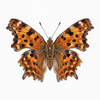
Question Mark Butterfly (Polygonia interrogationis): Identification, Habits, and How to Attract It
, by Andrew Norouzian, 5 min reading time
, by Andrew Norouzian, 5 min reading time
Identify the question mark butterfly (Polygonia interrogationis), learn what its caterpillars eat, and attract it with host trees from Flowing Well Tree Farm.
Flip over the wings of a resting question mark butterfly (Polygonia interrogationis) and you’ll see how it got its name: a tiny silver mark on the underside of the hindwing that looks like a punctuation mark, curve and dot included. With its ragged wing edges and leaf-like camouflage, it is one of the most distinctive butterflies in eastern North America, and one you can invite into your yard with the right trees. At Flowing Well Tree Farm, we love helping gardeners plant for wildlife, and this butterfly is a good reason to grow trees.
The question mark belongs to the brush-footed butterfly family, Nymphalidae, and to the group known as anglewings(genus Polygonia). Anglewings have jagged, notched wing edges and a tail-like point on each hindwing.
It is a medium-sized butterfly, with a wingspan of roughly 2 to 3 inches.
Similar species: The eastern comma (Polygonia comma) looks similar, but it is usually smaller and its silver mark is a comma without the dot.
The question mark is found across much of eastern North America, from southern Canada down to the Gulf Coast, including Florida (more often in the northern and central parts of the state than in the far south). Look for it in woodland edges, parks, gardens, and streamsides, especially where trees are nearby.
Question mark caterpillars feed mainly on trees and shrubs, including:
This makes the question mark a good example of a butterfly that depends on native trees, not just flowers.
Unlike many garden butterflies, adult question marks rarely visit flowers. They are far more likely to feed on:
Occasionally they will sip nectar from flowers, but sap and fruit are their main food.
Want to welcome question marks and other native butterflies? Flowing Well Tree Farm grows healthy trees and plants, and you can order them online at www.flowingwelltreefarm.com.
Explore our selection of:
Shop trees and butterfly-friendly plants online today →
Why is it called the question mark butterfly?
It is named for the silvery mark on the underside of its hindwing, which looks like a question mark.
Is the question mark butterfly rare?
No. It is widespread in the eastern U.S., though it can be easy to overlook because its underside looks like a dead leaf.
What is the host plant for the question mark butterfly?
Mainly elms and hackberries, along with nettles, false nettle, and hops.
Do question mark butterflies visit flowers?
Rarely. They prefer tree sap, rotting fruit, and moist soil.
Do question mark butterflies hibernate?
Yes. The fall generation overwinters as adults, sheltering in bark crevices or leaf litter.
The question mark butterfly (Polygonia interrogationis) is a reminder that a good butterfly garden includes more than flowers. Plant host trees, keep a little fruit and mud on hand, and avoid pesticides, and you may be rewarded with a visitor that looks like a leaf until it opens its wings. Start building your habitat today at Flowing Well Tree Farm.


