Tropic Beauty Peach (Prunus persica) — Florida Guard Rootstock — Locally Grown in Pierson, Florida at Flowing Well Tree Farm
Low-Chill Fruit Tree • Early Season Peach Variety • High-Yield Orchard Stone Fruit • Florida-Grown Specialty Rootstock
Tropic Beauty Peach (Prunus persica) on Florida Guard rootstock is one of the most reliable low-chill peach systems for warm southern climates. Selected for early ripening, strong fruit quality, and dependable production in mild winters, Tropic Beauty is widely used in home orchards, commercial plantings, and edible landscapes across Florida and the Gulf Coast.
When you buy Tropic Beauty Peach here, you're not getting weak, out-of-region nursery stock—you’re getting locally grown, Florida-adapted trees produced in Pierson and established on Florida Guard rootstock designed specifically for heat, humidity, sandy soils, and variable winter chill conditions.
That matters for long-term success. Rootstock selection is everything in peaches. Florida Guard rootstock improves adaptation, strengthens root systems, and increases long-term survivability in Florida’s challenging growing environment compared to generic nursery stock.
This is direct-from-grower edible orchard stock. Visit the farm, see how our stone fruit trees are grown, and receive practical guidance on pruning systems, spray schedules, spacing, and long-term orchard production planning.
Tropic Beauty is especially valued because it provides one of the earliest and most reliable peach harvests in warm climates.
Why Florida Guard Rootstock Matters
Starting with Florida-adapted rootstock provides key advantages:
Better adaptation to Florida heat and humidity
Improved performance in sandy soils
Stronger root system development
Increased drought and stress tolerance
More reliable long-term tree survival
Better anchoring and nutrient uptake efficiency
It creates a stronger foundation for orchard success in low-chill regions.
Fruit Quality & Production Value
Tropic Beauty is a proven early-season peach variety:
Medium to large red-blushed peaches
Sweet, juicy yellow flesh
Excellent fresh-eating quality
Early ripening for Florida climates
Reliable annual production with proper care
Strong flavor balance for fresh use and preserves
It is one of the most widely planted low-chill peaches in the Southeast.
Orchard Performance & Growth Habit
A productive deciduous fruit tree:
10–15 ft mature height (can be maintained smaller with pruning)
10–15 ft spread
Upright, open canopy structure
Fast growth under proper conditions
High fruiting potential on proper pruning cycles
It is ideal for structured backyard orchards and small farm systems.
Climate & Site Adaptability
Tropic Beauty performs best in warm, mild-winter regions:
Requires low winter chill hours
Performs well in Florida and Gulf Coast climates
Prefers full sun conditions
Sensitive to prolonged waterlogging
Performs best in well-drained soils
Benefits from airflow to reduce disease pressure
It is specifically selected for southern orchard systems.
USDA Growing Zones
Best suited for Zones 8–9, performing strongly throughout Florida and similar warm southern climates with low chill accumulation.
Light Requirements
For best fruit production:
Full sun required
Minimum 6–8 hours of direct sunlight daily
Reduced fruiting in shaded locations
Soil & Site Requirements
Adapted to orchard production soils:
Prefers well-drained sandy or loamy soils
Performs best in slightly acidic conditions
Avoid heavy or poorly drained soils
Benefits from organic matter and mulch
Raised beds or berms recommended in wet sites
Planting Guidance (Grower Recommended)
For best establishment and production:
Plant in full sun orchard rows
Dig hole 2–3× wider than root ball
Plant at original soil depth
Water thoroughly after planting
Apply mulch while keeping away from trunk base
Space appropriately for pruning and airflow (10–15 ft typical)
Establish pruning structure early for fruit production
We can assist with orchard layout, spray timing, and pruning system design.
Watering & Establishment
Water regularly during the first 1–2 growing seasons. Once established, Tropic Beauty requires consistent moisture during fruit development but benefits from well-drained conditions.
Fertilizer
Moderate feeding recommended:
Balanced fertilizer during active growth
Split applications during growing season
Avoid excessive nitrogen (can reduce fruit quality)
Organic compost improves soil structure and productivity
Pruning & Maintenance
High-priority management for production:
Annual dormant pruning required
Open-center pruning system recommended
Remove dead, crossing, or inward growth
Maintain airflow for disease prevention
Pruning directly impacts fruit size and yield
Disease & Orchard Management Notes
Peaches in Florida require active management:
Monitor for fungal pressure in humid conditions
Ensure good spacing and airflow
Maintain clean orchard floor with mulch control
Proper pruning reduces disease risk significantly
Why This Is a Smarter Long-Term Investment
✔ Locally grown in Florida for superior adaptation
✔ Low-chill peach variety for southern climates
✔ Grafted on Florida Guard rootstock for stronger performance
✔ Early-season, high-quality fruit production
✔ Proven orchard variety for Florida growers
✔ Strong edible landscape and small farm value
✔ Grower-direct orchard guidance and support
✔ Optimized for sandy soils and heat stress conditions
The Real Value
This isn’t just a peach tree—it’s a managed fruit production system built for Florida.
You’re not simply planting Tropic Beauty. You’re building a structured orchard, producing early-season stone fruit, and investing in a rootstock-driven system designed to survive heat, humidity, and low-chill winters while still delivering reliable harvests year after year.
Loquat (Eriobotrya japonica) — Locally Grown in Pierson, Florida at Flowing Well Tree FarmEvergreen Fruiting Tree • Edible Subtropical Crop • Early Spring Fruit Producer • Florida-Grown Landscape & Food Forest Species
Loquat (Eriobotrya japonica) is one of the most dependable evergreen fruiting trees for Florida landscapes, valued for its glossy tropical foliage, fragrant fall and winter flowers, and sweet golden-orange fruit that ripens in early spring when few other fruits are available. It is widely used in edible landscapes, food forests, and mixed-use residential plantings across the southeastern United States.
At Flowing Well Tree Farm in Pierson, Florida, we grow Loquat as premium edible landscape stock selected for strong branching structure, reliable fruiting potential, and long-term performance in Florida’s heat, humidity, sandy soils, and seasonal weather cycles. Each tree is conditioned from an early stage in real Florida field environments, not protected greenhouse conditions.
When you buy Loquat here, you’re not getting weak ornamental nursery filler—you’re getting locally grown, Florida-adapted trees built for real-world productivity including drought cycles, heavy rainfall, coastal wind exposure, and nutrient-variable soils.
That local adaptation matters. Loquat performs best when grown in Florida conditions from the start, developing stronger root systems, better fruiting consistency, and improved long-term canopy resilience.
Why Locally Grown Matters for Loquat
Starting with Florida-grown stock provides key advantages:
Faster establishment in sandy, well-drained soils
Improved heat and humidity tolerance
Stronger long-term fruit production consistency
Better drought resilience once established
Reduced transplant shock in Florida landscapes
More reliable evergreen canopy development
This creates a stronger, more productive edible landscape tree.
Fruit, Edible & Seasonal Value
Loquat is highly valued as an early-season fruit producer:
Sweet, tangy golden-orange fruit ripening in late winter to early spring
One of the earliest fruiting trees in Florida landscapes
Fresh eating fruit with juice, jam, and culinary uses
Highly productive in warm subtropical climates
Excellent for home orchards and food forests
Reliable seasonal harvest when other fruits are not in season
It fills an important early food gap in edible systems.
Flowering & Ornamental Value
Loquat is also a beautiful evergreen ornamental:
Fragrant white flower clusters in fall and early winter
Strong honey-like scent attracting pollinators
Dense glossy evergreen foliage year-round
Attractive tropical-subtropical landscape appearance
Excellent accent tree in edible and ornamental designs
It combines productivity with strong visual appeal.
Wildlife & Ecological Importance
Loquat supports multiple ecosystem functions:
Flowers attract bees and native pollinators
Fruit consumed by birds and small mammals
Dense canopy provides nesting and shelter habitat
Enhances biodiversity in urban and suburban landscapes
Supports seasonal wildlife food availability
It functions as both a food crop and habitat tree.
Growth Habit & Landscape Function
Loquat is a versatile evergreen fruit tree:
15–25 ft small to medium evergreen tree
Rounded canopy with dense branching structure
Can be trained as single trunk or multi-stem form
Responds well to pruning and shaping
Excellent for edible hedgerows or specimen planting
Long-lived with consistent productivity
It fits well into both formal and naturalized landscapes.
Climate & Site Adaptability
Loquat performs strongly in Florida conditions:
Thrives in full sun to partial shade
Highly heat and humidity tolerant
Performs well in sandy and loamy soils
Moderate drought tolerance once established
Handles coastal and inland environments
Adaptable to residential and orchard systems
It is one of the most reliable subtropical fruit trees for Florida.
USDA Growing Zones
Best suited for Zones 8–11, with excellent performance throughout Florida and the Gulf Coast region.
Light Requirements
For best fruit production:
Full sun produces strongest flowering and fruiting
Partial shade acceptable but reduces yield
Sun exposure improves canopy density and productivity
Ideal for open orchard or landscape planting
Soil & Site Requirements
Adapted to Florida soils:
Prefers well-drained sandy or loamy soils
Tolerates low to moderate fertility conditions
Performs best with organic matter and mulch
Avoid waterlogged or poorly drained sites
Benefits from consistent moisture during fruiting season
Planting Guidance (Grower Recommended)
For best long-term performance:
Plant in full sun for maximum fruit production
Dig hole 2–3× wider than root ball
Set at original soil depth
Water deeply after planting
Apply mulch to conserve moisture and stabilize soil
Space 12–20 ft apart for orchard or specimen use
Light pruning improves structure and fruit access
We can assist with food forest design, edible landscape planning, and orchard layout systems.
Watering & Establishment
Water regularly during the first 1–2 growing seasons. Once established, Loquat becomes moderately drought tolerant and performs well in Florida’s natural rainfall cycles.
Fertilizer
Moderate feeding requirements:
Light balanced fertilizer supports flowering and fruiting
Compost improves soil health and yield consistency
Avoid excessive nitrogen (can reduce fruit production)
Performs best in steady, low-input systems
Pruning & Maintenance
Low to moderate maintenance:
Responds well to pruning and shaping
Can be maintained as compact or open canopy tree
Pruning improves fruit access and airflow
Minimal upkeep once established
Long-lived with consistent production cycles
Why This Is a Smarter Long-Term Investment
✔ Locally grown in Florida for superior adaptation✔ Reliable early-season edible fruit tree✔ Excellent evergreen ornamental landscape value✔ Strong pollinator-supporting flowering species✔ Highly adaptable to Florida soils and climate✔ Low maintenance and long-lived productivity✔ Ideal for food forests and edible hedgerows✔ Grower-direct quality for real Florida conditions
The Real Value
This isn’t just a fruit tree—it’s a dual-purpose evergreen system that provides food, habitat, and year-round landscape structure.
When you plant Loquat, you’re investing in an early-harvest edible tree that strengthens food security while enhancing the beauty and ecological function of Florida landscapes.
Native Persimmon Tree (Diospyros virginiana) — Locally Grown in Pierson, Florida at Flowing Well Tree FarmNative Fruit-Producing Shade Tree • Wildlife Superfood Species • Long-Lived Hardwood Canopy Tree • Florida-Grown Homestead, Food Forest & Restoration Staple
Native Persimmon Tree (Diospyros virginiana) is one of the most valuable and resilient native fruiting trees in North America, prized for its sweet, honey-like fruit, exceptional wildlife value, and long-term durability in challenging landscapes. Naturally found across Florida woodlands, uplands, and disturbed areas, Native Persimmon is a cornerstone species for food forests, homesteads, wildlife plantings, and ecological restoration projects.
At Flowing Well Tree Farm in Pierson, Florida, we grow Native Persimmon as premium native fruiting stock selected for strong taproot development, vigorous establishment, and long-term performance in Florida’s heat, humidity, sandy soils, and seasonal rainfall patterns. Each tree is field-grown under real Florida conditions to ensure resilience, productivity, and long-term landscape success.
When you buy Native Persimmon here, you are not receiving weak ornamental nursery stock—you are getting Florida-adapted native trees built for survival, fruit production, and ecological performance.
That local adaptation matters. Diospyros virginiana develops stronger root systems, improved drought tolerance, and more consistent fruiting when grown under Florida conditions from the beginning.
Why Locally Grown Matters for Native Persimmon
Starting with Florida-grown stock provides key advantages:
Stronger taproot development for long-term stability
Improved heat and humidity tolerance
Better drought resistance once established
Higher survival rates in restoration and food forest systems
More reliable flowering and fruit production
Stronger adaptation to Florida’s sandy soils and seasonal weather
This creates a durable native fruit tree capable of thriving for generations.
Fruit Production & Edible Value
Native Persimmon produces one of Florida’s most unique native fruits:
Sweet, custard-like fruit when fully ripe and soft
Flavor profile often described as honey, apricot, or caramel-like
Best eaten after natural ripening or light frost exposure
Excellent for fresh eating, baking, puddings, and preserves
High wildlife value fruit production
Heavy seasonal drop when mature
It is one of the most beloved native wild fruits in the Southeast.
Wildlife & Ecological Importance
Native Persimmon is a powerhouse wildlife species:
Fruit is highly favored by deer, raccoons, foxes, and birds
Supports over 40+ species of native wildlife in some ecosystems
Provides critical late-season food resources
Flowers attract native pollinators and beneficial insects
Dense branching offers nesting and shelter habitat
Enhances biodiversity in natural and managed landscapes
It is one of the most important native food trees in Florida ecosystems.
Growth Habit & Structural Function
Native Persimmon is a medium-sized deciduous hardwood:
30–60 ft mature height depending on site conditions
Upright central leader with rounded canopy at maturity
Moderate growth rate with strong long-term stability
Deep taproot system provides excellent anchoring
Long-lived native fruiting hardwood species
Excellent shade and habitat tree for large landscapes
It functions as both a food producer and structural canopy tree.
Climate & Site Adaptability
Native Persimmon is highly adaptable across Florida:
Native throughout Florida and the southeastern United States
Excellent heat and humidity tolerance
Thrives in sandy, loamy, and disturbed soils
Strong drought tolerance once established
Performs well in uplands, edges, and open landscapes
Highly adaptable to naturalized and restoration environments
It is one of the most resilient native fruit trees available.
USDA Growing Zones
Best suited for Zones 5–9, with exceptional performance throughout Florida and the southeastern United States.
Light Requirements
For best fruit production:
Full sun preferred for maximum flowering and fruiting
Tolerates partial shade in natural woodland settings
Sun exposure increases fruit yield and sweetness
Ideal for food forests, homesteads, and open landscapes
Soil & Site Requirements
Highly adaptable native species:
Thrives in sandy Florida soils
Tolerates poor fertility and disturbed sites
Performs best in well-drained soils
Benefits from organic matter during establishment
Avoid prolonged standing water in poorly drained areas
Mulch helps support young root development
Planting Guidance (Grower Recommended)
For best long-term performance:
Plant in full sun whenever possible
Dig hole 2–3× wider than root ball
Set at original soil depth
Water deeply after planting
Apply mulch to conserve moisture and suppress weeds
Space 20–30 ft apart for canopy development
Allow room for natural fruit drop and wildlife activity
We can assist with food forest design, orchard integration, wildlife habitat planning, and native restoration projects.
Watering & Establishment
Water regularly during the first 1–2 growing seasons. Once established, Native Persimmon becomes highly drought tolerant and thrives under Florida’s natural rainfall cycles.
Fertilizer
Low input requirements:
Minimal fertilization needed once established
Organic compost supports early growth and fruiting
Balanced nutrients improve long-term productivity
Avoid excessive nitrogen to prevent excessive vegetative growth
Pruning & Maintenance
Low maintenance native fruit tree:
Prune young trees to establish strong structure
Remove crossing or weak branches as needed
Can be trained as single trunk or multi-trunk form
Naturally develops a strong, balanced canopy
Long-lived and highly resilient once established
Why This Is a Smarter Long-Term Investment
✔ Locally grown in Florida for maximum adaptation
✔ Native superfruit tree with exceptional wildlife value
✔ Sweet, high-value edible fruit production
✔ Strong drought and heat tolerance
✔ Excellent for food forests and homesteads
✔ Deep taproot provides long-term stability
✔ Critical wildlife food source species
✔ Grower-direct quality for Florida conditions
The Real Value
This isn’t just a fruit tree—it’s a long-term ecological and food-producing foundation species that supports wildlife, people, and landscape resilience simultaneously.
When you plant Native Persimmon, you’re investing in a Florida-native tree that delivers sweet seasonal harvests, strong canopy development, and lasting ecological value while strengthening homesteads, food forests, and natural ecosystems for generations to come.
Arbequina Olive Tree (Olea europaea ‘Arbequina’) — Locally Grown in Pierson, Florida at Flowing Well Tree Farm
Fast-Growing Edible Olive • Mediterranean Landscape Tree • Ornamental & Fruiting Value • Florida-Grown Premium Stock
When you buy Arbequina Olive Trees here, you’re not getting fragile, greenhouse-raised ornamental stock—you’re getting locally grown, field-conditioned trees produced in Pierson, already adapted to Florida heat, humidity, sandy soils, seasonal rainfall, and real-world landscape conditions.
That matters for edible landscape systems and commercial plantings. Locally grown Arbequina establishes faster, builds stronger root systems, and transitions more smoothly into Florida landscapes because it’s already been raised under the same environmental stress it will face after planting.
This is direct-from-grower material. You can visit the farm, see how our olive trees are grown, and get real guidance on spacing, orchard layout, and landscape design from people producing them at scale for both ornamental and edible applications.
Arbequina Olive is especially valuable because it delivers edible production, ornamental structure, and drought-tolerant performance in one of the most versatile Mediterranean trees available for warm climates.
Why Locally Grown Matters for Olive Trees
Starting with Florida-grown stock makes a noticeable difference:
Faster establishment in sandy soilsStronger root development under heat and humidityImproved long-term drought toleranceMore reliable transition from container to landscapeBetter survival rates with lower maintenance inputs
It’s a stronger foundation for edible landscapes and long-term plantings.
Edible + Ornamental Value in One Tree
Arbequina Olive is widely used because it does more than one job:
Produces high-quality olives for oil and culinary useProvides a refined Mediterranean landscape lookWorks as a specimen or orchard-style plantingFits both residential and commercial design systemsPerforms well in modern low-water landscapes
It’s both a production tree and a design feature.
Mediterranean Look, Florida Performance
One of its biggest advantages is its aesthetic:
Silvery-green evergreen foliageClean, compact branching structureNaturally elegant, sculptural formFits resort, courtyard, and high-end landscape designMaintains year-round visual appeal
It brings a Mediterranean character without high maintenance requirements.
Edible Production Value
Arbequina is one of the most widely planted olive varieties for a reason:
Reliable fruit production in warm climatesHigh-quality olives for oil productionEarly bearing compared to many olive varietiesSuitable for small orchards or mixed landscapesStrong long-term productivity potential
It is commonly used in both boutique agriculture and landscape food systems.
Climate & Site Adaptability
This is a tough, adaptable tree once established:
Performs well in Florida heat and humidityTolerates sandy, well-drained soilsHandles seasonal drought once establishedBest in full sun conditionsNot suited for heavy, waterlogged soils
It thrives in open, sunny landscapes where many ornamentals struggle.
USDA Growing Zones
Best suited for Zones 8–10, performing strongly across Florida and similar warm climates.
Mature Size & Growth Habit
Compact, manageable structure:
15–20 ft typical mature heightBroad, rounded Mediterranean canopyCan be maintained smaller with pruningSuitable for orchards, courtyards, and specimen planting
Light Requirements
Full sun is essential for best growth and fruiting:
Full sun for best production and formReduced performance in heavy shade
Soil & Site Requirements
Highly adaptable within proper drainage:
Prefers well-drained sandy or loamy soilsTolerates low fertility conditionsRequires good drainage for long-term healthPerforms well in landscape and orchard settings
Planting Guidance (Grower Recommended)
We focus on establishment success and long-term production:
Plant in full sun locationsEnsure well-drained soil conditionsDig hole 2–3× wider than root ballPlant at original container depthWater deeply after plantingMulch to conserve moisture (keep away from trunk)Maintain consistent watering during establishment
We can assist with orchard spacing, hedging layouts, or specimen placement depending on project goals.
Watering & Establishment
Water regularly during the first growing season to establish strong roots. Once established, Arbequina Olive becomes highly drought tolerant and requires only occasional irrigation during extended dry periods.
Fertilizer
Light, balanced fertilization in spring if neededAvoid excessive fertilization to maintain natural hardinessPerforms well in low-input landscape systems
Pruning & Maintenance
Low-maintenance and easy to manage:
Prune to maintain shape or orchard structureResponds well to training and canopy shapingCan be maintained as specimen or production treeMinimal long-term maintenance once established
Why This Is a Smarter Long-Term Investment
✔ Locally grown in Florida conditions for faster establishment✔ Dual-purpose: edible production + ornamental landscape value✔ Strong performance in heat, humidity, and sandy soils✔ Ideal for both residential and commercial projects✔ Long-lived Mediterranean tree for permanent landscapes✔ Low maintenance once established✔ Grower-direct expertise for orchard and landscape planning
The Real Value
This isn’t just a landscape tree—it’s a productive, design-forward edible system built for Florida conditions.
You’re not just planting an ornamental. You’re establishing a long-term, drought-tolerant Mediterranean tree that delivers both landscape beauty and food production potential for years to come.
Panama Red Passion Fruit — Locally Grown in Pierson, Florida at Flowing Well Tree Farm
Premium Tropical Vine • High-Yield Fruit • Ornamental Blooming Climber • Florida-Adapted from the Start
When you buy Passion Fruit ‘Panama Red’ here, you’re not getting a fragile, long-haul shipped vine—you’re getting plants grown directly in Pierson, raised in real Florida heat, humidity, rainfall patterns, and storm-season conditions from day one.
That matters. Locally grown vines establish faster, root deeper, and adapt more predictably to backyard trellises, fences, and orchard systems because they’ve already been conditioned in the same climate they’re going into.
This is direct-from-grower material. You can visit the farm, see how tropical fruit vines are produced, and get real guidance from the people who grow them—not a reseller reading from a label. That means better planting decisions, better training advice, and better long-term fruit production.
‘Panama Red’ is one of the most rewarding passion fruit varieties because it delivers both ornamental beauty and consistent, high-quality fruit in warm climates.
Why Locally Grown Makes the Difference
Because these vines are grown outdoors in Florida conditions, they’re already adapted to:
Heat, humidity, and heavy rainfall cycles
Fast summer growth patterns
High disease and pest pressure environments
Strong seasonal flowering and fruiting cycles
That translates into:
Faster establishment
Reduced transplant shock
Stronger early vine development
More reliable flowering and fruit set
It’s a head start on productivity and landscape success.
Sweet, Aromatic Tropical Fruit
Panama Red produces vibrant red-purple passion fruit with rich aroma and bold tropical flavor.
Perfect for:
Fresh eating
Juices and smoothies
Desserts and sorbets
Sauces, syrups, and cocktails
Culinary garnishes
The fruit combines sweetness and acidity in a way that makes it one of the most desirable tropical flavors you can grow at home.
Exotic Flowers with Real Landscape Impact
Before fruiting, this vine produces large, intricate tropical flowers that:
Attract bees, butterflies, and hummingbirds
Add strong visual interest to structures
Bloom throughout the warm growing season
Elevate edible landscapes into ornamental displays
It’s a plant that performs in both beauty and production.
USDA Growing Zones
Best suited for Zones 9–11. In cooler climates, it can be grown in containers and protected from frost.
Growth Habit & Landscape Use
A fast-growing climbing vine reaching significant coverage quickly when supported:
Trellises
Fences
Arbors
Pergolas
Privacy screens and edible green walls
With proper structure, it becomes a dense, productive canopy.
Sun Requirements
Full sun is essential for maximum flowering and fruit production. At least 6–8 hours daily is ideal.
Soil & Site Adaptability
Performs best in:
Well-drained sandy or loamy soils
Fertile, organic-rich planting areas
Slightly acidic to neutral conditions
Avoid poorly drained or constantly wet soils, which reduce vine health and productivity.
Planting Guidance (Grower Recommended)
We focus on real-world success, not just installation:
Choose a warm, sunny site with strong support
Dig a hole twice as wide as the root ball
Plant at original container depth
Water deeply after planting
Apply mulch, keeping it away from the stem
Install trellis or support immediately for training
If you visit the farm, we can help design placement for airflow, sun exposure, and long-term vine structure.
Watering & Establishment
Keep soil evenly moist during establishment. Once rooted in, vines benefit from deep watering during dry periods and fruit development to maximize yield and fruit quality.
Fertilizer
Feed in early spring and mid-summer with a balanced or fruiting fertilizer. Avoid excess nitrogen, which encourages vine growth at the expense of flowers and fruit.
Support & Pruning (Key to Productivity)
This is a vigorous climbing vine that requires structure:
Provide strong trellis, fence, or arbor support
Prune lightly to control growth and improve airflow
Remove tangled or weak growth to encourage fruiting wood
Maintain open structure for sunlight penetration
Good training equals better harvests.
Why This Is a Smarter Long-Term Investment
✔ Grown locally in Florida tropical conditions from the start✔ Faster establishment and stronger root systems✔ Direct grower expertise for planting and training success✔ Reliable flowering and fruiting performance in warm climates✔ High ornamental + edible value in one vine✔ Better adaptation than out-of-region nursery stock✔ Opportunity to visit, learn, and select in person
The Real Advantage
This isn’t just a passion fruit purchase—it’s a long-term edible landscape system built on local experience and real Florida-grown stock.
You’re not just planting a vine. You’re planting a fast-growing tropical harvest system that improves every season.
Passion Fruit ‘Bounty’ (Passiflora edulis ‘Bounty’) — Locally Grown in Pierson, Florida at Flowing Well Tree Farm
Fast-Growing Tropical Vine • Large Sweet Fruit • Ornamental Blooms • Florida-Adapted from Day One
When you buy Passion Fruit ‘Bounty’ here, you’re not getting a delicate, long-distance shipped vine—you’re getting plants grown directly in Pierson, raised under real Florida sun, humidity, rainfall, and storm-season conditions from the start.
That matters. Locally grown vines are already conditioned to the environment they’re being planted into, which means faster establishment, stronger early growth, and more reliable flowering and fruiting once in the landscape.
This is direct-from-grower material. You can visit the farm, see how tropical fruit vines are produced and trained, and get real guidance from the people who grow them every day—not generic instructions pulled from a label.
‘Bounty’ is a high-performance passion fruit variety chosen for its combination of vigorous growth, large fruit size, and dependable productivity in warm climates.
Why Locally Grown Makes the Difference
Because these vines are grown outdoors in Florida conditions, they are already adapted to:
Heat, humidity, and heavy rainfall cycles
Rapid summer growth and flowering patterns
High disease and pest pressure environments
Strong seasonal fruiting response
That translates into:
Faster establishment in the home landscape
Reduced transplant shock
Stronger vine structure early on
More consistent flowering and fruit production
It’s a better starting point for long-term success.
Large, Sweet-Tart Tropical Fruit
‘Bounty’ produces big, aromatic passion fruit with a rich sweet-tart tropical flavor.
Perfect for:
Fresh eating
Juices and smoothies
Desserts and sorbets
Syrups and sauces
Culinary use and cocktails
It’s a productive edible vine designed for both flavor and yield.
Exotic Flowers with Real Ornamental Value
Before fruiting, this vine produces intricate, tropical flowers that:
Attract bees, butterflies, and hummingbirds
Add bold ornamental appeal to structures
Bloom throughout warm growing seasons
Elevate edible landscapes into visual focal points
It’s as much a landscape feature as it is a fruit crop.
USDA Growing Zones
Best suited for Zones 9–11. In cooler regions, it can be grown in containers and protected from frost.
Growth Habit & Landscape Use
A vigorous climbing vine that rapidly covers structures when supported:
Trellises
Fences
Pergolas
Arbors
Edible privacy screens and green walls
With proper training, it becomes a dense, productive canopy.
Sun Requirements
Full sun is essential for best flowering and maximum fruit production (6–8+ hours daily).
Soil & Site Adaptability
Performs best in:
Well-drained sandy or loamy soils
Fertile, organic-rich garden beds
Slightly acidic to neutral conditions
Avoid waterlogged or poorly drained sites, which reduce plant vigor.
Planting Guidance (Grower Recommended)
We focus on setting vines up for long-term productivity:
Choose a warm, sunny site with strong structural support
Dig a hole twice as wide as the root ball
Plant at original container depth
Water deeply after planting
Apply mulch while keeping it off the stem
Install trellis or arbor immediately for training
If you visit the farm, we can help plan spacing and structure based on your property conditions.
Watering & Establishment
Keep soil evenly moist during establishment. Once rooted in, vines benefit from deep watering during dry periods and fruiting cycles to support yield and fruit quality.
Fertilizer
Feed in early spring and mid-summer using a balanced or fruiting fertilizer. Avoid excess nitrogen, which promotes vine growth at the expense of flowers and fruit.
Support & Pruning (Key to Productivity)
This is a vigorous vine that requires structure and management:
Provide a strong trellis, fence, or arbor
Prune lightly to maintain airflow and control growth
Remove tangled or weak growth to encourage fruiting wood
Maintain open structure for sunlight penetration
Proper training directly improves harvest quality and consistency.
Why This Is a Smarter Long-Term Investment
✔ Grown locally in Florida tropical conditions from the start✔ Faster establishment with stronger root development✔ Direct grower expertise for planting and training success✔ Proven performance in heat, humidity, and rainfall cycles✔ High ornamental + edible value in one plant✔ Reliable production in home orchard systems✔ Opportunity to visit, learn, and select in person
The Real Advantage
This isn’t just a passion fruit vine—it’s a high-performance edible landscape system built from locally grown, climate-adapted stock.
You’re not just planting a vine. You’re planting a long-term tropical harvest system that gets better every season.
Fig ‘LSU Gold’ (Ficus carica ‘LSU Gold’) — Locally Grown in Pierson, Florida at Flowing Well Tree Farm
Premium Edible Fruit Tree • Heat-Tolerant Fig Variety • High-Yield Orchard Tree • Florida-Grown Fruit Stock
Fig ‘LSU Gold’ (Ficus carica ‘LSU Gold’) is a highly regarded fig variety developed by Louisiana State University for exceptional performance in hot, humid southern climates. Known for its golden-yellow skin, rich sweet flavor, and reliable production, ‘LSU Gold’ is one of the most dependable fig cultivars for home orchards and edible landscapes throughout Florida and the Southeast.
When you buy Fig ‘LSU Gold’ here, you're not getting stressed, long-distance nursery stock—you’re getting locally grown, Florida-adapted plants produced in Pierson and conditioned for real Florida conditions including heat, humidity, sandy soils, and seasonal rainfall swings.
That matters for long-term success. Locally grown fig trees establish faster, develop stronger root systems, and transition more smoothly into productive fruiting cycles under Florida growing conditions.
This is direct-from-grower edible fruit stock. Visit the farm, see how our fruit trees are grown, and receive practical guidance on orchard design, pruning systems, and long-term edible landscape planning.
Fig ‘LSU Gold’ is especially valued for its reliable production, attractive fruit quality, and strong performance in warm coastal climates.
Why Locally Grown Matters for Fig Trees
Starting with Florida-grown stock provides key advantages:
Faster root establishment in sandy soils
Better adaptation to heat and humidity
Reduced transplant shock
Stronger early structural growth
Improved long-term fruiting consistency
Better survival in real landscape conditions
It creates a stronger foundation for productive orchard development.
Fruit Quality & Production Value
‘LSU Gold’ is known for its high-quality fruit and dependable yields:
Golden-yellow skin with attractive appearance
Sweet, rich, berry-like flavor profile
Excellent fresh eating quality
Reliable annual production in warm climates
Good for preserves and culinary use
Consistent performance in humid southern regions
It is considered one of the most dependable LSU fig releases for Florida growers.
Growth Habit & Landscape Use
A manageable and productive fruit tree:
8–12 ft mature height (easily maintained smaller with pruning)
8–12 ft spread
Multi-stem or small tree form
Well-suited for backyard orchards
Ideal for edible landscaping and small farms
Its compact size makes it easy to integrate into residential food systems.
Climate & Site Adaptability
Fig ‘LSU Gold’ performs exceptionally well in southern climates:
Thrives in warm, humid environments
Excellent heat tolerance
Performs well in Florida sandy soils
Prefers well-drained planting sites
More reliable than many traditional fig varieties in the Southeast
Handles seasonal drought once established
It is a strong choice for Florida’s challenging growing conditions.
USDA Growing Zones
Best suited for Zones 7–10, performing strongly throughout Florida and much of the southeastern United States.
Light Requirements
For best fruit production:
Full sun preferred
Minimum 6–8 hours of direct sunlight daily
Reduced yields in shaded locations
Soil & Site Requirements
Adapted to common Florida orchard soils:
Prefers well-drained sandy or loamy soils
Tolerates moderate soil fertility
Performs best in slightly elevated sites
Avoid heavy, poorly drained soils
Benefits from organic mulch and soil improvement
Planting Guidance (Grower Recommended)
For best establishment and production:
Plant in full sun locations
Dig planting hole 2–3× wider than root ball
Plant at original soil depth
Water thoroughly after planting
Apply mulch while keeping away from trunk
Space for mature canopy development
Prune lightly to establish structure and airflow
We can assist with orchard layout design, pruning strategy, and edible landscape planning.
Watering & Establishment
Water regularly during the first growing season. Once established, Fig ‘LSU Gold’ becomes moderately drought tolerant and performs well with minimal supplemental irrigation.
Fertilizer
Moderate feeding recommended:
Light balanced fertilizer during active growth
Avoid excessive nitrogen to promote fruiting
Organic compost supports long-term soil health
Consistent nutrition improves yields
Pruning & Maintenance
Low to moderate maintenance:
Prune during dormant season to shape and control size
Remove dead or crowded branches
Maintain open canopy for sunlight penetration
Can be trained as shrub or small tree form
Why This Is a Smarter Long-Term Investment
✔ Locally grown in Florida for superior adaptation
✔ High-performing LSU-developed fig variety
✔ Reliable fruit production in hot, humid climates
✔ Excellent edible landscape tree
✔ Sweet, high-quality golden fruit
✔ Compact and easy to manage size
✔ Strong performance in Southeast conditions
✔ Grower-direct orchard support and guidance
The Real Value
This isn’t just a fruit tree—it’s a reliable food-producing system for your landscape.
You’re not simply planting a fig. You’re creating a productive edible landscape, building long-term fruit production, and investing in a resilient tree that provides harvests, shade, and value season after season.
Fignomenal® Fig (Ficus carica ‘PT-DF-14’) — Locally Grown in Pierson, Florida at Flowing Well Tree Farm
Edible Fruit Tree • Naturally Compact Patio Fig • Heavy-Producing Dwarf Variety • Florida-Grown Fruit Stock
Fignomenal® Fig (Ficus carica 'PT-DF-14') is an exceptional dwarf fig variety that brings full-sized fig production to even the smallest gardens, patios, balconies, and edible landscapes. Bred specifically for compact growth without sacrificing fruit quality, Fignomenal produces an abundance of sweet, richly flavored figs on a naturally dense, well-branched plant that rarely requires extensive pruning. Its manageable size and high productivity have made it one of the most popular container fig varieties available today.
At Flowing Well Tree Farm in Pierson, Florida, we grow Fignomenal® Fig as premium Florida-grown fruit stock selected for vigorous root development, healthy branching, and reliable performance in Florida's warm climate. Every plant is conditioned under real Florida growing conditions, developing the strength needed to handle heat, humidity, sandy soils, and seasonal weather patterns before ever reaching your landscape.
When you buy Fignomenal® Fig here, you're not receiving stressed nursery stock shipped across the country—you’re getting locally grown, Florida-adapted plants that establish quickly and begin producing sooner.
That local adaptation makes a difference. Florida-grown figs develop stronger root systems, experience less transplant shock, and adapt more rapidly to Florida's demanding growing conditions, resulting in healthier plants and more dependable fruit production.
This is direct-from-grower fruit stock. Visit our farm to see our growing practices firsthand and receive practical advice on planting, pruning, container growing, and creating productive edible landscapes.
Fignomenal® is especially valued because it delivers impressive harvests while remaining compact enough for nearly any space.
Why Locally Grown Matters for Fig Trees
Starting with Florida-grown stock provides significant advantages:
Faster establishment in sandy Florida soils
Stronger root development before planting
Better tolerance to Florida heat and humidity
Reduced transplant stress
Improved long-term fruit production
Better adaptation to seasonal rainfall and drought cycles
Locally grown trees simply establish faster and produce more consistently.
Fruit Quality & Production Value
Fignomenal® produces an impressive crop despite its compact size.
Features include:
Sweet, rich fig flavor
Smooth reddish-pink interior
Medium-sized brown to purple fruit
Heavy fruit production throughout the growing season
Excellent fresh eating quality
Ideal for preserves, jams, baking, and drying
Produces fruit at a young age
Reliable harvests in warm climates
For many homeowners, Fignomenal® delivers orchard-quality fruit without requiring orchard-sized space.
Compact Growth & Landscape Value
One of the biggest advantages of Fignomenal® is its naturally dwarf growth habit.
Mature characteristics include:
Approximately 2–4 ft tall
2–4 ft wide
Dense branching with attractive foliage
Ideal for containers and raised beds
Excellent patio specimen
Fits beautifully into edible landscapes
Easy to maintain with minimal pruning
Its compact size makes it one of the easiest fruit trees for homeowners with limited growing space.
Climate & Site Adaptability
Fignomenal® performs exceptionally well throughout Florida when properly established.
It offers:
Excellent heat tolerance
Performs well in high humidity
Moderate drought tolerance after establishment
Suitable for containers or in-ground planting
Adapts well to sandy and loamy soils
Strong performer throughout much of the Southeast
It is one of the best compact figs available for Florida gardeners.
USDA Growing Zones
Best suited for USDA Zones 7–10, with outstanding performance throughout Florida and the southeastern United States.
Light Requirements
For maximum fruit production:
Full sun is recommended
Minimum 6–8 hours of direct sunlight daily
More sunlight produces heavier crops
Morning sun and afternoon sun are both beneficial
Proper sunlight is the key to abundant fruit production.
Soil & Site Requirements
Fignomenal® is adaptable but performs best when planted in:
Well-drained sandy or loamy soils
Slightly elevated planting locations
Raised beds or containers
Areas with good air circulation
Sites amended with compost during planting
Avoid standing water or poorly drained locations.
Planting Guidance (Grower Recommended)
For best establishment:
Plant in full sun
Dig a planting hole 2–3× wider than the root ball
Plant at original container depth
Water thoroughly after planting
Apply mulch while keeping it away from the trunk
Space 3–5 ft apart if planting multiple trees
Use quality potting media when growing in containers
We are happy to help design backyard orchards, patio fruit gardens, and edible landscapes that maximize production in any size space.
Watering & Establishment
Water regularly during the first growing season to encourage strong root development.
Once established, Fignomenal® becomes moderately drought tolerant, although consistent watering during fruit production improves fruit size, sweetness, and overall yield.
Container-grown plants may require more frequent irrigation during hot weather.
Fertilizer
Moderate feeding produces excellent results.
Recommended practices include:
Balanced fertilizer during active growth
Organic compost to improve soil structure
Avoid excessive nitrogen, which can reduce fruit production
Feed container plants more frequently due to nutrient leaching
Balanced nutrition supports both healthy growth and abundant fruiting.
Pruning & Maintenance
Very easy to maintain.
Routine care includes:
Light dormant-season pruning
Remove dead or damaged wood
Maintain an open canopy for airflow
Minimal structural pruning required
Easily maintained in decorative containers
Its naturally compact habit requires significantly less maintenance than traditional fig varieties.
Why This Is a Smarter Long-Term Investment
✔ Locally grown in Florida for superior adaptation
✔ Naturally compact—perfect for patios and small landscapes
✔ Heavy-producing dwarf fig variety
✔ Excellent fruit quality with sweet, rich flavor
✔ Ideal for containers or in-ground planting
✔ Heat and humidity tolerant
✔ Low-maintenance once established
✔ Grower-direct quality and expert growing advice
The Real Value
This isn't just a compact fruit tree—it's a complete edible landscape solution.
Fignomenal® allows almost anyone to enjoy homegrown figs, whether you have a backyard orchard, a small urban garden, or simply room for a decorative container on your patio. By planting a locally grown Fignomenal® Fig from Flowing Well Tree Farm, you're investing in years of fresh fruit, beautiful foliage, sustainable home food production, and one of the easiest, most rewarding edible plants you can grow in Florida.
Dwarf Pomegranate (Punica granatum var. nana) — Locally Grown in Pierson, Florida at Flowing Well Tree Farm
Compact Fruiting Shrub • Ornamental Blooming Plant • Heat-Loving Landscape Accent • Florida-Grown Nursery Stock
When you buy Dwarf Pomegranate here, you’re not getting mass-produced retail shrubs grown in different climates—you’re getting locally grown, Florida-acclimated plants produced in Pierson, already adapted to heat, humidity, sandy soils, and intense sun conditions from the start.
That matters with compact fruiting ornamentals. Locally grown stock establishes faster, handles transplant stress better, and transitions more smoothly into Florida landscapes, containers, and small-space gardens.
This is direct-from-grower material. You can visit the farm, see how flowering fruit shrubs are grown and selected, and get real guidance from people who work with these plants in Florida conditions year-round—not generic care instructions.
Dwarf Pomegranate is especially valuable because it delivers high visual impact in a small footprint—combining ornamental flowers, edible-style fruiting, and extreme heat tolerance.
Why Locally Grown Matters
Starting with Florida-grown shrubs improves long-term success:
Faster establishment in heat and sandy soils
Reduced transplant shock in containers and landscapes
Better flowering response in warm climates
Stronger long-term structure and branching habit
More reliable fruiting and bloom cycles
It’s a more dependable foundation for a long-lived ornamental edible shrub.
Brilliant Flowers & Seasonal Color
Dwarf Pomegranate is grown primarily for its ornamental impact:
Bright orange-red blooms from late spring through summer
Long flowering season with continuous color
Strong attraction for pollinators like bees and hummingbirds
High visual impact even at a young age
It functions as a flowering accent plant in nearly any warm-climate landscape.
Ornamental Fruit Display
In addition to blooms, it produces:
Small decorative pomegranates in late summer to fall
Bright seasonal fruit color for landscape interest
Long-lasting ornamental value even after flowering ends
Unique texture and visual appeal in edible landscapes
While fruit is smaller than standard varieties, the ornamental value is exceptional.
USDA Growing Zones
Best suited for Zones 7–11, performing especially well in Florida and other hot, sunny climates.
Mature Size & Growth Habit
A compact, highly manageable shrub:
2–4 ft tall (dwarf form)
2–3 ft wide
Ideal for containers, borders, patios, and small-space edible landscapes.
Light Requirements
Requires full sun (6–8+ hours daily) for:
Maximum flowering
Best fruit color development
Dense, compact growth habit
Soil & Site Requirements
Adaptable but prefers:
Well-draining sandy or loamy soils
Slightly acidic to neutral pH (5.5–7.0)
Added organic matter for best performance
Avoidance of heavy, compacted, or waterlogged soils
Planting Guidance (Grower Recommended)
We emphasize long-term performance in Florida landscapes:
Choose a full sun location with good airflow
Plant at the same depth as the container
Backfill with native soil and water deeply
Apply light mulch, keeping it away from the stem
Space properly for airflow and shape development
Maintain consistent watering during establishment
If you visit the farm, we can help match placement for containers, hedges, or ornamental edible borders.
Watering & Establishment
Water regularly during the first growing season to build a strong root system. Once established, Dwarf Pomegranate is highly drought tolerant and thrives in hot, dry conditions.
Fertilizer
Apply balanced slow-release fertilizer in early spring
Avoid excess nitrogen, which reduces flowering and fruiting
Light feeding is preferred for compact growth and bloom production
Pruning & Maintenance
Low-maintenance ornamental shrub:
Light pruning in late winter to shape
Remove suckers regularly to maintain structure
Thin dense growth to improve airflow and flowering
Minimal intervention needed once established
Why This Is a Smarter Long-Term Investment
✔ Locally grown in Florida conditions for stronger establishment✔ Direct grower expertise for heat-loving ornamentals✔ Long flowering season with high visual impact✔ Compact size ideal for modern landscapes and containers✔ Pollinator-friendly flowering shrub✔ Better adaptation than out-of-region nursery stock✔ Opportunity to visit, learn, and select in person
The Real Value
This isn’t just a small shrub—it’s a high-impact ornamental fruiting plant built for Florida heat and small-space landscapes.
You’re not just planting a plant. You’re adding long-lasting color, structure, and low-maintenance performance to your landscape with a proven warm-climate performer.
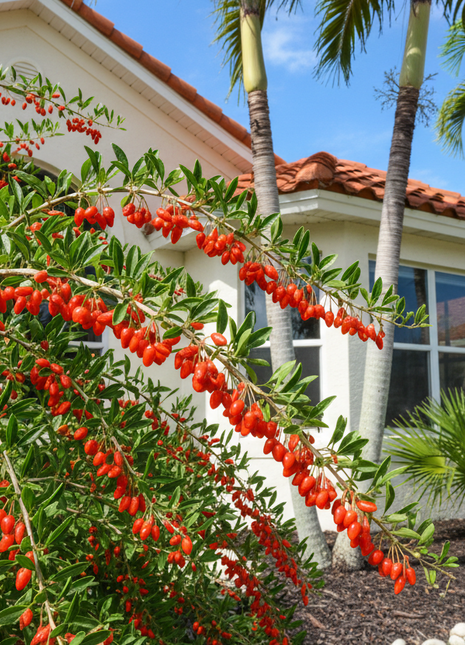
Red Berry Fruiting Shrub — Locally Grown at Flowing Well Tree Farm
Hardy Fruit Shrub • High-Yield Edible Landscape Plant • Drought-Tolerant Once Established • Florida-Grown Stock
When you buy this fruiting shrub here, you’re not getting generic, out-of-region nursery material—you’re getting locally grown plants produced in Pierson, already acclimated to Florida heat, humidity, sandy soils, and seasonal rainfall patterns.
That matters with fast-growing edible shrubs. Locally grown stock establishes faster, handles transplant stress better, and transitions more smoothly into real-world landscape conditions—especially in edible gardens and orchard systems where performance matters.
This is direct-from-grower material. You can visit the farm, see how edible shrubs are grown and selected, and get real guidance from people who work with these fruiting plants in Florida conditions year-round—not generic care sheets.
This type of productive berry shrub is especially valued for its adaptability, early fruiting potential, and long-term reliability in both home gardens and small orchards.
Why Locally Grown Matters
Starting with Florida-grown stock improves long-term performance:
Faster establishment in heat and sandy soils
Reduced transplant shock in home landscapes and containers
Better adaptation to humidity and rainfall variability
More consistent flowering and fruiting cycles
Stronger long-term root development
It’s a more reliable foundation for a productive edible shrub system.
Bright Red, Nutrient-Rich Fruit
This shrub is valued for its edible production:
Bright red, nutrient-rich berries
Suitable for fresh eating and culinary use
Attractive seasonal fruit display
Strong edible landscape appeal
It performs well in both ornamental and food-focused plantings.
USDA Growing Zones
Best suited for Zones 5–9, with strong adaptability across both warm and temperate climates once established.
Mature Growth & Habit
A fast-growing, productive shrub:
Medium shrub form depending on pruning
Dense, fruiting cane structure
Excellent for hedges, borders, and edible gardens
Can be managed for size and yield with regular pruning.
Light Requirements
Performs best in full sun (6–8+ hours daily) for:
Maximum fruit production
Strong cane development
Improved overall plant vigor
Soil & Site Requirements
Highly adaptable but prefers:
Well-draining sandy or loamy soils
Slightly acidic to neutral pH (6.5–7.0)
Organic matter added at planting for best establishment
Avoidance of heavy clay or waterlogged conditions
Planting Guidance (Grower Recommended)
We focus on real-world success in edible landscapes:
Dig a hole twice as wide as the root ball
Plant at the same depth as the container
Backfill with native soil and compost if needed
Water deeply after planting
Apply light mulch, keeping it away from the base
Maintain consistent moisture during establishment
If you visit the farm, we can help match this shrub to orchard rows, edible hedges, or container systems.
Watering & Establishment
Water regularly during the first growing season to build a strong root system. Once mature, the plant becomes moderately drought tolerant and performs well in low-water conditions.
Fertilizer
Apply balanced slow-release fertilizer in early spring
Avoid high nitrogen, which promotes foliage over fruit
Light feeding supports better fruiting performance
Fruiting Timeline
This is a fast producer:
Fruit may begin in years 1–2
Full production typically by year 3
Extended fruiting season from late spring into fall
Pruning & Maintenance
Low to moderate maintenance:
Prune in late winter
Remove weak, old, or unproductive canes
Encourage new shoots for higher future yields
Maintain airflow for better fruiting performance
Why This Is a Smarter Long-Term Investment
✔ Locally grown in Florida for stronger establishment✔ Direct grower expertise for edible shrub success✔ Fast fruiting timeline compared to many shrubs✔ Highly adaptable across multiple climate zones✔ Dual-purpose edible + landscape plant✔ Better performance than out-of-region nursery stock✔ Opportunity to visit, learn, and select in person
The Real Value
This isn’t just a berry shrub—it’s a fast-producing edible system designed for resilience and yield.
You’re not just planting a plant. You’re building a reliable, long-term source of homegrown fruit with a shrub engineered for adaptability and productivity.
Pomegranate ‘Saveh’ (Punica granatum ‘Shirin Saveh’) — Locally Grown in Pierson, Florida at Flowing Well Tree Farm
Premium Edible Fruit Tree • Sweet Iranian Pomegranate Variety • Heat-Tolerant Orchard Species • Florida-Grown Fruit Stock
Pomegranate ‘Saveh’ (Punica granatum ‘Shirin Saveh’) is a highly prized sweet pomegranate selection originally from Iran, known for its exceptionally rich flavor, soft seeds, and high juice content. Often referred to as one of the best-eating sweet pomegranates, ‘Saveh’ is valued in edible landscapes, home orchards, and specialty fruit plantings where quality and flavor are the priority.
When you buy Pomegranate ‘Saveh’ here, you're not getting weak, greenhouse-softened nursery stock—you’re getting locally grown, Florida-adapted plants produced in Pierson and conditioned for real Florida growing conditions including heat, humidity, sandy soils, and seasonal rainfall fluctuations.
That matters for long-term production. Locally grown pomegranates establish faster, develop stronger root systems, and adapt more reliably to Florida’s climate, leading to better flowering, fruit set, and long-term orchard performance.
This is direct-from-grower edible fruit stock. Visit the farm, see how our fruit trees are grown, and receive practical guidance on orchard spacing, pruning systems, and productive landscape design.
Pomegranate ‘Saveh’ is especially valued because it combines outstanding sweetness with strong heat tolerance and dependable fruiting in warm climates.
Why Locally Grown Matters for Pomegranate Trees
Starting with Florida-grown stock provides key advantages:
Faster establishment in sandy soils
Better adaptation to Florida heat and humidity
Reduced transplant shock
Stronger early branching and structure
Improved flowering and fruit production
Better long-term orchard resilience
It creates a stronger foundation for productive fruit systems.
Fruit Quality & Production Value
Pomegranate ‘Saveh’ is known for premium eating quality:
Extremely sweet, low-acid fruit
Soft, edible seed arils
High juice content and rich flavor
Excellent fresh-eating variety
Good for juicing, desserts, and preserves
One of the highest-quality sweet pomegranates available
It is especially valued in specialty fruit markets and home orchards focused on flavor.
Growth Habit & Landscape Use
A manageable, productive fruiting shrub-tree:
10–20 ft mature height (can be maintained smaller with pruning)
8–15 ft spread
Multi-stem shrub or small tree form
Easily trained for orchard production
Excellent for edible landscapes and backyard orchards
Its size makes it highly adaptable to residential food production systems.
Climate & Site Adaptability
Pomegranate ‘Saveh’ performs exceptionally well in warm climates:
Thrives in hot, dry environments
Highly tolerant of Florida heat once established
Performs best in full sun
Adapted to sandy and well-drained soils
More drought tolerant than many fruit trees
Handles coastal warmth and humidity with proper airflow
It is one of the most reliable fruiting species for Florida-style climates.
USDA Growing Zones
Best suited for Zones 7–10, performing strongly throughout Florida and the southeastern United States.
Light Requirements
For best fruit production:
Full sun required
Minimum 6–8 hours of direct sunlight daily
Reduced flowering and fruiting in shade
Soil & Site Requirements
Adapted to orchard and landscape conditions:
Prefers well-drained sandy or loamy soils
Tolerates low fertility soils
Performs best in slightly elevated planting sites
Avoid poorly drained or constantly wet soils
Benefits from organic mulch and soil improvement
Planting Guidance (Grower Recommended)
For best establishment and production:
Plant in full sun orchard locations
Dig planting hole 2–3× wider than root ball
Plant at original soil depth
Water thoroughly after planting
Apply mulch while keeping away from trunk base
Space appropriately for multi-stem growth habit
Prune lightly to establish structure and airflow
We can assist with orchard layout planning, pruning systems, and edible landscape design.
Watering & Establishment
Water regularly during the first growing season. Once established, Pomegranate ‘Saveh’ becomes highly drought tolerant and performs well with minimal supplemental irrigation.
Fertilizer
Moderate feeding recommended:
Light balanced fertilizer during active growth
Avoid excessive nitrogen to encourage fruiting
Organic compost improves long-term soil health
Consistent nutrition supports better yields
Pruning & Maintenance
Low to moderate maintenance:
Prune during dormant season to shape structure
Remove suckers or crowded stems
Maintain open canopy for sunlight and airflow
Can be trained as shrub or small tree form
Why This Is a Smarter Long-Term Investment
✔ Locally grown in Florida for better adaptation
✔ Premium sweet Iranian pomegranate variety
✔ Excellent heat and drought tolerance
✔ High-quality edible fruit production
✔ Ideal for home orchards and edible landscapes
✔ Strong performance in sandy soils
✔ Long-lived, productive fruiting plant
✔ Grower-direct orchard support and guidance
The Real Value
This isn’t just a fruit tree—it’s a high-value edible system built for flavor and resilience.
You’re not simply planting a pomegranate. You’re building a productive orchard, producing premium sweet fruit, and investing in a long-term landscape that delivers harvests, sustainability, and value year after year.
Possum Purple Passion Fruit (Passiflora edulis) — Locally Grown in Pierson, Florida at Flowing Well Tree Farm
Tropical Fruiting Vine • Fast-Growing Edible Climber • Pollinator-Friendly Flowering Plant • Florida-Grown Food Forest, Trellis & Backyard Orchard Favorite
Purple Possum Passion Fruit (Passiflora edulis ‘Possum Purple’) is one of the most productive and flavorful passion fruit varieties available for warm climates. Known for its vigorous climbing habit, spectacular exotic flowers, and sweet-tart purple fruit, this variety is a favorite among home gardeners, food forest enthusiasts, and commercial growers throughout Florida and the Southeast.
At Flowing Well Tree Farm in Pierson, Florida, we grow Purple Possum Passion Fruit as premium fruiting vines selected for vigorous growth, healthy root systems, and long-term performance in Florida's heat, humidity, sandy soils, and seasonal rainfall patterns. Every plant is grown under real Florida conditions to ensure rapid establishment, abundant flowering, and dependable fruit production.
When you buy Purple Possum Passion Fruit here, you are not receiving greenhouse-softened vines—you are getting Florida-adapted plants conditioned for strong outdoor performance and long-term productivity.
That local adaptation matters. Passiflora edulis develops stronger root systems, improved heat tolerance, and more reliable flowering and fruit set when established under Florida growing conditions from the beginning.
Why Locally Grown Matters for Purple Possum Passion Fruit
Starting with Florida-grown stock provides key advantages:
Faster establishment after planting
Improved heat and humidity tolerance
Stronger root development in sandy soils
Better drought tolerance once established
More reliable flowering and fruit production
Higher survival rates in Florida landscapes
Excellent long-term vine vigor
This creates a productive perennial fruiting vine capable of producing for many years.
Fruit Production & Edible Value
Purple Possum Passion Fruit is prized for its delicious tropical fruit:
Produces medium to large deep purple fruit
Sweet-tart aromatic pulp with exceptional tropical flavor
Excellent for fresh eating, juices, smoothies, desserts, and preserves
Rich in antioxidants, vitamin C, and dietary fiber
Heavy fruit production throughout the growing season under favorable conditions
Reliable harvests once vines mature
It is considered one of the finest passion fruit varieties for home gardens and edible landscapes.
Flowers & Ornamental Value
Purple Possum Passion Fruit produces some of the most spectacular flowers in the plant world:
Large, intricate purple and white blooms
Flowers attract attention throughout the growing season
Outstanding ornamental value on fences and trellises
One of the most unique flowering vines available
Creates dramatic tropical interest in any landscape
Combines ornamental beauty with edible production
Its extraordinary flowers make it as beautiful as it is productive.
Pollinator & Wildlife Benefits
Purple Possum Passion Fruit provides outstanding ecological value:
Flowers attract bees, butterflies, and other native pollinators
Supports beneficial insect populations
Provides nectar throughout the blooming season
Dense vines offer cover for beneficial wildlife
Enhances biodiversity in food forests and edible landscapes
Creates valuable habitat while producing abundant fruit
It is an excellent addition to pollinator-friendly gardens.
Growth Habit & Structural Function
Purple Possum Passion Fruit is a vigorous climbing perennial:
15–30 ft vine length depending on growing conditions
Rapid growth during warm weather
Climbs readily using tendrils
Excellent for trellises, arbors, pergolas, and fences
Produces dense foliage for seasonal privacy
Long-lived with proper care
It serves as both a productive crop and an ornamental landscape feature.
Climate & Site Adaptability
Purple Possum Passion Fruit thrives in Florida's climate:
Excellent heat and humidity tolerance
Performs exceptionally well in subtropical conditions
Thrives in sandy, well-drained soils
Moderate drought tolerance once established
Fast recovery after seasonal pruning
Ideal for Florida food forests and backyard orchards
It is perfectly suited for warm-climate edible gardening.
USDA Growing Zones
Best suited for Zones 9–11, with excellent performance throughout Central and South Florida and protected locations in North Florida.
Light Requirements
For best flowering and fruit production:
Full sun preferred
Minimum 6–8 hours of direct sunlight daily
Partial afternoon shade tolerated in extremely hot locations
Sun exposure maximizes flowering and fruit yield
Ideal for open trellis systems
Soil & Site Requirements
Adaptable tropical fruiting vine:
Prefers well-drained sandy or loamy soils
Benefits from compost-rich planting areas
Requires good drainage
Performs well in Florida's sandy soils
Mulch helps conserve moisture and regulate soil temperature
Avoid prolonged standing water
Planting Guidance (Grower Recommended)
For best long-term performance:
Plant in full sun
Provide sturdy trellis, arbor, or fence support
Dig hole 2–3× wider than root ball
Set at original soil depth
Water deeply after planting
Apply mulch around the base
Space vines 8–12 ft apart
Allow room for vigorous climbing growth
We can assist with food forest planning, edible landscape design, trellis systems, and backyard orchard layouts.
Watering & Establishment
Water regularly during establishment and flowering. Once established, Purple Possum Passion Fruit becomes moderately drought tolerant but produces its heaviest crops with consistent moisture.
Fertilizer
Moderate nutrient requirements:
Organic compost supports vigorous growth
Balanced fertilizer encourages flowering and fruit production
Avoid excessive nitrogen to prevent excessive leafy growth
Regular feeding improves harvest quality and yield
Pruning & Maintenance
Low to moderate maintenance:
Prune after fruiting to encourage vigorous new growth
Remove dead or overcrowded vines
Train onto trellises or arbors for best production
Harvest fruit as it naturally ripens and drops
Highly productive with routine seasonal care
Why This Is a Smarter Long-Term Investment
✔ Locally grown in Florida for maximum adaptation
✔ Delicious tropical fruit with exceptional flavor
✔ Spectacular exotic flowers
✔ Fast-growing perennial vine
✔ Excellent pollinator and butterfly plant
✔ Perfect for food forests and edible landscapes
✔ Reliable fruit production in warm climates
✔ Grower-direct quality for Florida conditions
The Real Value
This isn't just a fruiting vine—it's a living tropical food system that combines spectacular flowers, abundant harvests, and ecological value in one beautiful plant.
When you plant Purple Possum Passion Fruit, you're investing in a Florida-adapted perennial vine that produces delicious tropical fruit, supports pollinators, and transforms fences, pergolas, and food forests into productive edible landscapes for years to come.
Pomegranate ‘Wonderful’ (Punica granatum ‘Wonderful’) — Locally Grown in Pierson, Florida at Flowing Well Tree FarmEdible Fruit Tree • High-Yield Superfruit Producer • Drought-Tolerant Homestead Staple • Florida-Grown Orchard, Food Forest & Subtropical Landscape Fruit Tree
Pomegranate ‘Wonderful’ (Punica granatum ‘Wonderful’) is one of the most widely planted and reliable fruiting pomegranate varieties in the world, prized for its large, deep red fruit, rich juice content, and exceptional antioxidant value. Known for its heat tolerance, drought resistance, and consistent production in warm climates, it is a cornerstone fruit tree for homesteads, food forests, and edible landscapes throughout Florida and the Southeast.
At Flowing Well Tree Farm in Pierson, Florida, we grow Pomegranate ‘Wonderful’ as premium fruiting stock selected for strong root systems, vigorous establishment, and long-term productivity in Florida’s heat, humidity, sandy soils, and seasonal rainfall patterns. Each plant is field-grown under real Florida conditions to ensure resilience, adaptability, and dependable fruit production.
When you buy Pomegranate ‘Wonderful’ here, you are not receiving greenhouse-softened or high-input nursery stock—you are getting Florida-adapted fruit trees conditioned for real-world survival, flowering, and consistent harvest cycles.
That local adaptation matters. Punica granatum develops stronger drought tolerance, improved flowering reliability, and better long-term fruit yield when established in Florida-grown conditions from the beginning.
Why Locally Grown Matters for Pomegranate
Starting with Florida-grown stock provides key advantages:
Stronger establishment in sandy Florida soils
Improved heat and humidity tolerance
Better drought resistance once established
More reliable flowering and fruit set
Higher survival rates in orchard and food forest systems
Improved long-term productivity under Florida conditions
This creates a dependable fruiting tree capable of producing for many years with minimal input.
Fruit Production & Edible Value
Pomegranate ‘Wonderful’ is valued for its high-quality superfruit production:
Large fruit with deep red rind and abundant arils
Juicy, sweet-tart flavor ideal for fresh eating and juicing
High antioxidant and nutritional content
Excellent for jams, syrups, and culinary use
Heavy annual fruit production in warm climates
Reliable yields once mature and established
It is one of the most important commercial and homestead fruiting crops in warm regions.
Flowering & Ornamental Value
Pomegranate provides strong ornamental appeal in addition to fruit:
Bright orange-red flowers bloom over a long season
Highly attractive to pollinators
Decorative fruit adds seasonal visual interest
Glossy green foliage provides landscape texture
Excellent specimen tree for edible landscapes
Combines beauty and productivity in one plant
Wildlife & Ecological Benefits
Pomegranate contributes to ecosystem diversity:
Flowers attract bees and native pollinators
Fruit can support birds and small wildlife in naturalized settings
Dense branching provides shelter habitat
Enhances biodiversity in food forest systems
Supports beneficial insect activity in garden environments
It is both a productive crop and a supportive ecological species.
Growth Habit & Structural Function
Pomegranate ‘Wonderful’ is a versatile fruiting shrub or small tree:
10–20 ft mature height depending on pruning and conditions
Multi-stemmed or single-trunk training possible
Moderate growth rate with strong fruiting potential
Naturally bushy growth habit ideal for hedges or orchards
Long-lived perennial fruiting species
Excellent for compact edible landscapes
It adapts easily to different landscape designs and production systems.
Climate & Site Adaptability
Pomegranate is highly suited for Florida conditions:
Native to arid and semi-arid climates but highly adaptable
Excellent heat and drought tolerance once established
Thrives in sandy, well-drained soils
Performs well under seasonal rainfall variation
Strong adaptability in subtropical environments
Ideal for Florida food forests and homesteads
It is one of the most dependable fruiting trees for warm climates.
USDA Growing Zones
Best suited for Zones 7–11, with excellent performance throughout Florida and other warm regions of the southeastern United States.
Light Requirements
For best fruit production:
Full sun is essential for maximum yield
Minimum 6–8 hours of direct sunlight daily
Sun exposure increases flowering and fruit quality
Ideal for open orchard and landscape locations
Soil & Site Requirements
Adaptable fruiting species:
Thrives in sandy Florida soils
Prefers well-drained conditions
Tolerates low-fertility soils
Benefits from organic matter during establishment
Avoid waterlogged or poorly drained sites
Mulch improves moisture retention and root development
Planting Guidance (Grower Recommended)
For best long-term performance:
Plant in full sun
Dig hole 2–3× wider than root ball
Set at original soil depth
Water deeply after planting
Apply mulch to conserve moisture and stabilize soil temperature
Space 10–15 ft apart for orchard or hedge systems
Allow room for natural shrub expansion if unpruned
We can assist with orchard design, food forest planning, edible landscaping, and homestead production systems.
Watering & Establishment
Water regularly during establishment. Once established, Pomegranate becomes highly drought tolerant and thrives with minimal irrigation in Florida’s seasonal climate patterns.
Fertilizer
Moderate input requirements:
Light fertilization supports fruit production
Organic compost improves soil health and yield
Balanced nutrients enhance fruit size and quality
Avoid excessive nitrogen to prevent excessive vegetative growth
Pruning & Maintenance
Low to moderate maintenance:
Prune to shape and improve airflow
Remove suckers or unwanted shoots as needed
Can be trained as shrub or small tree
Periodic pruning improves fruit production and structure
Highly productive with proper management
Why This Is a Smarter Long-Term Investment
✔ Locally grown in Florida for maximum adaptation
✔ High-yield superfruit with strong market and homestead value
✔ Excellent heat and drought tolerance
✔ Reliable annual fruit production
✔ Ornamental flowers and attractive fruit
✔ Ideal for food forests and orchards
✔ Long productive lifespan in warm climates
✔ Grower-direct quality for Florida conditions
The Real Value
This isn’t just a fruit tree—it’s a resilient edible landscape system that combines nutrition, beauty, and long-term productivity.
When you plant Pomegranate ‘Wonderful’, you’re investing in a Florida-adapted fruiting tree that delivers consistent harvests, supports sustainable food production, and strengthens homesteads, orchards, and food forest systems for years to come.
Fuyu Persimmon (Diospyros kaki ‘Fuyu’) — Locally Grown in Pierson, Florida at Flowing Well Tree Farm
Non-Astringent Fruit • Heavy Producer • Landscape-Ready Edible Tree • Florida-Grown on Hardy Rootstock
When you buy Fuyu Persimmon here, you’re not getting a generic orchard tree shipped in from a different climate—you’re getting grafted fruit trees grown and finished in Pierson, on Florida-adapted rootstock, and conditioned for real Southern growing conditions from the beginning.
That matters. These trees are already adjusted to Florida heat, humidity, sandy soils, and seasonal rainfall patterns before they ever reach your yard. The result is stronger establishment, fewer setbacks, and a more reliable path to fruit production.
This is direct-from-grower material. You can visit the farm, see how fruit trees are trained and selected, and get real guidance from the people who actually grow them—not a reseller. That means practical advice based on field performance in Florida landscapes and home orchards.
Fuyu is one of the most dependable and rewarding persimmons for edible landscapes because it combines ease of growth with high-quality fruit you can enjoy fresh right off the tree.
Why Locally Grown, Grafted Trees Matter
Because these persimmons are grafted and grown locally, they offer clear advantages:
Faster time to fruit compared to seed-grown trees
Stronger adaptation to Florida soils and climate
Reduced transplant shock
More predictable growth and production habits
Improved long-term orchard performance
It’s a smarter starting point for a tree you’ll rely on for years of harvests.
Sweet, Crisp Fruit You Can Eat Off the Tree
Fuyu is a non-astringent persimmon, meaning the fruit can be eaten while still firm—no waiting for full soft ripeness.
Fruit characteristics:
Bright orange medium to large fruit
Sweet, honey-like flavor with crisp texture
Excellent fresh eating quality
Great for salads, baking, drying, and preserves
Ripens in fall with reliable seasonal production
It’s one of the easiest and most enjoyable fruit trees for home growers.
USDA Growing Zones
Best suited for Zones 7–10, with strong performance in Florida and the Southeast when properly sited.
Mature Size & Growth Habit
A manageable, productive fruit tree:
15–25 ft tall
10–20 ft wide
Well-suited for home orchards, edible landscapes, and backyard food production.
Light Requirements
Performs best in full sun (6–8+ hours daily). More sun improves fruit quality, yield, and overall tree structure.
Soil & Site Adaptability
Adaptable and forgiving when properly planted:
Prefers well-drained soils
Performs well in sandy Florida conditions
Tolerates slightly acidic to neutral pH
Avoids consistently wet or poorly drained sites
Once established, it becomes a strong, low-maintenance fruiting tree.
Planting Guidance (Grower Recommended)
We focus on long-term success, not just installation:
Choose a sunny site with good drainage
Dig a hole 2–3 times wider than the root ball
Plant with root flare slightly above ground level
Backfill with native soil and water in deeply
Apply 2–3 inches of mulch, keeping it away from the trunk
Water consistently during establishment
If you visit the farm, we can help match the tree to the right location based on your soil and space.
Watering & Establishment
Water deeply after planting and regularly during the first 1–2 years. Once established, Fuyu Persimmon becomes moderately drought tolerant but benefits from consistent moisture during fruit development and dry periods.
Fertilizer
Apply a balanced slow-release fruit tree fertilizer in early spring. Light supplemental feeding during the growing season may help young trees. Avoid excessive nitrogen, which can reduce fruiting.
Pruning & Structure
Prune during winter dormancy:
Remove dead, weak, or crossing branches
Encourage a strong central structure while young
Light shaping improves airflow and fruit production
Avoid heavy pruning to preserve fruiting wood
Additional Grower Notes
Grafted trees typically fruit earlier than seed-grown persimmons
Florida rootstock improves adaptability to local conditions
Trees are relatively low maintenance once established
Self-fruitful, though additional trees may improve yields
Young trees may need frost protection during establishment
Why This Is a Smarter Long-Term Investment
✔ Grown and grafted locally in Florida conditions✔ Faster and more reliable fruit production✔ Reduced transplant shock and stronger establishment✔ Direct grower support and planting guidance✔ Proven performance in Southern landscapes✔ Long-lived, productive edible tree✔ Opportunity to visit, learn, and select in person
The Real Value
This isn’t just a fruit tree purchase—it’s a long-term edible landscape investment built on local experience and real Florida-grown stock.
You’re not just planting a persimmon. You’re planting a dependable harvest system that gets better every year.
Matsumoto Persimmon (Diospyros kaki ‘Matsumoto’) — Locally Grown in Pierson, Florida at Flowing Well Tree Farm
Sweet Fruit • Productive Japanese Persimmon • Landscape-Ready Edible Tree • Florida-Grown on Hardy Rootstock
When you buy Matsumoto Persimmon here, you’re not getting a generic orchard tree shipped in from a different climate—you’re getting grafted fruit trees grown and finished in Pierson, Florida, on Florida-adapted rootstock and conditioned for real Southern growing conditions from the beginning.
That matters. These trees are already adjusted to Florida heat, humidity, sandy soils, and seasonal rainfall patterns before they ever reach your yard. The result is stronger establishment, fewer setbacks, and a more reliable path toward fruit production.
This is direct-from-grower material. You can visit Flowing Well Tree Farm, see how our fruit trees are grown and trained, and get practical guidance from the people who actually grow them—not a reseller.
Matsumoto is a beautiful and productive Japanese persimmon that brings attractive fruit, ornamental value, and dependable edible-landscape potential to the home orchard when properly sited and cared for.
Why Locally Grown, Grafted Trees Matter
Because these persimmons are grafted and grown locally, they offer clear advantages:
Faster time to fruit compared to seed-grown trees
Stronger adaptation to Florida soils and climate
Reduced transplant shock
More predictable growth and production habits
Improved long-term orchard performance
Professional grower selection and training
It’s a smarter starting point for a fruit tree you’ll enjoy for years of harvests.
Sweet, Flavorful Fruit for Fresh Eating
Matsumoto produces attractive, flavorful persimmons that develop their best quality when allowed to mature properly on the tree.
Fruit characteristics include:
Attractive orange fruit
Sweet, rich flavor
Excellent fresh-eating quality
Useful for desserts, baking, preserves, and drying
Fall-ripening fruit
Attractive fruit that adds ornamental interest to the landscape
Matsumoto is a particularly appealing choice for growers who want a substantial, flavorful fruit tree that also contributes beauty to the landscape.
USDA Growing Zones
Best suited for approximately Zones 7–10, with strong potential throughout Central and North Florida when planted in full sun and well-drained soil.
Matsumoto performs particularly well when given adequate moisture during establishment and fruit development without allowing the root zone to remain saturated.
Mature Size & Growth Habit
A manageable, productive fruit tree:
Approximately 15–25 ft tall
Approximately 10–20 ft wide
Final size will vary depending on rootstock, pruning, soil, irrigation, and growing conditions.
Matsumoto works well in:
Backyard orchards
Edible landscapes
Food forests
Homesteads
Mixed fruit-tree plantings
Residential landscapes
Light Requirements
Plant in full sun, preferably receiving 6–8+ hours of direct sunlight each day.
Adequate sunlight helps promote:
Better fruit production
Improved fruit flavor and color
Stronger branch development
Better canopy density
Improved airflow through the tree
Avoid planting where nearby mature trees will eventually shade the persimmon.
Soil & Site Adaptability
Matsumoto adapts well to the well-drained sandy soils common throughout Central Florida.
Ideal conditions include:
Well-drained sandy or sandy-loam soil
Slightly acidic to neutral pH
Good organic matter around the root zone
Consistent moisture without standing water
Full sun
Florida sand can drain rapidly, so maintaining a layer of organic mulch around the tree is especially beneficial.
Avoid planting in areas that remain saturated after heavy rain.
Planting Guidance (Grower Recommended)
We focus on long-term establishment, not just installation:
Select a sunny site with excellent drainage
Dig a hole 2–3 times wider than the root ball
Do not dig the hole deeper than the root ball
Position the tree with the root flare at or slightly above grade
Backfill primarily with native soil
Water deeply immediately after planting
Apply 2–3 inches of mulch over the root zone
Keep mulch several inches away from the trunk
Maintain a grass- and weed-free area around the young tree
For Florida sandy soil, avoid creating a small pocket of heavily amended soil around the root ball. Encouraging roots to move outward into the surrounding native soil helps create a stronger, more extensive root system.
If you visit Flowing Well Tree Farm, we can help you select the appropriate tree and discuss placement based on your property.
Watering & Establishment
Consistent moisture is important during the first 1–2 years.
Newly planted trees:
Water thoroughly immediately after planting
Monitor moisture around the root ball frequently
During dry weather, water approximately 2–4 times per week
Adjust irrigation according to rainfall, temperature, and soil moisture
Gradually reduce irrigation frequency as the tree establishes
Established trees:
Water deeply during prolonged dry periods
Pay particular attention during fruit development
Provide supplemental irrigation during extended Florida droughts
Avoid shallow, frequent watering once established
Avoid keeping the root zone constantly saturated
Because Florida sand can dry quickly, a thick layer of organic mulch can significantly help stabilize moisture around the roots.
Fertilizer
Matsumoto benefits from a balanced, slow-release fruit-tree fertilizer containing micronutrients.
A good approach is:
Fertilize primarily during active growth
Divide annual fertilizer into several lighter applications
Follow the manufacturer's recommended rate
Consider a soil test before adding large quantities of nutrients
Avoid excessive nitrogen
Too much nitrogen can encourage excessive leafy growth while reducing fruiting efficiency and may increase certain pest and disease pressures.
For Florida-grown trees, moderate nutrition combined with proper irrigation is generally preferable to aggressive fertilization.
Pruning & Structure
Train young Matsumoto Persimmon trees to develop a strong, well-spaced framework.
Prune during winter dormancy when practical:
Remove dead or damaged branches
Remove crossing and rubbing branches
Remove weak interior growth
Remove competing leaders
Select several strong scaffold branches
Encourage wide branch angles
Maintain good spacing between major limbs
Keep the canopy open enough for sunlight and airflow
Avoid heavy pruning.
Persimmons produce fruit on younger branches, so removing too much productive wood can reduce the following year's crop.
Young trees benefit most from structural training, while mature trees generally require only light maintenance pruning.
Fruit Production & Thinning
Once established, Matsumoto can become a productive fruit tree.
If a young or mature tree sets an unusually heavy crop, selective thinning can help balance the tree.
Thinning can:
Improve fruit size
Improve remaining fruit quality
Reduce stress on branches
Reduce excessive crop load
Help maintain a healthy tree structure
Allow young trees to establish a strong root system before expecting maximum production.
Pollination
Matsumoto can produce fruit without necessarily requiring another persimmon tree immediately nearby, depending on the individual tree and pollination conditions.
However, having additional compatible persimmon cultivars nearby can provide additional pollination opportunities and may improve fruit production in some landscapes.
For a home orchard, growing more than one persimmon cultivar can also extend the overall harvest and provide different fruit characteristics.
Disease & Fungus Prevention
The best disease program begins with proper site selection and cultural care.
For Matsumoto:
Plant in full sun
Maintain good spacing
Keep the canopy open
Avoid excessive irrigation
Avoid excessive nitrogen
Remove dead and diseased wood
Clean up fallen diseased leaves and fruit
Prune during dry weather when possible
Sanitize pruning tools when removing diseased material
Japanese persimmons grown in Florida can experience problems such as leaf spot, anthracnose, fruit rot, and canker diseases.
Do not automatically spray fungicide on a healthy tree. If disease develops, identify the problem first and use only a product specifically labeled for persimmon and the disease being treated.
Weed & Herbicide Management
Young Matsumoto trees benefit significantly from a clean root zone.
Grass and weeds compete directly for Florida's limited soil moisture.
For best establishment:
Maintain a weed-free area around the tree
Apply 2–3 inches of mulch
Keep grass away from the trunk
Replenish mulch as it decomposes
Avoid damaging the trunk with lawn equipment
If herbicide is necessary, use only products labeled for the intended fruit crop and follow the current label exactly.
Never allow herbicide drift to contact the leaves, green bark, flowers, or fruit.
For most home landscapes, mulch and careful mechanical weed control are excellent first choices.
Additional Grower Notes
Grafted trees generally fruit earlier than seed-grown persimmons
Locally grown trees are conditioned to Florida's heat and growing environment
Matsumoto is a Japanese persimmon selected for quality fruit production
Full sun is important for fruit quality
Consistent moisture is especially important during establishment and fruit development
Avoid excessive nitrogen
Proper structural pruning creates a stronger long-term tree
Fall fruit provides seasonal color and edible harvest
Young trees should be protected from unusual hard freezes
Mature trees can become productive, attractive components of an edible landscape
Matsumoto pairs beautifully with other persimmons and fruit trees in a home orchard
Why This Is a Smarter Long-Term Investment
✔ Grown and grafted locally in Florida conditions✔ Florida-adapted growing practices from the beginning✔ Faster and more predictable fruit production than seed-grown trees✔ Reduced transplant shock and stronger establishment✔ Sweet, flavorful persimmon fruit✔ Excellent choice for home orchards and edible landscapes✔ Direct grower support and planting guidance✔ Long-lived, productive edible tree✔ Locally grown by Flowing Well Tree Farm in Pierson, Florida✔ Opportunity to visit the farm and select your tree in person
The Real Value
This isn't just a fruit tree purchase—it’s a long-term edible landscape investment built on locally grown stock and real Florida growing experience.
Matsumoto Persimmon can provide years of beautiful seasonal growth and flavorful fall fruit while becoming a productive centerpiece of your backyard orchard, food forest, or edible landscape.
You're not just planting a persimmon. You're planting a dependable harvest system that can get better every year.
Grown locally at Flowing Well Tree Farm — Pierson, Florida.
Jiro Persimmon (Diospyros kaki ‘Jiro’) — Locally Grown in Pierson, Florida at Flowing Well Tree Farm
Non-Astringent Fruit • Reliable Producer • Landscape-Ready Edible Tree • Florida-Grown on Hardy Rootstock
When you buy Jiro Persimmon here, you’re not getting a generic orchard tree shipped in from a different climate—you’re getting grafted fruit trees grown and finished in Pierson, Florida, on Florida-adapted rootstock and conditioned for real Southern growing conditions from the beginning.
That matters. These trees are already adjusted to Florida heat, humidity, sandy soils, and seasonal rainfall patterns before they ever reach your yard. The result is stronger establishment, fewer setbacks, and a more reliable path toward fruit production.
This is direct-from-grower material. You can visit Flowing Well Tree Farm, see how our fruit trees are grown and trained, and get practical guidance from the people who actually grow them—not a reseller.
Jiro is an excellent choice for Florida edible landscapes because it combines attractive growth, manageable size, and sweet, non-astringent fruit that can be enjoyed while firm.
Why Locally Grown, Grafted Trees Matter
Because these persimmons are grafted and grown locally, they offer clear advantages:
Faster time to fruit compared to seed-grown trees
Stronger adaptation to Florida soils and climate
Reduced transplant shock
More predictable growth and production habits
Improved long-term orchard performance
Professional grower selection and training
It’s a smarter starting point for a fruit tree you’ll enjoy for many years.
Sweet, Non-Astringent Fruit
Jiro is a non-astringent Japanese persimmon, meaning the fruit can be eaten while firm without the mouth-puckering sensation associated with astringent persimmons.
Fruit characteristics include:
Attractive orange fruit
Sweet, mild flavor
Firm, crisp-to-tender texture depending on ripeness
Excellent fresh-eating quality
Can be used in salads, desserts, baking, drying, and preserves
Fall-ripening fruit
Attractive fruit that also adds ornamental interest to the landscape
Allow the fruit to develop its full color for the best flavor. Fruit can be harvested firm and allowed to soften further depending on your preferred texture.
USDA Growing Zones
Best suited for approximately Zones 7–10, with excellent potential throughout Central and North Florida when planted in a sunny, well-drained location.
Jiro is particularly well suited to Florida's growing conditions when provided with good drainage, adequate irrigation during establishment, and proper nutrition.
Mature Size & Growth Habit
A productive, manageable edible landscape tree:
Approximately 15–25 ft tall
Approximately 10–20 ft wide
Actual size depends on rootstock, growing conditions, pruning, soil, and available space.
Its manageable growth habit makes it suitable for:
Home orchards
Backyard food forests
Edible landscapes
Garden specimen planting
Mixed fruit-tree plantings
Residential landscapes
Light Requirements
Plant in full sun, providing at least 6–8 hours of direct sunlight per day.
More sunlight generally means:
Better fruit production
Improved fruit quality
Stronger branching
Better overall tree structure
Reduced humidity within the canopy
Avoid planting Jiro where large structures or mature trees will eventually shade the canopy.
Soil & Site Adaptability
Jiro performs well when planted in well-drained Florida soils, including sandy soils common throughout Central Florida.
Ideal conditions include:
Well-drained sandy or sandy-loam soil
Slightly acidic to neutral soil
Good organic matter maintained around the root zone
Consistent moisture without standing water
Full sun
For Florida's very sandy soils, mulch is particularly valuable because it helps slow moisture loss and gradually improves the soil environment around the roots.
Avoid planting persimmons in locations that remain saturated for extended periods.
Planting Guidance (Grower Recommended)
We focus on long-term establishment, not simply getting the tree into the ground:
Select a sunny location with good drainage
Dig the planting hole approximately 2–3 times wider than the root ball
Do not plant deeper than the original soil level
Keep the root flare at or slightly above surrounding grade
Backfill primarily with native soil
Water thoroughly after planting
Apply 2–3 inches of mulch over the root zone
Keep mulch several inches away from the trunk
Maintain a weed- and grass-free area around the young tree
In sandy Florida soil, avoid creating a small pocket of heavily amended soil around the roots. Encouraging the roots to move outward into the surrounding native soil produces a stronger, better-adapted root system.
If you visit Flowing Well Tree Farm, we can help you select the appropriate tree size and discuss placement based on your available space and growing conditions.
Watering & Establishment
Consistent moisture is particularly important during the first year or two after planting.
Newly planted trees:
Water deeply immediately after planting
Monitor the root zone frequently during hot weather
Water approximately 2–4 times per week during dry periods, adjusting for rainfall and soil conditions
Reduce frequency as the root system becomes established
Established trees:
Water deeply during prolonged dry periods
Provide additional moisture during fruit development when rainfall is limited
Avoid constantly saturated soil
Do not rely on shallow daily watering
Florida's sandy soil can dry rapidly, so checking the soil around the root zone is more useful than following a rigid calendar.
Fertilizer
Jiro benefits from a balanced, slow-release fruit-tree fertilizer containing micronutrients.
A good Florida approach is:
Apply fertilizer primarily during active growth
Split applications rather than applying one large amount
Follow the fertilizer manufacturer's recommended rate
Consider a soil test before adding large amounts of supplemental nutrients
Avoid excessive nitrogen
Too much nitrogen can encourage excessive vegetative growth at the expense of fruit production and may increase certain disease and pest problems.
For young trees, moderate nutrition combined with proper irrigation generally produces better long-term results than aggressive fertilization.
Pruning & Structure
Train young Jiro Persimmon trees to develop a strong, open framework.
Prune during the dormant season when practical:
Remove dead or damaged branches
Remove crossing or rubbing branches
Remove weak interior growth
Remove competing leaders
Maintain several well-spaced scaffold branches
Encourage strong branch angles
Keep the canopy open enough for sunlight and airflow
Avoid excessive pruning. Persimmons produce fruit on younger branches, so aggressive pruning can remove productive wood and reduce the following season's crop.
Young trees benefit most from structural training, while mature trees generally need only maintenance pruning.
Fruit Production & Thinning
Jiro can produce an attractive crop once established.
If a young tree sets an exceptionally heavy crop, selective thinning can help prevent excessive strain on the tree.
Thinning can:
Improve remaining fruit size
Reduce branch stress
Improve overall fruit quality
Help maintain a balanced tree
Allow the tree to establish a strong root system before expecting heavy production from a young tree.
Pollination
Jiro is considered a non-astringent Japanese persimmon and can produce fruit without necessarily requiring another persimmon cultivar nearby.
However, fruit set and production can vary with cultivar, weather, pollination conditions, and the individual tree.
Planting additional compatible persimmon cultivars nearby can provide additional pollination opportunities and may improve overall fruit production in some landscapes.
Disease & Fungus Prevention
The best fungicide program begins with good cultural practices.
For Jiro:
Plant in full sun
Provide adequate spacing
Maintain good airflow
Avoid excessive irrigation
Avoid excessive nitrogen
Remove dead and diseased branches
Clean up fallen diseased leaves and fruit
Prune during dry weather when possible
Sanitize pruning tools between cuts when working with diseased material
Potential problems in Florida persimmons can include leaf spots, fruit rots, anthracnose, and canker diseases.
Do not routinely spray a healthy tree simply because it is a fruit tree. If disease develops, identify the problem first and use only a fungicide specifically labeled for the crop and disease being treated.
Weed & Herbicide Management
Young persimmon trees compete poorly with aggressive turfgrass and weeds.
For best establishment:
Maintain a weed-free zone around the tree
Use 2–3 inches of mulch
Keep grass away from the trunk and root zone
Replenish mulch as it decomposes
If herbicide is used, select a product specifically labeled for use around the applicable fruit crop and follow the current label exactly.
Never allow herbicide spray or drift to contact green bark, leaves, flowers, or fruit.
For most homeowners, mulch and careful mechanical weed control are the safest starting points.
Additional Grower Notes
Grafted trees generally fruit earlier than seed-grown persimmons
Locally grown trees are already conditioned to Florida's heat and growing conditions
Jiro is a non-astringent fruiting type
Full sun is important for good fruit production
Consistent moisture is especially important while young
Avoid excessive nitrogen
Proper structural pruning helps develop a strong long-lived tree
Fall fruit adds seasonal interest to the landscape
Young trees benefit from protection during unusual freezes
A well-maintained persimmon can become both a productive food source and an attractive landscape tree
Why This Is a Smarter Long-Term Investment
✔ Grown and grafted locally in Florida conditions✔ Florida-adapted growing practices from the beginning✔ Faster and more predictable fruit production than seed-grown trees✔ Reduced transplant shock and stronger establishment✔ Sweet, non-astringent fruit✔ Excellent choice for edible landscapes and home orchards✔ Direct grower support and planting guidance✔ Long-lived, productive landscape tree✔ Locally grown by Flowing Well Tree Farm in Pierson, Florida✔ Opportunity to visit the farm and select your tree in person
The Real Value
This isn't just a fruit tree purchase—it's a long-term edible landscape investment built on locally grown stock and real Florida growing experience.
With Jiro Persimmon, you're getting a tree that can provide attractive seasonal interest, shade, and years of sweet fall fruit while becoming an increasingly productive part of your home orchard or food forest.
You're not just planting a persimmon. You're planting a dependable harvest system that can get better every year.
Grown locally at Flowing Well Tree Farm — Pierson, Florida.
Arbequina Olive Tree Gift
Locally Grown by Flowing Well Tree FarmSIZE: APPROX. 18"–24" TALL
"Shipping Included": No shipping to CA., AZ., HI., & U.S. Territories
Give a gift that grows for years to come. Our Arbequina Olive Tree is a timeless symbol of peace, prosperity, friendship, and abundance, making it the perfect gift for holidays, birthdays, housewarmings, weddings, anniversaries, client appreciation, or any special occasion.
Lovingly grown at Flowing Well Tree Farm in Pierson, Florida, each tree features beautiful silvery-green evergreen foliage that brings classic Mediterranean charm to any home, patio, or landscape. Compact and naturally attractive, Arbequina Olive Trees make elegant living centerpieces during the holidays and transition beautifully to outdoor patios, porches, balconies, or edible landscapes.
One of the most popular olive varieties in the world, Arbequina is prized for its heavy production of small, flavorful olives that are perfect for fresh eating, curing, and producing premium extra virgin olive oil. Mature trees can reach 15–25 feet tall in the landscape but are easily maintained in decorative containers for years, making them an excellent choice for gardeners with limited space.
Hardy in USDA Zones 8–10, Arbequina Olive Trees thrive in full sun and well-drained soil. Gardeners in colder climates can enjoy them as attractive container plants, bringing them indoors or into a protected location whenever temperatures fall below 15°F.
Easy to grow and exceptionally rewarding, every tree includes detailed care instructions to help ensure years of healthy growth and abundant harvests.
Interesting Facts About Arbequina Olive Trees
One of the oldest cultivated trees in the world. Olive trees have been grown for over 6,000 years and are among humanity's oldest cultivated fruit trees.
A symbol of peace and prosperity. Throughout history, olive branches have represented peace, wisdom, friendship, victory, and new beginnings.
Produces fruit at a young age. Arbequina trees often begin producing olives within 2–4 years, much earlier than many other olive varieties.
Self-fertile. Unlike many fruit trees, Arbequina olives do not require another olive variety for pollination, although planting multiple trees can increase yields.
Excellent container tree. Naturally compact and slow-growing, Arbequina is one of the best olive varieties for patios, balconies, and decorative containers.
Heavy producer. Mature Arbequina trees are known for producing abundant crops of small, flavorful olives year after year.
Cold hardy. Once established, Arbequina trees can tolerate temperatures down to approximately 15°F, making them one of the most cold-hardy olive varieties.
Beautiful year-round. Their soft silvery-green foliage remains evergreen, providing elegant color and texture throughout every season.
Perfect for edible landscaping. Arbequina combines ornamental beauty with practical food production, making it ideal for food forests, kitchen gardens, and sustainable landscapes.
Long-lived investment. With proper care, olive trees can live for decades—and in some parts of the world, even centuries—making them a living gift that can be enjoyed by generations.
Perfect Gift For
Christmas & Holiday Gifts
Housewarming Gifts
Weddings & Anniversaries
Mother's Day & Father's Day
Birthdays
Corporate & Client Appreciation Gifts
Garden Lovers
Foodies & Home Chefs
New Homeowners
Retirement Gifts
Host & Hostess Gifts
Anyone Who Loves Unique Living Gifts
A beautiful gift today becomes a lasting memory tomorrow. With proper care, your Flowing Well Tree Farm Arbequina Olive Tree will provide beauty, shade, and delicious olives for decades to come—a living reminder of your thoughtful gift that continues to grow year after year.
Fall is one of the most rewarding seasons for growing edible plants in Florida. As temperatures begin to moderate, many fruiting trees, shrubs, and vines can provide fresh fruit, colorful foliage, wildlife food, and lasting landscape value.
At Flowing Well Tree Farm, we grow a variety of fruiting trees and edible plants suited to Florida growing conditions, from traditional favorites like persimmons and pomegranates to unique edible plants that can become part of a backyard food forest.
Native Persimmon — Diospyros virginiana
Native Persimmon is one of the standout fall fruiting trees for Florida. Its orange fruit ripens in fall and becomes especially sweet and soft when fully mature.
The tree also provides excellent wildlife value, with fruit enjoyed by birds and other animals. Its attractive seasonal foliage adds additional interest to the landscape.
Best for: Food forests, wildlife gardens, edible landscapes, native plantings, and larger yards.
Fuyu Persimmon — Diospyros kaki 'Fuyu'
Fuyu Persimmon is a popular Japanese persimmon known for its sweet, crisp, non-astringent fruit.
The fruit can be eaten fresh while still firm and is excellent for snacking, salads, desserts, and preserving. The tree also provides attractive seasonal foliage, making it both a productive fruit tree and an ornamental landscape plant.
Best for: Home orchards, edible landscapes, food forests, and backyard fruit production.
Giro Persimmon — Diospyros kaki
Giro Persimmon produces sweet, flavorful fruit and is a great addition to a home orchard or food forest.
Persimmons are particularly rewarding because the trees can provide both fall fruit and seasonal color, giving you something to enjoy from the landscape as well as the harvest.
Best for: Home orchards, edible landscapes, food forests, and fruit gardens.
Mutsu Persimmon — Diospyros kaki 'Mutsu'
Mutsu Persimmon is a productive Japanese persimmon valued for its flavorful fruit and attractive tree form.
Its fruit provides a delicious fall harvest, making it an excellent choice for gardeners who want to incorporate edible plants into their landscape rather than keeping fruit trees separate from the ornamental garden.
Best for: Home orchards, food forests, edible landscapes, and backyard fruit production.
Pomegranate — Punica granatum
Pomegranate is an excellent warm-climate fruiting plant that provides both ornamental beauty and edible fruit.
Its attractive flowers develop into distinctive fruits that mature during the later part of the growing season. The fruit's jewel-like seeds are excellent fresh and can be used in cooking, beverages, salads, sauces, and desserts.
Pomegranate also has attractive foliage and branching that can add ornamental character to an edible landscape.
Best for: Full sun, edible landscapes, food forests, home orchards, and specimen planting.
Saveh Pomegranate — Punica 'Saveh'
Saveh Pomegranate is an excellent choice for gardeners looking to grow a productive and attractive pomegranate variety.
Like other pomegranates, it combines colorful flowers, attractive fruit, and landscape value. Its fruit can become a highlight of the fall harvest.
Best for: Home orchards, edible landscapes, food forests, and warm Florida gardens.
Celeste Fig — Ficus carica 'Celeste'
Celeste Fig is a classic edible fig valued for its sweet, flavorful fruit.
Figs are excellent for eating fresh or using in preserves, baking, desserts, and cooking. Their broad foliage also provides an attractive tropical appearance in the landscape.
Best for: Backyard orchards, edible landscapes, food forests, and patio or garden plantings.
Loquat — Eriobotrya japonica
Loquat is an evergreen fruit tree that provides year-round foliage and delicious fruit. Its large leaves give it a tropical appearance, while its clusters of fragrant flowers and golden-orange fruit add seasonal interest.
Loquat is especially useful when you want an edible tree that also functions as an attractive landscape plant.
Best for: Edible landscapes, home orchards, privacy plantings, and food forests.
Arbequina Olive — Olea europaea 'Arbequina'
Arbequina Olive is a compact, attractive olive variety that can be grown as an edible landscape tree or container plant.
Its silvery-green foliage provides excellent contrast against darker green plants. With proper growing conditions, the tree can produce olives that can be harvested and processed.
It also makes an attractive gift tree for special occasions and can become a long-term landscape feature.
Best for: Containers, patios, edible landscapes, specimen planting, and warm-climate gardens.
Goji Berry — Lycium barbarum
Goji Berry is an interesting edible shrub for gardeners who want something different from traditional Florida fruit trees.
Its berries are valued for their culinary uses and can be eaten fresh or dried. Its naturally informal growth makes it a good fit for food forests and mixed edible gardens.
Best for: Food forests, edible gardens, mixed borders, and backyard fruit production.
Passion Fruit — Passiflora incarnata
Native Passion Fruit is a vigorous vine that provides both beautiful flowers and edible fruit.
Its intricate flowers are highly attractive to pollinators, while the resulting fruit can be harvested when ripe. The vine can be trained onto a trellis, fence, arbor, or other support.
Best for: Food forests, pollinator gardens, trellises, fences, and edible landscapes.
Purple Possum Passion Fruit
Purple Possum Passion Fruit adds an exotic touch to the edible landscape while producing delicious passion fruit.
Its vigorous vines can quickly cover a trellis or other support, creating both vertical greenery and an edible harvest. The flowers are also highly ornamental.
Best for: Trellises, arbors, fences, food forests, and edible landscapes.
Build a Fall Food Forest
One of the best ways to take advantage of fall edibles is to combine different types of fruiting plants into a layered food forest.
Consider combining:
Fruit trees: Persimmons, pomegranate, fig, loquat, olive
Shrubs: Goji berry and other edible shrubs
Vines: Passion fruit and other climbing edibles
Native fruiting plants: Native persimmon, mulberry, mayhaw, and native plums
This approach gives you more than a harvest. It creates a landscape with food, flowers, wildlife habitat, shade, seasonal color, and year-round interest.
Grow Something You Can Eat
Your landscape doesn't have to be purely ornamental. Fruit trees and edible plants can be beautiful additions to the yard while providing something you can actually harvest and enjoy.
Whether you're starting a backyard orchard, expanding an existing food forest, or simply adding one productive tree to your landscape, fall is an excellent time to think about what you want growing in your yard for years to come.
Plant it. Grow it. Harvest it. Enjoy it.
Flowing Well Tree Farm — Premium Native & Fruiting Grower
Our Trusted Partners
We grow premium Florida native and fruiting trees for homeowners, landscapers and large-scale projects.
"Welcome to Flowing Well Tree Farm, the leading Florida native nursery serving Florida and the surrounding areas. We specialize in high-quality native plants, wildflowers, and pollinator gardens that thrive in our local climate. Looking for specific species? We stock customer favorites including Native Milkweed (for Monarchs), Coontie, Firebush, and Beautyberry. Our expert team helps you build beautiful, drought-tolerant landscapes that save water and support local wildlife. Whether you need shade trees, privacy hedges, or Florida-friendly groundcovers, we have the right plants for your yard. Visit Flowing Well Tree Farm today to explore our inventory of sustainable, locally grown plants. We also grow suitable fruiting plants like peaches."