
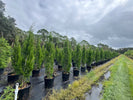
Ditch the Ficus: The Top Florida Native Hedges for Privacy and Wildlife
, by Andrew Norouzian, 3 min reading time
, by Andrew Norouzian, 3 min reading time
Looking for a privacy fence that doesn't require constant trimming? Discover the best Florida native hedges recommended by UF/IFAS experts. Stop planting invasive species and explore beautiful, low-maintenance native shrubs at our nursery.
If you live in Florida, you know the drill. You want privacy from neighbors or a screen for a busy road. You go to a big-box garden center, and they sell you a Ficus or an Areca Palm.
Two years later, the Ficus roots are destroying your plumbing, or the Arecas have turned yellow from a nutrient deficiency.
As a specialized Florida native nursery, we see this all the time. Florida homeowners want privacy, but they are often sold plants that aren't suited for long-term success in our unique environment.
The solution isn't another high-maintenance exotic import. The solution is going native.
When you choose a native shrub for a hedge, you are choosing a plant that has spent thousands of years adapting to Florida’s sandy soil, intense heat, and specific pests. They generally require less water, less fertilizer, and less fuss than non-natives.
But don't just take our word for it. We align our practices with the gold standard of Florida gardening advice: The University of Florida Institute of Food and Agricultural Sciences (UF/IFAS).
UF/IFAS strongly advocates for the "Right Plant, Right Place" philosophy. They warn against monoculture hedges (planting just one type of plant in a long row), especially exotic ones prone to pests.
According to UF/IFAS resources on Florida-Friendly Landscaping™:
“Relatively few native plants are used as formal, clipped hedges... However, many native shrubs can be used as informal screen plantings, which are often preferred in Florida-Friendly Landscaping™ over formal hedges because they require less pruning and provide better habitat for wildlife.”
A native "screen" is softer, more resilient, and supports local pollinators, unlike a sterile wall of non-native green.
At our nursery, we stock several excellent options for creating privacy screens. Here are our top sellers for homeowners who want a beautiful, dense barrier.
If you need privacy yesterday, Wax Myrtle is your best bet. It is incredibly fast-growing, often shooting up several feet per year, reaching heights of 15+ feet. It's evergreen, highly aromatic when crushed, and produces small waxy berries that native birds go crazy for in the winter. It makes an excellent, tall, informal screen.
If you prefer a cleaner, tighter look that resembles traditional boxwoods, Walter’s Viburnum is a fantastic native alternative. It has small, dense leaves and explodes with white flowers in the spring. It takes shearing well if you want a formal hedge, but it's equally beautiful left natural. Look for the dwarf varieties if you need a lower boundary.
This is perhaps the most beautiful native hedge option. It has gorgeous, peeling reddish bark and dense, aromatic foliage. It blooms with fragrant white flowers followed by bright orange-red berries that attract mockingbirds, cardinals, and blue jays. It grows moderately fast and creates a very thick visual barrier.
Who says a privacy fence can’t also be a snack?
If you are looking to incorporate more native fruiting trees and shrubs into your landscape, consider an edible boundary.
Sea Grape (Coccoloba uvifera): For coastal regions, nothing beats a Sea Grape hedge. Its massive, round leaves provide incredible privacy, and the grapes it produces in late summer make excellent jams.
Highbush Blueberry: While deciduous (losing leaves in winter), planting a dense row of native blueberry bushes creates a lovely seasonally changing boundary that provides buckets of fresh fruit in late spring.
Forget the high-maintenance imports that struggle in our climate. Stop by our Florida native nursery today to see these hedge plants in person. Our staff can help you choose the right species based on your soil type and sun exposure to ensure your new privacy screen thrives for years to come.

$130.00

$125.00

$130.00

$30.00

$40.00

$135.00

$30.00

$130.00

$30.00

$30.00

$10.00

$10.00

$30.00

$30.00

$25.00

$155.00

$190.00

$160.00

$10.00

$130.00

$190.00

$135.00

$25.00

$12.00

$130.00

$10.00

$10.00

$125.00

$130.00

$190.00


